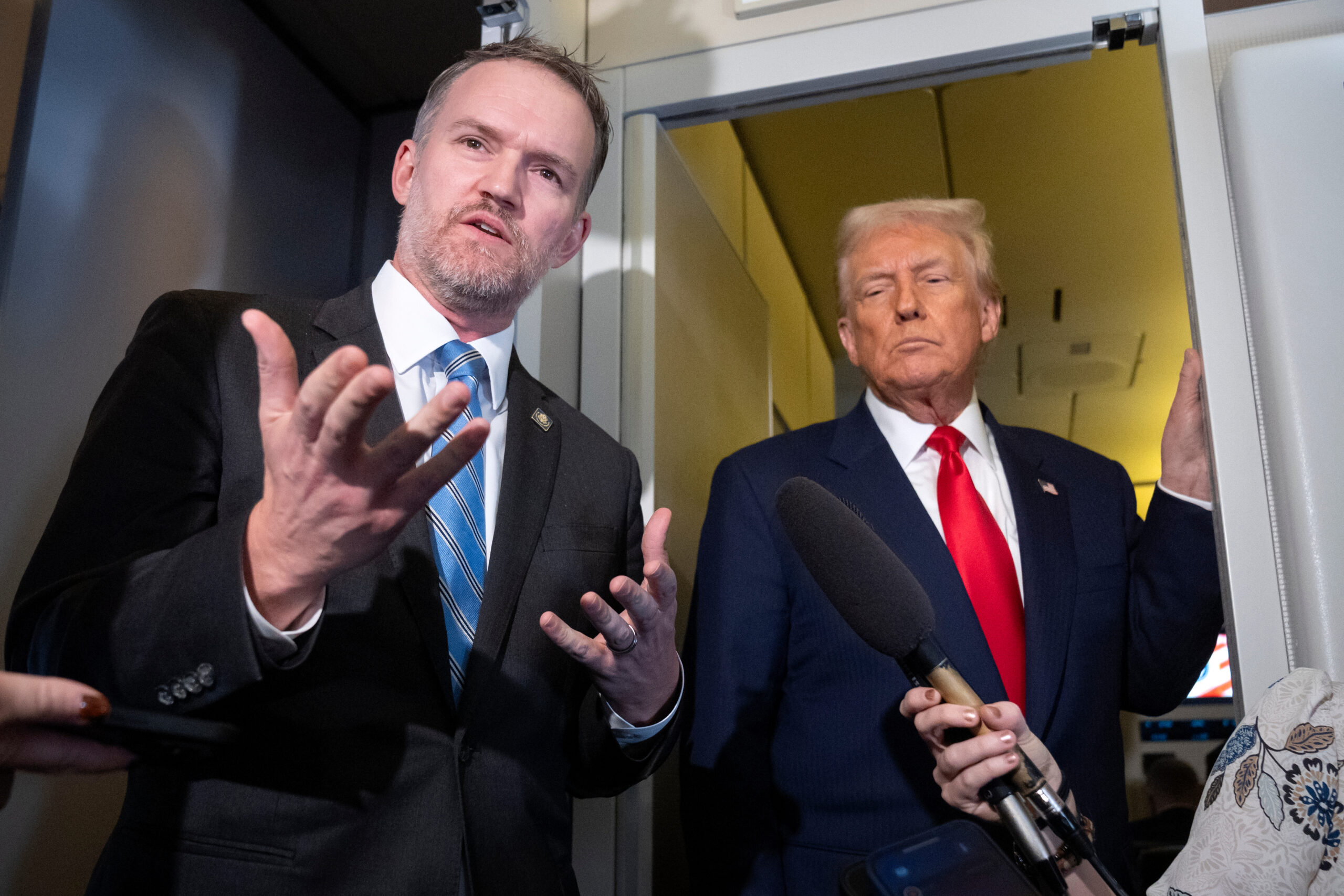
President Donald Trump has changed his position on more than a few things over the years, but in at least one area he’s been consistent: tariffs. The president is a tariff man, as he’s fond of saying. And the man behind the man in this instance is U.S. Trade Representative Jamieson Greer.
A longtime trade lawyer who served in the first Trump administration, Greer is now working to help revamp the global trading system at the president’s behest — and he rejects the widespread criticism that Trump’s sweeping tariff regime has been rolled out haphazardly.
“Yes, there’s a strategy,” Greer said in a new interview with The Conversation. “First of all, you don’t change 70 years of trade policy overnight. And second of all, when some people say, ‘Oh, well, this is chaos. What’s your strategy?’, what they really want to know is can we go back to how it was before? And that’s not going to happen.”
Much of the president’s tariff agenda is currently at risk amid a seeminglyskeptical Supreme Court, though Greer professed confidence and said the White House had backup options if need be.
Perhaps most worrisome for the administration is the politics of higher prices, and Greer was eager to bat down charges that tariffs were to blame.
“People are worried about housing, they’re worried about healthcare — things we don’t import,” he said.
This conversation has been edited for length and clarity.
You have probably the most important portfolio of this administration given just how big of a priority trade has been for the president. I was at many a Trump rally when he talked about how “tariff” is his favorite word, now his fifth favorite word, “God, love, wife,” something else.
Yeah, he had to moderate a little bit on that.
You are a veteran trade lawyer. You served in Trump’s first term as chief of staff to then-U.S. Trade Representative Robert Lighthizer. What is different about the approach this time around?
In the first Trump administration, we were charting new waters, right? We were coming into the so-called Washington consensus that tariffs were bad and we shouldn’t protect domestic industry and we shouldn’t try to make tough deals with our friends and foe alike.
Now having laid the groundwork in the first term, showing we could use tariffs effectively while having a booming economy, the president was able to move to his true vision, which he’s had for many years, which is to protect the American economy with tariffs, use them as leverage where needed to get foreign market access, and otherwise use them for geopolitical issues.
So where we were walking in the first term, now we can run and fly, frankly.
One of the narratives around the tariffs is that the strategy is chaos, that this has been really unpredictable. I’ve heard from businesses that it’s been a challenge because they’re just not sure where all of this is going to land, plus you have all of the legal cases on top of that. So is the strategy chaos? Is there a strategy?
So yes, there’s a strategy. First of all, you don’t change 70 years of trade policy overnight. And second of all, when some people say, “Oh, well, this is chaos. What’s your strategy?”, what they really want to know is can we go back to how it was before? And that’s not going to happen. A lot of people focus on April 2 Liberation Day. We announced potentially very, very high tariffs. But I would focus people more on Aug. 1, and I use that date because that is the date where the president really set the tariff rates, and where we announced a bunch of deals. And from there, the structure that has played out demonstrates the strategy that we have.
If you look at the tariff setup in the world that’s come out of the president’s program, the highest tariffs are on China. Again, not because we bear China any ill will, but because we have a giant trade deficit with them and they have a lot of unfair trading practices. The next set of highest tariffs is Southeast Asia, India, these other areas that use a lot of Chinese content, Southeast Asia in particular, and we have giant trade deficits with them, Vietnam, for example. And then the next highest tariff rates, and these are usually about 15 percent, folks who are allies but with whom we have big trade issues: Korea, Japan, Europe, etc. And then the lowest tariff rates are really in the Western Hemisphere, where we want our supply chains to be, where it’s very secure. So you can really see almost like concentric rings going out from China, what the tariff rates are like. We have a couple outliers right now. India has a higher tariff for some geopolitical reasons. They buy Russian oil. Brazil has some higher tariffs.
We were close to a deal there over the summer and it got derailed. What happened there?
The president wants deals but he only wants good deals. And so whenever you present a deal to the president, the question is, am I better off with just having the tariff? And the assessment of the deal in the summer with India was, well, I think we’re just better off with the tariff than with the potential deal. But that has not stopped us from continuing conversations. It’s still going quite well, I would say, with the Indians. There’s a separate issue where they were buying Russian oil. They’ve stopped doing that largely now. So I think we could see some tariff modification at some point for them. But I’m confident that we’ll get a deal with India at some point in the future, maybe the near future. It’ll be up to the president and Prime Minister Modi.
Have you been involved at all in talking about a potential future trading partnership with Russia after the end of the war?
Not very much. Even before the war, we didn’t have a huge trading relationship with Russia. We would get oil and steel and some fertilizer from them. We’d ship them cars and some ag products. So it was never a giant trading relationship. If the war ends then obviously there may be opportunity there. But we’re really focused on big export markets.
There’s been a ton of debate about the short, medium and long term impact of these tariffs. The Organization for Economic Cooperation and Development just released a report saying the world economy has been surprisingly resilient in the face of Trump’s trade wars, but they added that they expect higher tariffs to gradually result in higher prices and reduce growth in household consumption and business investment. How do you respond to that assessment and are you worried about some economic pain in the short term?
I just look at the data, right? They’re saying we think it’ll lead to lower growth in the future or higher prices or something, but they’ve been saying that for a long time. And the data show that last quarter was 3.8 percent [annual] growth. The Atlanta Fed is projecting 4.2 percent growth next year. We’ve seen inflation in check. We’ve seen imported goods remain relatively low-priced. Where we see prices high are things like housing and health care, because Obamacare is a disaster.
The Supreme Court is weighing whether to narrow the president’s use of the International Emergency Economic Powers Act — IEEPA — which is the 1970s-era law that the administration has cited for imposing many of these tariffs. How are you preparing for the possibility that one of these main tariff authorities you’ve been using could be constrained?
First of all, we believe the law and the facts are on our side. This Supreme Court has talked about how important it is to simply analyze the plain text of the law. And if you look at the plain text, it says the president, if he determines there’s an emergency, he can regulate imports. And he’s determined there’s an emergency and he’s regulating imports, which is the tariff.
Now, we’ve been thinking about this plan for five years or longer. Since the first term. So you can be sure that when we came to the president at the beginning of the term, we had a lot of different options. IEEPA is the most appropriate because there is an emergency with the trade deficit and the loss of manufacturing, and it has the flexibility that you need to respond to the type of emergency that there is.
My message is tariffs are going to be a part of the policy landscape going forward. Are there other ways to do it? Courts during this process have actually cited those different tools. And while we certainly can use those, IEEPA is the best tool. It fits the situation, and we’re looking forward to hearing back from the Supreme Court soon.
But you’re prepared for alternative measures if they do decide to constrain IEEPA?
Well, I’m not going to go into too much detail about that, or else I’ll get in trouble with my general counsel.
But you’ve got something in your back pocket.
Of course.
Regardless of how the Supreme Court rules on this, the administration’s reciprocal tariffs could be reversed by a future president. Is there any plan to go to Congress to try to codify any of this stuff?
Well, if I were Congress, I would codify it. I have heard from a handful of members of Congress from all over the ideological spectrum, whether left or right or progressive or conservative, free trader or protectionist — however you want to characterize it. I’ve heard a lot of interest in this and for a lot of reasons.
People have seen what I just described, which is that you can implement tariffs and have growth at the same time. You can protect your supply chains and have wages increase. You can do all of these things together, especially if you couple it with good energy policy, etc. I’ve also had members of Congress come to me, people who maybe weren’t fans of tariffs two years ago, and they said, “This is actually real money that’s coming in that can be used to pay down the debt or pay for other things or finance our reindustrialization.”
Who are those members?
Well, I won’t betray their confidences.
You said that some members are telling you, “Hey, I’ve changed my mind on tariffs.” There are other members that have spoken privately or publicly, saying “These tariffs are hurting my constituents,” particularly people in farm states. I’m thinking GOP Sens. Chuck Grassley and Rand Paul and a number of folks that have come out and said they’re concerned. What do you say to members of Congress who feel that this is not beneficial for their folks?
Well Sen. Paul is a little bit of a man on an island on this issue.
Well sure, but Rep. Don Bacon —
He [Paul] compared me to a Soviet commissar in some comments.
All right, we’ll leave Rand Paul on the side here, but there are others like Bacon and Grassley and other folks that have voiced some concerns.
I’ve talked to Sen. Grassley a lot, and he knows a lot about trade. He’s been around a long time and as a general matter, it sounds to me frequently that he is quite aligned with the president in terms of wanting to get foreign market access, particularly for his folks who are trying to sell pork and soybeans overseas. We have made sure, in addition to securing soybean purchases from China, who’s a big customer, to open markets in Southeast Asia in particular for soybeans. Markets that were never open before. Now these countries are taking down their tariff, they’re taking down their non-tariff barriers. And so on that, I think we’re aligned.
There’s always concern when you’re changing what’s a 70-year trade policy to something new, and there can be frictions. But we are careful to listen to these folks again, from both sides of the aisle, find out what their concerns are and respond to them.
The president did exempt some agricultural imports from tariffs amid ongoing concerns about higher prices. Why didn’t he do that from the beginning? How did that shift come about?
First of all, inflation’s been in check. So let’s just clear the air on that.
Secondly, in early September, the president signaled, he put out an executive order, and we made a list of all the — whether it’s agricultural goods or minerals or things that physically can’t be grown in the United States or extracted from the United States. The rocks aren’t here, or you can’t grow a banana here, on any scale. So in early September, he put out an executive order. He said, as I do deals with countries, I will release tariffs on these items. Why? Because we get them from those countries.
There seems to be a real resistance in the language around tariffs to say that tariffs are causing higher prices. Nobody wants to really say that. But in making the exemptions, aren’t you basically acknowledging that tariffs do lead to higher prices on products?
No.
Okay. Can you explain?
There’s never really a 1-to-1 with a tariff. In the first term, when we put tariffs on China, inflation actually went down. As we were putting tariffs in place, inflation went down. We’ve seen a similar effect here. When the president says, “We’re going to have deals with you folks,” you have to have leverage, right? And so you keep tariffs on folks for all kinds of things and it becomes a carrot. So it’s a lot easier for me to go to Ecuador or Indonesia or Vietnam and say, “Listen, if you do a deal with us and we’ve announced frameworks or full agreements with all these countries I just mentioned, then at a given time, we will release these things because obviously we don’t make them.”
When you have a tariff, it doesn’t necessarily go through to the consumer. I don’t want to get too technical here for you, except I’m kind of nerdy about it.
But sometimes does it?
I mean it can, right?
Like on those things that you mentioned, like coffee and bananas and all of that stuff?
It depends on what the production economy is like. And when I say production economy, say bananas, if you have a hundred banana producers overseas, they’re all going to compete for market share in the U.S. because we’re the biggest consumer of a lot of these things. And so they will compete to eat the tariff. Do you see what I’m saying?
I do, but when voters who don’t understand this are going to the grocery store and seeing that prices haven’t gone down, how do you tackle that with all the leverage that you’re talking about?
Well, I can’t control the weather in Brazil with a tariff. Coffee prices, for example, have been going up for two years. Before there was ever a tariff on coffee for six months or whatever we had. And there are secular pricing trends in coffee and cocoa that were going on well before. And beef, these kinds of things.
All that being said, we don’t have to have a tariff on these things. We don’t make them here. We can have a tariff on them for leverage, which is how the president used them. It’s how he said he was going to use it. He signaled in September, these are for leverage to finish the deals. So we were well placed two months later once we announced the rest of our deals to take the tariff off.
The US-Mexico-Canada agreement — USMCA — that Trump negotiated in his first term is facing a mandatory review next year. What are the top changes that the administration is looking to make?
When you think about the U.S., Canada, Mexico agreement, there are a few things we trade among us in a massive way. One of them is automobiles, another’s agriculture, another is energy. With respect to the auto trade, the goal is to make more autos in the United States of America. Mexico has been a huge beneficiary of NAFTA and then of USMCA. And so the president, earlier in his second term, imposed tariffs on autos globally, including on Mexico. So there’s an overlap between those tariffs and our agreement and USMCA. And those tariffs, which are about 25 percent, are layered over USMCA.
Now all of that being said, we can look at the underlying rules of USMCA. If something comes in and gets special duty treatment or a lower tariff, there’s usually a rule of origin associated with it that says a certain amount of this widget has to come from the region. Otherwise you have to pay a higher tariff. We can change some of those rules to make them tighter, to have a higher percentage have to come from the United States. Those are the kinds of things we can do. There’s also a bunch of stuff in Mexico and Canada where maybe they discriminate against our companies. It could be telecom companies or it could be our corn exports. There are a variety of little things like that that may seem small and don’t lend themselves to sound bites, but they mean a lot for agricultural producers.
Is there still a scenario where the U.S. could walk away from USMCA or is that off the table at this point?
I mean that’s always a scenario, right? The president’s view is he only wants deals that are a good deal. The reason why we built a review period into USMCA was in case we needed to revise it, review it or exit it. I have heard from a lot of folks how important USMCA is. Canada and Mexico are huge export markets for us.
I was in the White House yesterday, and we were talking about USMCA. What about Mexico? What about Canada? You know, the possibility that we kind of negotiate separately with them, right? Their economies are subject to it.
Yeah, where’s his head at right now?
Listen, our relationship with the Canadian economy is totally different than our relationship with the Mexican economy. The labor situation’s different, the stuff that’s being made is different, the export and import profile is different. It actually doesn’t make a ton of economic sense why we would marry those three together. The actual trade between Canada and Mexico is much smaller than the trade between the U.S. and Canada and U.S. and Mexico. Sometimes you’ll hear people say, “Oh, well, you know, USMCA, it’s a $31 trillion agreement.” It’s like, well, yeah, but like $29 trillion is us. So I think it makes sense to talk to them separately about that agreement. A lot of the underlying rules are helpful and you know our exporters benefit from them, but we have to make sure that we are getting the benefit of our bargain on USMCA.
You were in Brussels recently, talking about deals. Commerce Secretary Howard Lutnick said when he was over there that the U.S. could modify its approach on steel and aluminum tariffs if the EU reconsidered its digital rules. Some European officials were a little irked by that and interpreted it as targeting the EU’s flagship tech regulations, including the Digital Markets Act. Europe’s antitrust chief, Teresa Ribera told POLITICO that Washington is using “blackmail” to strong-arm the EU. What’s your response to that?
That’s a totally extreme thing to say. The problem is the Digital Markets Act and other European digital regulations and regulations outside of digital, they actually target U.S. companies. And how do we know that? First of all, when all these laws were being passed, all the European parliamentarians and all the leaders in Europe were saying, “We’re going to implement these laws to get Google, Apple, Facebook, Amazon and Microsoft.” In fact, they have certain taxes over there, and they call them GAFA tax. The acronym is for American companies. And then they have these thresholds built into these laws where if you meet a certain global revenue threshold or you have a certain business model, and just magically they only capture U.S. companies.
We reported last month that the European Commission was set to present a list to you of sectors that it wants to be exempted from U.S. tariffs. The list was expected to include medical devices, wine — which is very important to me — spirits, beers and pasta. Where do those deliberations stand?
Well, they did not present such a list.
Ah!
And the reason why is because under our deal from the summer, the United States has already adjusted its tariff levels for Europe, and Europe is still adjusting its tariffs. And I don’t say this to be critical. They have a legal process they have to go through, and they’re proceeding through it as quickly as they can, I think. So it would be weird for them to come and say, “We haven’t finished making our tariff adjustments yet, and we want more from you.” Listen, if they want to come and talk about other tariff adjustments, that’ll be up to the president and that kind of thing. But it’s a sequencing issue. Like why would I give them more tariff relief before they’ve done their part of the bargain, right? That doesn’t make sense.
Trump talked about tariffs on the campaign trail, but I don’t think a lot of the world, particularly our allies in Europe, were necessarily prepared for the scale, as you mentioned earlier. When you were in Brussels, for example, can you give me a little bit of a behind-the-scenes on what those conversations are like when you sit across a table?
Sure. So we are eleven months into this presidency. And I would say that most of our European partners have frankly become quite pragmatic. In the first term, when we talked about tariffs and changing the global structure, there was a lot of almost religious-sounding sermonizing from the Europeans. For them, international institutions and what they believe is international law, this is like religion. It’s their religion, and they have these high priests and the European Commission, all these places. But the folks we’re dealing with right now in the European Commission, President von der Leyen, the trade commissioner, these are pragmatic folks. They understand the facts on the ground. They understand the U.S. view. They understand we have these huge trade deficits that are not sustainable. And so the conversations are constructive. We’re not fighting about policy, we’re talking about implementation. So that’s all positive.
All that being said, there are two or three countries that still like to sermonize a little bit about this. The ambassador from one country came to me and said, “Well, how can you use these tariffs against us? You know, tariffs are bad, blah, blah, blah.” I said, if tariffs are so bad, then how come your tariffs on us are so high still? And he said, “Well, I’m not trying to negotiate.” But I mean, that’s my point. They come and they say, “Well, you shouldn’t have tariffs,” but European tariffs have been higher on the U.S. historically for many years.
You said the conversations are productive and pragmatic now. Is that a shift from early this year?
Yes. Yes, a hundred percent.
So where does the EU deal stand?
We had our joint statement in August. We’ve adjusted our tariffs to be a little bit lower for them. They’re in the process of adjusting theirs. We have a lot of non-tariff barriers that we face in Europe, regulatory constraints, certifications, inspection regimes, things that are duplicative, things that gum up trade between the United States and Europe.
Did Brussels move that all forward?
I would say so. It was less of a negotiating trip and more of taking stock of where we are, where we’re divergent and next steps. We have a small team coming over from the Europeans next week to really talk about how we can better memorialize changes in these non-tariff barriers going forward. Because even though the Europeans are taking down most of their tariffs for us, if you take down the tariff but there’s still non-tariff barriers, it’s not effective market access. So we have to do both the tariffs and the non-tariff barriers.
We can’t talk about trade without talking about China. What is the administration’s endgame with China? Is it coexistence? Is it decoupling? Is it selective engagement? What is it?
Well, it’s funny because Washington creates these kind of fake categories. They’ll say, “Oh, well, either you’re a China hawk or a China dove.” The way we think about it in the administration is we’re pro-American. We’re not anti-China. We’re not China doves. We’re not China hawks. We are pro-American.
I think you meant to say America First.
Well, yes, America First. Thank you. And sometimes you hear people saying, “For America to win, China has to lose.” I just don’t think that’s the case. I mean, the reality is we are going to do what’s right for America in terms of trade. And in some cases, it means we have to have a tariff on countries, higher tariffs on some, like China, because they’re a bigger issue with respect to trade. They have more trade cheating, they have more subsidies and that kind of thing. If China still manages to be successful? Fine. We’re not here to try to contain China. We’re here to make sure that America has a strong national security, strong economic security, that our workers have jobs that are good for them in the towns and cities where they live, that they can raise a family. That’s what we’re trying to do. If China rises or falls on that, that’s kind of up to them. We’re happy to work with them. They have their own plans.
One thing I will say is people act like American policy drives Chinese reaction, that China’s just always reacting to us. And I think they want us to think that, but they’re agents unto themselves. They publish a new policy every five years. They announced this Made in China 2025 project in 2015, well before President Trump was the president. So they have their own economic plans, which are oftentimes adverse to our interests, and so we will control for that, whether through tariffs or other measures.
We just saw voters in this last election in November clearly send a message that affordability, cost of living really, really matters. What can you tell the American people about what they can expect to see going into next year? How will all of this impact not the markets, but their day-to-day?
What I would say is trade, it’s not a big factor in the affordability discussion. When you look at affordability, it’s really about the crazy high expenses for health care that were engendered by Obamacare, which was a disaster. It’s about housing expenses that went way up during the Biden years and are still —
But some people, as they’re shopping for Christmas, are connecting prices at Walmart and at the grocery store to the affordability conversation.
I’ve talked to Walmart officials, I’ve talked to all kinds of officials, and they have said that they’re not raising prices. At back-to-school time in September, they say we’re not raising prices. They’re still doing their rollback. I know that’s a press narrative, but it’s actually not a true narrative. When you talk about affordability, people are worried about it. People are worried about housing, they’re worried about healthcare — things we don’t import.
But where trade comes into it is when you have a trade system in place that protects U.S. jobs, you get higher incomes. So the blue collar wages are up this year. That’s what matters. In the first term, we had real income increase, up until the pandemic, which was like this black swan event. That’s what we’re trying to do with trade. Trade is not, “Let’s manage affordability through trade.” Trade is, “Let’s make sure we have good paying jobs here, especially for that working class whose jobs went away to Mexico or Vietnam or China. And so if you have blue-collar wages going up, whatever price effects are going on from all kinds of things in the economy — as long as the real income is outpacing whatever price effects there are — that’s what we’re looking for. That’s what we’re seeing.
What about those tariff dividends that the president has floated?
Well, you can talk to Scott Bessent. I don’t control the money. I just put the tariffs on to make the deals.