
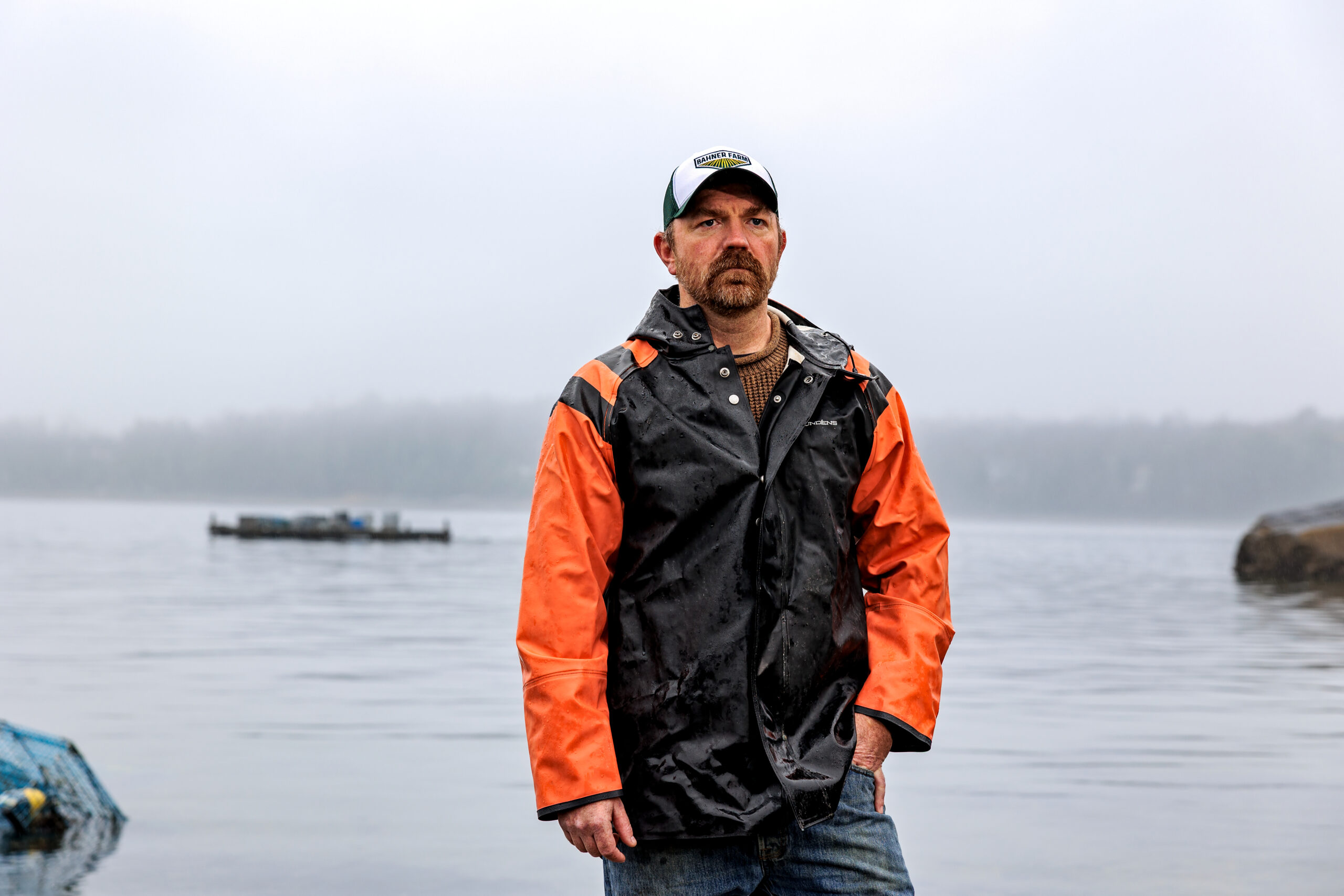
CARIBOU, Maine — Onstage at American Legion Post 15 in this state’s northeast nook in early October, Graham Platner wrapped up a speech in his deep, gravelly political howitzer of a voice, saying he was “extremely angry” — angry at “the oligarchy,” angry at “a system that is built to extract wealth and time and energy out of working people and put it into bank accounts on Wall Street and into private equity funds in California,” angry at the “politicians” from both parties “who have spent decades building the system.” The soldier turned oyster farmer turned senatorial hopeful turned Rorschach test of contemporary Democratic politics took off his black Dropkick Murphys hoodie. “Fallujah ’05 Ramadi ’06,” read his tight gray T-shirt. “Best job I ever had.”
He was ready for questions.
A woman clutching a crutch asked about universal health care. “We are the only G7 country,” she said, “that doesn’t — excuse my language, y’all — fuckin’ do it!”
“I have the strange luck of being a disabled combat veteran,” said Platner, 41, deploying a line that’s become something of a campaign mantra. “I was lucky enough,” he continued, invoking his experience with Veterans Affairs, “to do four tours in Iraq and Afghanistan and get blown up enough that the VA says that I deserve health care and a little bit of money every month that helps me pay my mortgage. If it wasn’t for that, I would not have been able to move back to Sullivan, Maine. If it wasn’t for that, I would not have been able to start a business. Because I get free health care — and because I get a roof over my head — that gave me an immense amount of freedom. That gave me an immense amount of material freedom to build a life that I wanted to build. I don’t think that you should have to go fight in stupid foreign wars —”
Here he suddenly stopped talking. He covered his mouth and touched the scruff on his face. People got quiet and watched him, and Platner’s eyes started to glisten. “Sorry,” he managed to say. He turned and took a sip of water so he could finish his sentence.
“— to get that kind of support.”
“Take a breath,” said the woman who’d asked the question.
In the couple months since, Platner’s gone from a fresh-faced, out-of-the-blue nod to Democrats’ perennial dream of a “regular guy” contender to one of the most hyped and scrutinized political figures in America. The overnight sensation’s candidacy’s also been beset by a series of possibly campaign-killing revelations — an old Reddit account littered with racially insensitive, misogynistic, anti-police comments and homophobic slurs; a tattoo on his chest of the death’s-head design favored by the paramilitary forces that guarded Nazi concentration camps — and a fledgling political staff navigating the sort of internal strife that generally heralds doom. The rules of politics, or whatever is left of them, dictate that his bid is done — any shot to top two-term and 77-year-old Democratic Gov. Janet Mills in the primary, any chance to beat five-term and 72-year-old Republican Sen. Susan Collins in the general, any semblance of any remnants of any electability at all. Yet polling, however admittedly early and inexact, suggests that’s not necessarily the case. Ditto the crowds he continues to draw and the money that keeps coming in. What’s going on?
Is it that Democratic voters at this raw, post-Joe-Biden juncture are just that peeved at their party’s leadership, at the “establishment,” at the “gerontocracy,” at … everything? Is it that in the shock wave of Donald Trump, of “Access Hollywood,” impeachments, indictments and the rest, almost literally no publicity is bad publicity? Is it that Platner, who actually comes from a fair measure of privilege, nonetheless is simply the best of the lot of a working-class campaign-cycle casting call orchestrated by ambitious left-leaning consultants, operatives and ad makers? “The rules have changed,” longtime Washington-based Democratic strategist Doug Sosnik, a former senior advisor to President Bill Clinton, told me. “President Trump reinvented politics in 2016. Prior to his successful first campaign for president, his background would have disqualified him for office — any office,” Maine-based Democratic strategist David Farmer told me. And Platner? “I had one older woman, who’s very politically savvy, say to me,” said Farmer, “‘Men want to be him, women want to be with him.’”
I’ve talked for hours and hours with Platner, his mother, his father, his brother, the woman whose house he went to for daycare as a tyke. I’ve talked to friends, and I’ve talked to ex-friends. I’ve talked to political allies, and enemies, too. I’ve seen him at town halls in southern Maine, Midcoast Maine and a stone’s throw from Canada. I’ve read through the decade-plus of his de facto diary on Reddit that not that long ago would’ve ended his plans posthaste. And I doubt the unpleasant headlines are over for Platner. I wonder when or whether those with axes to grind might get sufficiently irked or provoked. I listen to pundits and political pros say he’s effectively finished, and I’m not sure I disagree — but it’s not up to them, and it’s not up to me.
For now, then, I think Platner and his candidacy are more than merely an interesting intraparty spar. I think Platner and his candidacy are more than even a singularly instructive lens through which to mull American politics writ large as 2025 careens toward 2026. What I think is that it’s worth thinking about Platner and his candidacy not in the context of the year since Trump won again — or even the near decade since he won at first — but rather in the context of the whole of the last quarter-century. Because in my mind there’s not to this point been a major candidate who is more uniquely a manifestation of the ineffable national frustration dating back to Sept. 11, 2001 — the failed wars in Iraq and Afghanistan, the Great Recession and its toxic wake, the unabated deterioration of social, cultural, political, even psychic existence for citizens in what used to be an envy of the world. The emotional scars, the literal physical marks, the contradictions coursing through his story from the start — all of what could make for kryptonite for Platner’s campaign simultaneously is the source of its potential success. The seeds of his demise, in other words, are the roots of his appeal. Understanding Platner is therefore essential to understanding where politics have gotten and where politics might be going — regardless of whether he skulks back to Sullivan or gets sent to the Senate.
“He embodies the trauma of a country that lost its way,” New York-based Platner adviser Morris Katz told me. “And he embodies,” said Katz, a strategist for the Philadelphia-based Fight agency, which works to sell outsider candidates in Democratic primaries, “the vision of a country that still knows what’s fundamentally right.”
Back at Post 15, Platner finished his answer to the woman with the crutch. “Universal health care is a moral imperative,” he said. “It also unleashes creativity. It unleashes small business. I often think about what eastern Maine would look like if all of my friends who work incredibly hard didn’t have to worry about health care. What businesses would we have? What art would be created? What risks would be taken? What extra time would people have in their lives to connect and build community?” The standing-room-only gathering gave him a standing ovation.
Downeast Maine, a rocky, ragged stretch of coast, is a beautiful, complicated place. Some 150 or more miles north of Portland, the region is as close or closer, and not only spatially, to the Canadian Maritimes. It is a distinct fusion of New England and New Brunswick and Nova Scotia, with the cultural residue of French Acadia. It is marked by a subtle but unmistakable mix of generational prosperity and generational privation. It is, in the end, a combination of contradictions all its own, and Graham Cunningham Platner, born on Sep. 1, 1984, in Blue Hill, is thus aptly native — a meld of ego and insecurity, of service and ambition, of a strain of self-importance intertwined with a search for self-worth, all of which makes him both a consummate test case for the confounding and ongoing tectonic shifts in the politics of this country and a natural vessel for the traumas of this time.
His bookish, stoic father, Bronson Platner, was a Dartmouth-educated attorney in Ellsworth who had a captain’s license and did yacht deliveries on the side. His father’s father was a Cornell-educated architect and designer of furniture who became a man of some wealth and renown. His chatty, enterprising mother, Leslie Harlow, is the daughter of an engineer. She’s owned and run over the years a smoked salmon business, a bed and breakfast, a coffee shop and a seasonal wreath-making outfit. She still is the doyenne of a restaurant called Ironbound — popular with both locals and the well-heeled summer set with homes ensconced in and by the area’s woods and bays.
Platner’s parents, who split when he was six and divorced a few years after that, were active in local Democratic politics and donated to Democrats and Democratic causes. They did not want the eldest of their two sons to go into the military and told him so. But he was headstrong from the get-go, and he always wanted to be a soldier, and for reasons even he couldn’t quite explain. He sang the Marine Corps Hymn when he was all of 3 years old. “Knew every verse,” a family friend recalled. His mother read him Peter Rabbit, and his father read him Rudyard Kipling, but young Platner read Killer Angels: A Novel of the Civil War and Uniforms of the Civil War and Soldier Songs & Home-Front Ballads of the Civil War and A Maine Town in the Civil War and Stand Firm Ye Boys from Maine. He read The Old Breed: At Peleliu and Okinawa. He read Up Front by Bill Mauldin. He read all 39 volumes of Time-Life’s series about World War II. “Graham always,” Harlow told me, “carved his own path.”
For their “inquisitive, smart son,” as Harlow put it to me, Platner’s parents worried about the local public high school — after going from kindergarten to eighth grade to Mountain View, a small, rural public school. Bronson Platner had gone to prep school at St. Paul’s in New Hampshire. Some of Harlow’s father’s family had gone to Northfield Mount Hermon in Massachusetts. So in the fall of 1999, with the help of a financial-aid package from the school, they sent their first son to tony, selective Hotchkiss in Connecticut. He’d been around some money in Maine — contrary to what he’s sometimes said since — but the rarefied air at Hotchkiss constituted a different degree that amounted to what Platner quickly came to consider an untenable fit. “I hated it,” he told me. “My mom was, like, ‘No, you need to stick with it.’ And I was, like, ‘Fuck this.’ And I realized that if I didn’t go to class, they would just kick me out, which was essentially what happened.”
He landed mid-year his freshman year at Bangor’s John Bapst Memorial, not a boarding school but another private school. Once he got his driver’s license, Platner motored the hour back and forth to Bangor in a red Volkswagen Jetta, jamming to anti-authority punk bands like the Pogues, the Dead Kennedys and the Dropkick Murphys — at a time when most of his peers favored poppier options. Platner liked Bapst, its blend of kids from around the state. He did theater, and he wrestled — enticed by “the one-on-one kind of violence,” he told me. “He would often defeat his opponents,” remembered his teammate and friend Alex Desmond, “just by sheer will.”
On 9/11, he was a junior, sitting in Mitch McCarthy’s honors Irish and British literature class when the first plane hit. “I wanted to see combat,” Platner told me. Maybe, he had thought, he could be a war correspondent. “But then 9/11 happened, and I had this realization that I didn’t have to go be a war correspondent. I was going to be able to go to war,” he said. “We talked about it several times,” Ryan Hews, his U.S. history teacher, told me, “and he was committed to making a difference by enlisting.”
He tried to join the Marines when he was 17, but his parents needed to sign off, and they refused. “The recruiter was saying, ‘Well, he could get a job at $10 an hour after he gets out,’” his father told me. “Babysitters on Nantucket were getting $10 an hour. The idea that this recruiter thought I was going to be impressed …” His parents told him he had to apply to college, so he did — to American University, George Washington University and George Mason University. Washington beckoned; he was interested in international relations, perhaps a job eventually within the foreign policy bureaucracy.
And his literature teacher’s college reference letter painted Platner as a natural for a Beltway would-be statesman. “What can you say about a kid whose hero is Winston Churchill? Who devours history books for pleasure? Who is demanding that I read Kipling’s The Man Who Would Be King?” McCarthy wrote. He likened Platner to Chet Douglas in John’ classic prep-school tale A Separate Peace. “Chet was the brightest boy in class, but he would never be the valedictorian because he was so genuinely interested in the things he learned about that he investigated them further on his own, even if that got in the way of his ongoing studies.” Platner, drawn to stories of soldiers, conflicts and costs, did his honors project on Pat Barker’s Regeneration Trilogy — novels, as McCarthy put it, about World War I “soldier-pacifist Siegfried Sassoon,” “the psychologist who treated him” and the “wounds of men at war.”
A soldier who’s a pacifist? Some circles can’t be squared, and don’t need to be. Platner had, he told me, a “weird sense of service” and “a young man’s angst” and “wanted adventures” and yet that same year was one of a half-dozen protesters booted from an appearance President George W. Bush made at Bangor International Airport in October of 2002 — less than half a year from the invasion of Iraq. Platner unfurled a sign he’d hidden in his pocket. “No war,” it said. “Don’t attack Iraq!” he yelled. “Bush looked right at me, and people started yelling for me to shut up,” an 18-year-old Platner told a reporter from the Bangor Daily News, “but he saw me.” In his yearbook he was dubbed by his classmates the “Most Likely to Start a Revolution.”
When admission decisions came back, according to Platner, he got into George Mason — and didn’t go. He backpacked in Europe and North Africa. He worked on the Appalachian Trail, chopping down trees and building rock staircases. He did a short stint in a call center in Orono. And in February of 2004, the congenitally contrary kid with the main-character energy who wanted to be a grunt finally enlisted, knowing he’d be sent to the war he had protested — seeking it. He still didn’t have his parents’ permission. He no longer needed it. “My father essentially told me I was a fucking idiot,” Platner told me. “It was totally contrary to what I wished him to do,” his father told me. “My father,” Platner once said, “became a schoolteacher so he didn’t have to serve in Vietnam. I used to hold that against him.” His mother? She “cried a lot,” Platner said. He went to her 50th birthday party — which doubled as a going-away party. The next day Platner boarded a bus for boot camp.
At Camp Lejeune in Jacksonville, North Carolina, he was assigned to Kilo Company, 3rd Battalion, 8th Marine Regiment, and trained to be a machine gunner. His mother sent him articles she clipped from the New York Times about Marines being killed in Iraq. Platner didn’t need the mail. “We’re going to the rifle range and the DIs” — drill instructors — “are coming in every day, and they’re just throwing down the names of dead Marines. … ‘This is why you need to get good with your gun.’ … ‘This is why the rifle range matters,’” he told me. “You’re young and you’re scared, but you’re also, like, ‘Oh shit,’” he said. “‘It’s going to happen.’”
His first tour was in Fallujah in 2005 — January to September, according to Marine records. “The United States is doing an amazing thing here. It took my coming here to realize that. Don’t think we are somewhere we shouldn’t be. We are exactly in the right place. Iraq is the perfect guinea pig for this. Most of the Iraqis want us here, and most of them proved that yesterday by coming out and voting,” Platner wrote in an email to his mother, according to the Ellsworth American at the time. “We took some fire,” he wrote. “A rocket went right over my head …” He asked for beef jerky. “Lots.” A few months later, the Humvee he was riding in rolled over an IED. “So I run around the back, and my best friend’s there — shrapnel had come up under his helmet and just ripped the side of his head off, and I start to try to go to work on him, but I don’t know what the fuck I’m doing,” he told me. A medic relieved him. “And so at that point there was a guy standing on a berm, I don’t know, 2-, 300 yards distance, and I shot him. And that was the first person I ever killed. Not the last. But that was the first,” he said. And then “we have to go clean all the blood and the shell casings and all that out of the back of the truck, so I’m there, like, squeegeeing up my fucking best friend’s insides.” Somehow his friend lived. “I thought he was dead,” Platner said. “I saw his brains.”
His second tour was worse. Ramadi in 2006 was the epicenter of the Iraqi insurgency, and Platner was there from March until September — stationed at the hot, foul, sandbagged, heavily barricaded Government Center. He watched tracer fire shoot through the sky. He watched RPGs skip down the streets. He and his fellow Marines, he said, watched an insurgent try to bury an IED, trained their machine guns and “chopped him to pieces.” They did the likes of six hours on watch, two hours on sandbag duty, four to five hours of sleep, seven hours on watch, two hours on sandbag duty, four to five hours of sleep, for seven straight months. They listened for the thoomp thoomp thoomp of mortar fire and waited for the 30 to 40 seconds it took to arrive, and braced. “Artillery doesn’t give a fuck if you dug a good foxhole. It doesn’t give a fuck if you camouflage your position. Artillery,” Platner told me, “is just artillery. And if it’s going to rip you to pieces because it landed on top of you, there’s not a fucking thing in the world that you can do to keep that from happening.” He smoked two packs of cigarettes a day. At night on his cot, he read George Packer’s 2005 book, The Assassins’ Gate. “Why did the United States invade Iraq? It still isn’t possible to be sure — and this remains the most remarkable thing about the Iraq War,” Packer wrote, citing “no strong evidence” about Saddam Hussein’s weapons. “I’m here doing this,” Platner thought, he told me, “because of this.” He turned 22 that September. It was a week later before he even realized that he had. Thoomp thoomp thoomp.
His third tour was from July of 2007 to January of 2008 on a Marine Expeditionary Unit. He and the others had wanted to go to Afghanistan. Instead they were on this on-call ship — off Kuwait, off Somalia, off Bahrain and the Balkans. They saw no combat — just its compounding effect. In Split, Croatia, he got inked on his right pec the tattoo with what he later learned were Nazi connotations. He didn’t get it, he told me, because he considered himself a Nazi. He got it because he considered himself a killer. “That’s what we did, and we were good at it, and we were proud of the fact that we were good at it.” The trauma mounted. “We thought it was normal for a guy to get blackout drunk and start screaming and crying,” he said. “We’d be, like, ‘Oh, fucking so-and-so is having a fucking PTSD moment.’ And these Navy cats are, like, ‘What the fuck is wrong with you people?’ I mean … you’re in the bus going back to the ship, and there’s a guy in the back punching the windows out and screaming bloody fucking murder and crying, and all of his friends are bear-hugging him and holding him down,” he said. “And we’re, like, ‘Well, don’t worry about it, man. What are you talking about? This is just what happens, right? You guys don’t have this? You don’t have the night that one of your friends gets blackout drunk and punches a random Croatian in a bar, and then we have to drag them away from the police, and then they fucking scream and cry as their friends sit on top of ‘em?’” And then he went home.
Back in Maine, he talked at length to a reporter from the local newspaper. “Five guys from my company died in Ramadi,” Platner told the Ellsworth American on March 27, 2008. “Four at once in an IED blast, and one was shot in the head,” he said. “You do want revenge, and you feel angry, and you want to hurt somebody. You also feel sad,” he said. “I loved Iraq,” he said. “I loved fighting there,” he said. “You come home, and people are proud of you. They always tell you that they are. They’ve got the yellow ribbons on the cars, and they tell you, ‘Good job, son, we’re behind you.’ But people don’t care. It’s not their problem. It bugs you, you know? You go over there, you put all this energy into this war, trying to make things better, and you sacrifice a lot, and guys you know sacrifice more, sacrifice everything, and you come home and you’re sitting in a bar and you see a friend of yours from high school who says, ‘So what have you been doing?’” he said. “You get angry sometimes,” he said. “You see people living a nice happy life,” he said.
He left the Marines late the following month with the rank of sergeant. He applied again to George Washington. This time, he got in.
Platner started school that fall on the GI Bill. He felt almost impossibly out of place. He liked some of his classes — a history of Iraq, a history of the Indochina wars. He helped start a campus chapter of the Student Veterans of America — part of what made him a go-to vet voice for the D.C. press. But he was 24, and he didn’t want to live in a dorm with “children,” he told me, so he used his GI Bill housing stipend to get an apartment in Foggy Bottom. “I don’t feel as though I have much common ground,” he told a reporter from MTV.com that month. “And I don’t feel as though my fellow students feel they have much common ground with me.” Classmates asked him if he’d killed anybody. “They’re these little 18-year-olds,” he told a reporter from the Washington Post in June of 2009. “I’m this gruff, heavily tattooed former Marine.”
The Marines he’d been with deployed to Afghanistan. He felt he was both missing out and letting them down. He tried to reenlist. But the Marines had changed their tattoo policy in 2007, and the sleeve tattoos he’d gotten between Fallujah and Ramadi while downing Miller High Lifes and flasks of Jack Daniels or Jim Beam meant he couldn’t. So he joined the Army — an infantryman in the National Guard, according to Army records, starting in September of 2009. “I’m, like, ‘Oh, my God,’” his mother told me. “And he goes, ‘Mom, I get the place.’”
He was in Afghanistan by November of 2010, part of the surge ordered by President Barack Obama. He liked the fighting in Afghanistan — “going out into the fucking valleys and getting in days-long running gunfights,” he told me. What he did not like was basically everything else. “We weren’t doing any of the shit I thought we were supposed to be doing. We used all the new words. We talked about ‘KLEs’ — key leader engagements — we talked about ‘COIN’” — counterinsurgency — “but the behavior was the same. The leadership, mid-level leadership, battalion leadership — they didn’t give a fuck about making friends. They didn’t give a fuck about building relationships.”
His tour in Afghanistan ended in July of 2011. He returned to Washington and rented a room in a rowhouse on Capitol Hill. Last time he had lived in D.C., he hadn’t been shy about talking to reporters — now he ramped up his activity on Reddit.
“What are some ACTUAL natural highs?” a poster asked that September.
“Combat,” said Platner, posting as P-Hustle, his nickname in the Marines.
He got a DUI that November, in Arlington, Virginia, according to public records. It scuttled his shot at special forces, he said — at being a Green Beret, which was a goal. He left the Army National Guard, according to Army records, as a sergeant in October of 2012.
He went back to George Washington because he “didn’t know what the fuck else to do.” He went to class, and he didn’t. He did his papers, and he didn’t. He tended bar — at the Tune Inn on the Hill, at Justin’s Cafe near Nationals Park, at the Ugly Mug on Barracks Row. He listened to people who worked in offices of members of Congress talk about Iraq and Afghanistan as if it were all part of some politics contest. He had up-and-down relationships with on-and-off girlfriends. He drank.
He did go to the VA. “And the D.C. VA, it’s not their fault, it’s just understaffed and underfunded, and I go to the VA, and they ask me all the questions: … have you killed people, have you seen Americans die, have you seen civilians die? Blah, blah, blah. And at the end of it, they hit a button that’s like a readout of medications. And I was, like, ‘No, I want to talk to somebody,’” Platner told me. “So then I just spent the next three years really holding on by a thread.”
Including on Reddit. “I can’t tell you how many guys I know get disability of some form who have no need for it, and who will openly admit in closed circles they gamed it for the cash. Oddly enough, same dudes will turn around and bitch about welfare queens who live off the government,” he wrote. “It’s the motherfuckers who lie to get a paycheck who are fucking it up for the guys who need it,” he wrote. “I’m not dismissing PTSD,” he wrote. “I found when I’d get rip roaring drunk I turned into a massive prick,” he wrote. “I still catch myself after a few too many, when the anger and hate starts to well up,” he wrote. The U.S. “just spent 12 years inconclusively fighting two prohibitively costly wars against guys whose main method of transport is flip flops,” he wrote. “Why don’t black people tip? I work as a bartender and it always amazes me how solid this stereotype is. Every now and again a black patron will leave a 15-20% tip, but usually it’s between 0-5%. There’s got to be a reason behind it, what is it?” he wrote. “… there was a reason we joined the infantry, and it’s not because we weren’t angry young men,” he wrote. I “wanted to go to war as an infantryman. Which I did, and I enjoyed it immensely,” he wrote. “… actions taken in combat are morally reprehensible, period. Your job is to efficiently and brutally murder other human beings, and to sap their will to fight,” he wrote. “Holy fuck, how about people just take some responsibility for themselves and not get so fucked up they wind up having sex with someone they don’t mean to? Men and women, you make a choice to consume enough of a substance to lose your self control. So if you don’t want to be in a compromising situation, act like an adult for fucks sake. Rape is a real thing, if you’re so worried about it to buy Kevlar underwear you’d think you might not get blacked out and fucked up around people you aren’t comfortable with,” he wrote. He was “bored senseless by civilian life,” he wrote. “I would re-enlist in the Marine Corps infantry today if the opportunity presented itself,” he wrote.
A Marine friend talked to him. “He essentially was, like, ‘Hey man, you gotta get help,’” Platner told me. “And I was, like, ‘I’m fine.’ And he was just, like, ‘Oh, yeah, how’s school going?’ ‘Fuck off.’ He’s, like, ‘You’re having healthy relationships? You’re in good, healthy relationships?’ I’m, like, ‘Fuck you, dude.’ He’s, like, ‘You’re not drinking too much? Everything’s good?’”
Everything wasn’t. “I suppose the most frustrating thing is to watch these Iraqis have to fight their way back into a building that was once the bastion of U.S. and Iraqi government power in Anbar,” Platner told a reporter from the Washington Post in an article that ran on Dec. 27, 2015. “Iraqi forces capture main government compound in Ramadi,” read the headline. “A decade later,” Platner said, “and these cats are spilling blood in the same streets.” What was the point? Had there even ever been one? To what he and so many others had endured? How could the arena in which he found the most meaning also be so meaningless? And yet he yearned for it again — wanted it still — needed it as much as he ever had?
Probably he was in Washington. Maybe he was drinking. Platner can’t really remember. But it’s clear he spent most of the rest of that very same day on Reddit, trying to reconcile the irreconcilable. “It’s hard to explain how much I enjoyed combat,” he wrote. “I think that our modern society is very likely the most unwelcoming of warriors who enjoyed war. Not in any malicious or purposeful way, just because virtues in combat (aggression and intense emotional connection with comrades) have almost no place in our very safe yet emotionally distant society,” he wrote. “… there was a reason we joined the infantry, and it’s not because we weren’t angry young men,” he wrote. “We all volunteered, we all knew what we were getting ourselves into, but when you’re 19 or 20 and you watch a close friend die or be horrifically injured, it’s a terrible thing,” he wrote. “I’ve come to the conclusion that there really isn’t a place for me in the civilian world,” he wrote. “It’s the numbness that sucks the most,” he wrote. “Nothing really makes me ‘feel’ anymore,” he wrote. “Given the choice of a safe, stable and fulfilled civilian life or another tour like Ramadi in 2006, I wouldn’t even hesitate,” he wrote.
In 2016, he wrote that he was supporting Bernie Sanders, that he was “rabidly anti-Hillary,” and that he’d been “diagnosed with combat related PTSD.” Friends urged him to just find a way to finish George Washington. “He was there for a long time, and he tried and tried and tried. It was, like, the dark door was always there,” his mother told me. “He was having a hard time focusing. He was having a hard time getting his work done. He was getting frustrated with himself. He was, like, ‘I don’t understand. I’m a smart guy. Why can’t I get this paper done?’” He left school in the summer of ‘16, according to GW, with 91 credits — 29 credits shy of graduating, slightly more than the 16 or 20 I’ve heard him cite on the stump. He visited Maine with a friend from D.C., and they sat by Frenchman Bay. “And she was, like, ‘It’s this beautiful, it’s this amazing, and it feels like home to you’ — and she was, like, ‘Why do you live in Washington?’”
And so, just before Trump moved to Washington, Platner moved back to Maine. He stayed with his mother. In the summer of 2017, he bought a house, according to public records, with financial help from his father — on the same road on which he grew up in Sullivan, population 1,219,with a median household income a little more than $60,000 a year. Maine wasn’t an immediate balm. All was not well all of a sudden. At a Thanksgiving get-together that fall, he still seemed to family friends sullen and withdrawn. And the following year, he went back to Afghanistan, doing security as a State Department contractor. “And I’ll gladly admit that I went back and padded the bank account,” he wrote on Reddit. “Doesn’t mean I believe in any of it.”
Part of that pay, though, plus his $4,800 a month in benefits from the VA given his 100-percent disabled status, afforded him a certain safety net when family friend Jock Crothers made him an offer — to take over his hobby-sized farm. He spent the next few years getting the right lease and certifications as a shellfish dealer, harvester and aquaculturist, and developing eco-tourism tours on what he turned into a six-acre plot. He sold the oysters at his mother’s restaurant and the Blue Hill Wine Shop and the deli at the Dunbar Store down the road from his house. He shucked at private parties. Working out on the water, Platner watched seals, eagles, seagulls and terns. He watched the sun rise.
Even this — he was now a bona fide local business owner — didn’t make for a night-and-day change in his moods. He continued to unleash unresolved emotions on Reddit. He wrote that he was a member of the Democratic Socialists of America. He wrote that he was “pretty radically left.” He called himself a “vegetable growing, psychedelics taking socialist.” He called himself a “communist.” He called Trump a “mentally incapable narcissist” and a “piece of shit” and a “disgusting human being.” He wrote that he voted for Sanders in the presidential primary in 2020. He used the f-slur. He wrote that Susan Collins’ “INACTION JUST GOT A CAPITOL HILL POLICE OFFICER MURDERED” on Jan. 6, 2021 (a reference to her “general lack of spine when it comes to any kind of accountability for the Trump administration,” he told me). “After the war, I’ve pretty much stopped believing in any of the patriotic nonsense that got me there in the first place, and am a firm believer that the best thing a person can do is help their neighbors live a loving life,” he wrote. “Nothing makes my skin crawl more when I get a ‘thank you for your service.’ I used to ignore it, but these days I tell people not to thank me, I didn’t do anything good for America when I was in uniform,” he wrote. “Fuck these cops,” he wrote after the killing of 20-year-old Black man Daunte Wright in Minnesota. He wrote that he “used to love America, or at least the idea of it.”
Platner stopped posting on Reddit as much, and then at all, as he got more and more involved with small-town governance in Sullivan in the early part of this decade — again and increasingly a part of a community that wasn’t primarily online. He was appointed to the town’s planning board. He was appointed to be the harbor master. People periodically asked him to run for the state legislature. His answer was always the same. “Absolutely not.”
Platner got married in November of 2023 — to Amy Gertner, a bit more than a year younger, a dock manager and a middle school teacher from a town down the coast called Hope.
He kept going regularly to his therapist at the VA.
One night late this past July, marginally Boston-based but mainly itinerant duo Daniel Moraff and Leanne Fan showed up at Ironbound. Moraff and Fan, who are engaged to be married, met on Bernie Sanders’ 2020 campaign. They aren’t recognizable names or faces even to political obsessives, but in the last few years they’ve helped recruit and guide several high-profile candidates: Navy veteran and mechanic Dan Osborn, who ran (and is running again) for U.S. Senate in Nebraska; and Marine veteran and mechanic Nathan Sage, a candidate for U.S. Senate in Iowa. Now Moraff and Fan were in Maine, and in a hurry — because the guy they’d tapped to take the blue-collar lane in next year’s Democratic Senate primary hadn’t worked out. Chris Williams, the former president of the Machinists Local S6 in Bath, was going to be Platner before Platner. “It was a go,” Williams told me. “But there was a skeleton in the closet that wasn’t true that we would’ve had to explain,” he said. “They decided to go in a different direction” — some two and a half hours northeast.
Moraff and Fan wanted to talk to Platner’s mother because they wanted to talk to Platner. They had heard his name from some of the same union officials, community organizers and grassroots progressives who’d helped them identify Williams. They did a cursory Google search. Platner had emerged as a leader of the Downeast activist group Acadia Action. He’d just been in the New York Times in a travelogue about oysters. Moraff and Fan watched a video from the Frenchman Bay Conservancy in which Platner was featured and his mother was mentioned. “They came to Ironbound knowing I was Graham’s mother,” Harlow told me. They made their pitch about the kind of candidate they were looking for. Moraff asked her for her son’s number. He walked outside and called Platner. “And he came back in, and said,” Harlow said, “‘Well, I guess we’re going to meet Graham tomorrow at 6 a.m.’”
Moraff got on the phone again immediately after his initial meeting with Platner. “He called me and was, like, ‘There’s someone who’s seriously thinking about this who I think is exceptional,” Morris Katz told me. Katz, 26, works for the Philadelphia firm Fight. The head of Fight is the veteran New York-based strategist Rebecca Katz (no relation). The philosophy of Fight could be summed up by something she said to me earlier this year: “Democrats took triangulation from Bill Clinton, when they should’ve been taking ‘It’s the economy, stupid’ and ‘I feel your pain’” — a theory of the case, in other words, fixed on affordability and authenticity. Morris Katz has worked for the likes of John Fetterman and Osborn — and most recently, and most publicly, Zohran Mamdani. He hightailed it to Maine. Platner knew about Osborn, he’d heard of Nathan Sage, and he’d followed Mamdani’s rise. And here was Morris Katz sitting in his house. “Within, like, five minutes,” Katz told me, “I was thinking, ‘Holy shit, this guy can help save the Democratic Party.’”
Platner had what he’s described as his “quiet little life.” Friends from D.C. were more than happy for him — they were relieved. They also wondered if it in the end would be enough. Even as a boy, after all, he wasn’t content to read stories about wars. He wanted to be in them. He was good at being a soldier. He was proud of being a soldier. “It was one of the things I was best at,” Platner told me the first time we talked. “It’s always been hard for me to reconcile that sort of personal reality with the reality that it was all for something I don’t believe in,” he said. “The single best and worst experience of my life,” he wrote about Ramadi on Reddit — which in some sense actually might be the single most revealing words he ever wrote on Reddit. He had in the military and in particular in Iraq, a friend of his told me, an intense sense of loyalty, of camaraderie, of stakes, of purpose — a sort of engagement, this friend suggested, he couldn’t replicate. Maybe even can’t. Or at least hadn’t. His “quiet little life” gave him so much. It didn’t give him that. He wanted peace. But he hungered for a fight. So he had a decision to make. He called his brother. “He said, ‘So the weirdest thing just happened,’” Alan Platner told me. Jock Crothers got a call too. Platner wanted him to come to the oyster farm. “I knew something was up,” Crothers told me. “I rowed out.” He and his wife were trying to have a child and struggling and making plans for treatments for IVF. Platner always had said no to the notion of smaller offices. This, though, was no smaller office. And to Crothers, it sounded like Platner’s mind was mostly made up. “I said, ‘Well, I just worry about you and Amy being hurt.’”
The campaign launched Aug. 19. The announcement video went viral — more than two and a half million views in its first 24 hours — wood-chopping, truck-steering, oyster-harvesting catnip for the left-of-center elite, the politically obsessed, the hyper-online. Platner at events at the outset drew 850 people in Ellsworth, 900 people in Rockport, 1,400 people in Portland. Bernie Sanders endorsed him and rallied with him in front of 6,500 people. Ro Khanna followed suit. Platner raised a million dollars in just his first nine days, $2.5 million in the first month, $3.2 million in the third quarter. He was written about in the New Republic, the New Yorker, GQ, even Bon Appetit — not exactly working-class must-reads. “I don’t think that we’re going to just beat Susan Collins,” Platner told Chris Hayes on his podcast. “I feel pretty confident that we’re going to be able to trounce Susan Collins.”
The first time I saw Platner in person was in early October in Brunswick. More than 1,000 people showed up at an event that had to be moved from inside a hotel to outside on the town green. “It is the corporate interests, the billionaires, the D.C. elites and the establishment politicians … that is who is screwing us,” he thundered. “You’ve been very open about being a disabled veteran. What’s your response if Republicans criticize you for that?” a woman asked. “Fuck off,” Platner said. The people in the encroaching chill laughed and cheered and queued up in a long line to meet him. Standing to the side, I met Platner’s national finance director. Ron Holmes III, a campaign fundraiser who’s worked on mayoral, gubernatorial and congressional campaigns in Michigan, New York and Pennsylvania, said he’d grown disillusioned with politics because of the overall state of affairs and the Democrats’ straits but also due to time he’d spent with this or that candidate on the road — time he could have spent with his father who’d recently died. He wasn’t sure he was going to continue to work on campaigns. It took, he told me, one call with Platner to convince him otherwise. So here he was. Here everybody was.
Not two weeks later, Maine Gov. Janet Mills, backed by Senate Minority Leader Chuck Schumer and the Democratic Senatorial Campaign Committee, announced her candidacy in the same primary. And two days after that, CNN, POLITICO, the Washington Post, the Bangor Daily News and the Advocate started reporting on Platner’s past on Reddit. He cut a five-minute-long, straight-to-camera apology video. Platner had told just enough people about his tattoo, and those people had told just enough people, and now it was going to be a story, too. He went to the relatively friendly arena of Pod Save America to try to explain and get ahead of it. It didn’t work. He made another video. He went to a local tattoo parlor to cover it up with a nondescript Celtic knot. Staff fled. His political director left. Holmes left. His treasurer left. A just-hired campaign manager who’d also been a friend in Washington left. A top Mills aide sent me a text. “He’s a dead man walking.”
But the status of Platner’s prospects isn’t so simple or stark.
Additional possible controversies lurk. So, too, does the fourth-quarter fundraising report, which should indicate the extent to which scandal has sapped his capacity to fill coffers. Slippage in support from the critical constituencies of women and labor could spell coalitional ruin. “There’s definitely many women in the women’s movement here in Maine that are now stepping back,” one female former Platner supporter to whom I granted anonymity to speak freely told me. “I’m not so sure that I’m going to vote for Graham,” said Williams, the union boss in Bath who’d been the first choice for Moraff and Fan. To Williams, Platner at this point looks more like a non-working-class person’s idea of a working-class person. “We have 4,300 members here” at IAM Local S6, he told me, “and I think the majority … feel the same way.”
A fistful of unions, though, have endorsed Platner — nurses, ironworkers, others — pre- and post-controversy. “He’s the only pro-worker candidate in the primary,” said Jay Wadleigh, a leader in Machinists District Lodge 4. “I haven’t heard a single person in labor say, ‘I did support him, but I don’t anymore,’” Wadleigh told me. “Look at the stuff that Trump says every single day, and I don’t want to compare Graham to Trump, but I don’t see that level of you’re automatically disqualified from a candidacy for something that you said in a one-off comment or something you said a long time ago.” Sanders and Khanna buttressed their endorsements. And polling doesn’t point to a race that’s obviously over. “Everything they did to knock him out basically made him Teflon,” Platner campaign manager Ben Chin told me. “People are really interested in someone who’s able to authentically grapple with things in a messy way and move beyond that,” said Chin, formerly the deputy director of the progressive advocacy group known as the Maine People’s Alliance. “So now his regular-person bona fides are just crystal clear, and everybody knows who he is, and they like it.”
And the crowds certainly haven’t subsided. I went back to Maine in late October for the 25th town hall of his campaign, in Damariscotta. Parked cars lined the sides of the street outside the Great Salt Bay Community School. Some 700 people packed the gym. Two Platner pals played fierce Acadian fiddle music as an opening act. Platner, festooned in flannel, took the stage. Folks clambered up onto the basketball hoops to get a better view. “SHUCK THE OLIGARCHY,” read one woman’s sign. “The New York Times loves to point out that I have no political experience,” Platner said. “We love you for it!” a man hollered. “Shuck the Times!” a woman yelled. On hand was Michelle Goldberg from the Times. “The feeling in the room, among people desperate for someone to chart a way out of our current disaster, was electric,” she wrote. “Magnetic,” she called him. “I Thought Graham Platner Was Finished. What I saw in Maine Changed My Mind,” read the headline.
“We’re working-class people,” Sami McIntire, a clerk at a gas station and a transgender woman, told me. “We’re rough, and our politicians should be rough, but they should be people who will fight against the oppressive systems that we face.”
“All of us,” she said, “are wounded.”
To some, that might seem an odd nonstarter of a slogan for a winning campaign. To others, it’s an apt, overdue refrain.
“We’re already dealing with a generation that has been raised in a post-9/11 America with the moral weight and burden of that, with the economic weight and burden of that,” Morris Katz told me. “And we are dealing with such a deep, deep frustration of a broken and fucked political system that is the single most unifying thing in the entire country.”
The day after Damariscotta, I drove up to Sullivan and met Platner at his house. We walked down to the water and sat on some rocks and talked for three hours. The tides lapped.
“We have all this unresolved trauma,” he said.
“We as a nation need to fucking go to goddamn therapy,” he said.
“We as a country need to have a reckoning about what we have subjected ourselves to for the past however many decades,” he said.
“The people that sent me to Iraq and Afghanistan are still the people in charge,” he said. “Fucking Chuck Schumer can’t be an oyster farmer,” he said. “Susan Collins isn’t going to fix outboard engines,” he said. “By trying to destroy me, they’ve now forced everybody to maybe listen to the conversation I wanted to be having all along,” he said.
“It’s why I’m fucking doing this,” he said. “It gives me the opportunity to explain exactly how the fuck I got here — and how we got here.”