On a recent Sunday morning, I wandered dazed among the hordes of well-heeled holiday shoppers at the Marin Country Market in Larkspur, California, self-conscious as always of my mangy appearance and the condition of my beat-up, stolen-then-recovered pickup truck, which I parked sheepishly in the furthest corner of the lot.
Here, in Marin County, the holiday pony rides were wrapping up for the weekend. Enormous Koi fish swam in a fountain between a Birkenstock store and a SoulCycle. Families decked out in “quiet-luxury” athleisure milled about. Luxury SUVs formed a traffic jam at the entrance to the parking lot, and a little boy, his face covered in hot chocolate, pointed at a white Rivian with his eyes wide.
“That is not our Jeep,” the boy said to his mom, who nodded approvingly.
Just a few weeks earlier, this county, a paradisical, mostly suburban community sitting across the Golden Gate Bridge from San Francisco, voted over 80 percent to support Proposition 50, a partisan redistricting of California’s congressional districts that would advantage Democrats — and combat a similar effort taking place in Texas that would advantage Republicans.
In part due to the support of Marin, a deeply Democratic county with a population of about 260,000, Prop 50 passed. In the days since, the ballot measure has been touted as a key win over President Donald Trump, a stepping stone for Gov. Gavin Newsom’s political ambitions and a sign that the national mood is turning. It also means new representation for millions of Californians, and a series of severely distorted districts that aim to capitalize on the state’s Democratic voting base in urban centers.
Partisan redistricting has long been part of the fabric of California politics for decades, dating back at least as early as 1951, when Republicans losing political power in the growing statecarved up California to concentrate the Democrat vote in just a few districts. In the 1970s and 1980s, Phil Burton, a congressman from San Francisco, was legendary for drawing bizarre maps that favored Democrats, calling one freakish map “my contribution to modern art.” And by the new millennium, the gerrymander was so entrenched in California that, in 2004, not a single incumbent in California lost their election.
The process might have continued unabated. But in 2010, the state’s voters rallied around a ballot measure sponsored by then-Gov. Arnold Schwarzenegger that created an independent citizens’ commission. For 15 years, that commission has drawn maps without a partisan skew. Then, with Prop 50, voters chose to suspend it — temporarily installing newly drawndistricts that heavily favor Democrats, potentially helping the party grab up to five more seats in Congress in the 2026 midterm elections.
Perhaps the most extreme example of the newly enshrined gerrymander is CA-02, a massive, hatchet or flag-shaped district that links Marin, one of the wealthiest counties in the country, with the remote, isolated high desert of northeastern California. It is million-dollar mansions in Tiburon, empty beaches in Sonoma, struggling lumber mills in Siskiyou, healing rocks in Mt. Shasta, and simply sand and sky and silence. There is little uniting these communities politically, economically, climactically, culturally, historically — or even symbolically. But as a result of Prop 50, they will all share the same representative in Congress. And that representative, in all likelihood, will be a Democrat.
CA-02, incidentally, is huge. Traveling from one edge of the district to the other requires an absurd 15 hour and nearly 700-mile journey across the state, traversing mountain ranges and rock slides, dirt roads and agricultural checkpoints, following the rough lines of the district through coarse and ancient geography while attempting to dodge deer seemingly intent on murdering themselves on your windshield.
While Prop 50 has been trumpeted as a victory for Democrats and democracy, it was also, fundamentally, a decision to further distance vast stretches of the state from political representation. Farflung places that couldn’t feel more different from urban centers like Marin will now, at least geographically, make up the vast majority of the district. I was curious what that would look like at ground level.
So I decided to drive it.
The following morning, I picked up a rental car at the airport, upgrading my truck for a gray Mazda that looked a bit like a hearse (“an electric is cheaper,” the agent cajoled, prompting a brief debate about the charging capabilities in rural California, before we agreed gas was the way to go). I hopped in, revving the engine melodramatically, and heading north from Sausalito on Highway 1, leaving Marin behind for the agricultural fields of Sonoma County and then emerging along the Pacific. My task was clear: use the three days afforded to me by my editor to drive the entirety of CA-02, from Marin to Modoc County, without leaving the district.
The base of the District 2 flagpole begins in Marin, then hugs the California coast in a narrow band northward for some 300 miles up to the redwoods of Humboldt County. From there, the flag extends up and outward from the coast in an enormous square, encompassing nearly all of the rugged, rural communities of northeastern California. Nearly 80 percent of the 760,000-person district is white, with a sizable 15 percent Latino population and smaller Asian and Black communities (4 percent and 1 percent, respectively).
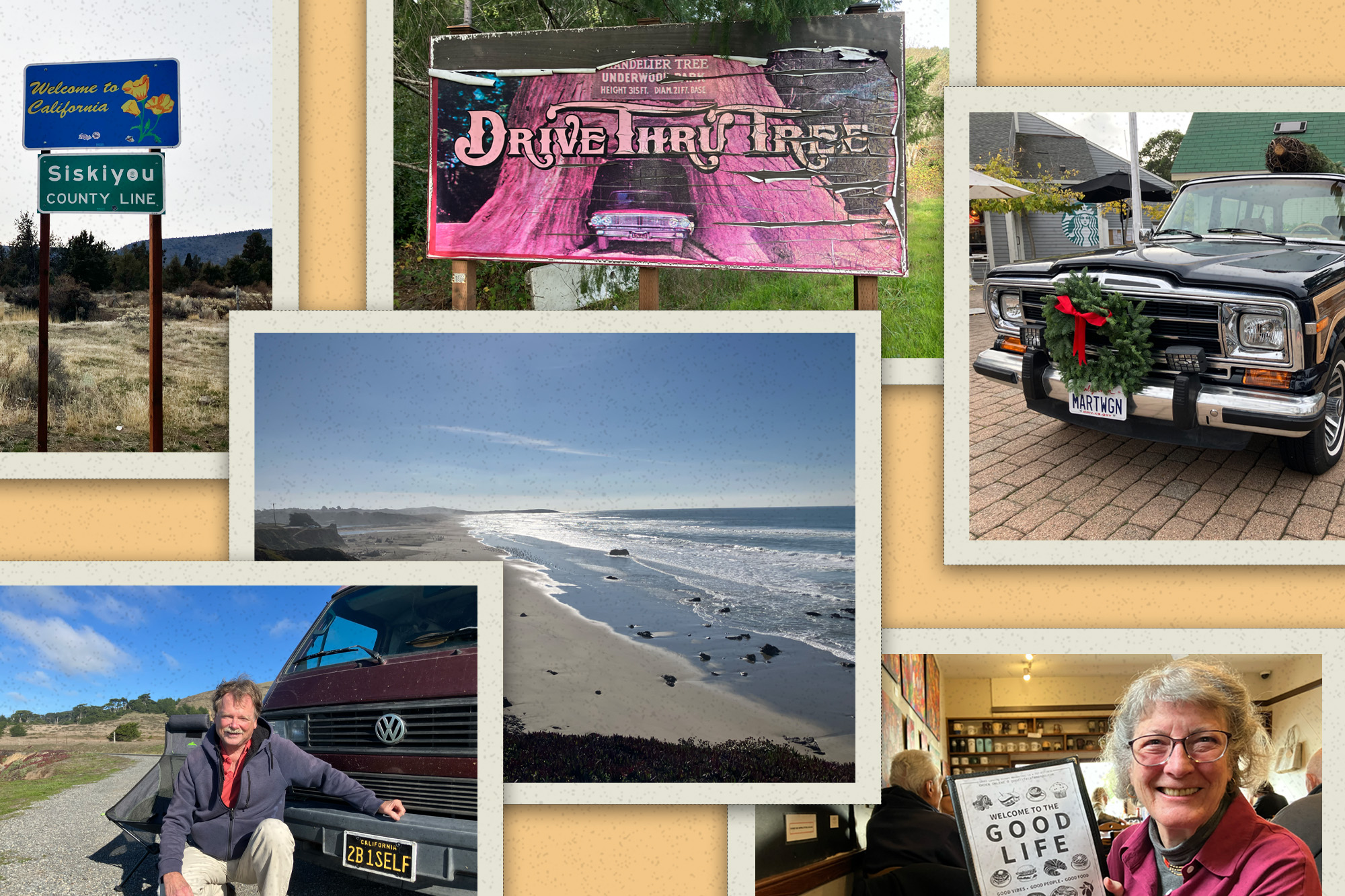
I was currently at the base of the flagpole — an accessible, tourist-friendly version of the state. Driving up Highway 1, gift shops sold salt water taffy in the quaint fishing town of Bodega Bay. RVs wound along the road past friendly oyster and seafood restaurants, seemingly narrowly avoiding catastrophe with every banked turn. A man wearing full Santa Claus attire sat in the passenger seat of his car in a parking lot near Sonoma Coast State Park. The perpetual fog bank lingered offshore, the coast almost discordantly bright in early December, hillsides a deep green and the sun reflecting off grass and water like some sort of California love poem.
At Sea Ranch, an architecturally distinctive planned community that long fought to limit public access to the beach, a Lexus pulled sharply out of the driveway of a beautiful, timber-framed house and onto Highway 1. In the small, unincorporated community of Anchor Bay, a longtime Indigenous settlement turned one-street town, nearly everyone greeted one another as they entered the general store.
California’s northern coastal counties are widely Democratic-leaning. Sonoma County voted 73 percent for Prop 50, and about the same share supported Kamala Harris in the 2024 election. Yet despite the strong support for the measure, life appeared to have moved on. A few weeks after an election that was pitched as the only way to save democracy, there was not a single Yes on Prop 50 sign to be seen, unlike other pockets of the state where those signs remained a regular sight. Even the residents themselves, in some of my brief questioning, seemed to have forgotten exactly what the measure stood for, remarking instead on their dislike of or support for Trump.
Miles and miles later, as the light began to fade beneath the ocean, I pulled into the small, historic and somewhat upscale village of Mendocino. At Dick’s Place, a cash-only, red-trimmed dive off Main Street, an elderly regular told me and other patrons, “My bar is your bar,” and proceeded to ask a visiting couple to put his favorite song on the juke box.
Against the odds, it isBig Sean’s “I Don’t Fuck With You,” featuring E-40 – a maybe not-so-subtle message to us, the out-of-towners, unwelcome at his favorite drinking establishment. Or, maybe, more hopefully, just a damn good song.
The following morning, I met up with Cynthia Gair, a lively, curly-haired woman in her 70s, at GoodLife Cafe & Bakery in downtown Mendocino. Gair, now retired, is one of the faces of the grassroots organizing effort that helped get Prop 50 over the finish line in Mendocino County.
Now a core member of Indivisible Mendocino Coast, a progressive grassroots group, Gair initially retired to the area with the expectation of “living the good life” following a long career in non-profit work around San Francisco. Then Trump was elected in 2016, and Gair, a lifelong Democrat, started organizing. What began as a small weekly meeting with a group of friends in the back of a downtown bookstore morphed, by the time Prop 50 rolled around, into a well-organized grassroots organization with dozens of volunteers and regular events across the county.
In Gair’s retelling, there were some initial doubts about Prop 50. Mendocino County has a conservative, MAGA contingent, and many more voters in the region lean libertarian. The prospect of tearing up an independent redistricting commission and emboldening lawmakers to install their own partisan maps was not something that came naturally to many voters in the area. But the argument in favor of Prop 50 was made easier by the simple fact that their district would not, in fact, be flipping from red to blue — nor would they have new representation at all. Democrat Jared Huffman, who is near certain to represent CA-02, has been their representative in Congress since 2013.
The county voted 63 percent in favor of Prop 50, lower than Marin and Sonoma, but still with strong support. But Mendocino, Gair told me, is not Marin.
The small town in which we had breakfast was quaint, idyllic — a tourist destination for its rugged cliffs and windswept coast. The village hosts boutique hotels, spas, a cute bed and breakfast. It does not seem to be struggling. But in certain ways, of course, it is. The only maternity ward at the nearest hospital closed recently, leaving people with a long drive over the mountains to Ukiah to give birth. Over the decades, a region settled by a redwood logging boom built bustling urban centers, which then faded with the trees themselves in the 1930s. Fisheries helped fill the gaps in work and industry, but that, too, declined by the late 1970s.
“A lot of people haven’t quite accepted that tourism is our main, really our only, industry,” Gair said. “The whole coast is in this sort of cultural transition.”
I set off to see the rest of it. CA-02, although contiguous and technically navigable, seems drawn almost purposefully with the goal of making it extremely difficult to traverse by land. Along the water, there is but one path: Highway 1, the beautiful two-lane road that traces the entire west coast. Heading inland, there are a few more options, but only a few — many of them old mule and wagon trails. To stay within the district, one is limited to increasing remote county roads through inhospitable mountain ranges.
I plunged over the coast range into Humboldt County, my second day on the road, driving through new-growth redwoods onto the faded-Americana kitsch of the 101 freeway. I passed the famous “Drive Thru Tree” (it’s a hole in a tree). I passed the Legend of Bigfoot (a dwarf- and Sasquatch-themed roadside gift shop). I passed the famous Confusion Hill Mystery (still not exactly sure what this is).
The road was nearly empty on this Tuesday in December. No talk of Prop 50 out here, at least not in the forest. And as I turned inland onto Highway 36, the concept of the ballot measure itself seemed like a strange memory. I maneuvered the hearse past the lone chimneys of burned-out homes, trying to avoid the many deer ambling across the highway, the road plummeting into one steep canyon after the next. The sun dipped below the mountains in a painfully beautiful pink glow, and I was nearly dozing when I suddenly saw Platina Road, my next turn, and skidded to a stop in the darkness. I backed onto the rutted road, the red burn of my taillights illuminating the country in an eerie glow, before turning off and continuing down toward the lights of Redding.
“I think you cheated,” Bruce Ross, the Shasta County GOP vice chair, said at a cafe in downtown Redding, mentally retracing my route. “You may have dipped into Tehama County.”
I had been describing the purpose of my journey (he seemed skeptical), and the path I had taken (apparently dubious, too). But most significantly, he thought I may have broken my editor’s only rule: not leaving the district on my way from Marin to Modoc. Highway 36, which I was on for most of the evening, does in fact leave CA-02 before connecting with Interstate 5 and Redding.
But, thankfully, I hadn’t cheated. In its journey across Northeast California, the border of CA-02 cuts off just miles from the road I took through the dark to Redding, at a little dry stream called Beegum Creek. My ramble through the night into town, driving along the potholed road cut into a hillside, was indeed legitimate. After taking a closer look, Ross reluctantly agreed.
He has lived in Shasta County for decades, working in politics as a spokesperson for Republican state assemblymember Brian Dahle and now his wife Megan. He’s a member of a local school board. And he’s long been an advocate in Sacramento for the issues rural Californians face. Even Ross’ Linkedin reads like a mission statement to that effect, his profile proudly committing to elevating “the important voices of rural California.”
Shasta County, one of the state’s original counties and a progenitor of many a gold rush-era fortune, was the first I had been to on my trek that, as a result of Prop 50, was now about to have new representation. The county is primarily white and older, with a poverty rate slightly above the national average and a population concentrated in Redding, its largest city. For over a decade, the region had been represented by Republican Doug LaMalfa, a gray-bearded Northern California lifer and fourth-generation rice farmer. Now, Huffman, the Democrat lawyer, will serve them. People in Redding and Shasta County, according to Ross, were not happy with how the ballot measure shook out.
“I mean, it sucks,” Ross said. “A substantial number of lawmakers have just never been north of the Sacramento River.”
Northern California, particularly the rural and conservative-leaning parts of it, has long lacked political power. For years, there have been frustrations over the perception that urban politicians are making decisions that ignore the region’s culture and geography. There was an electric bus mandate, signed in 2023, which required transit agencies to have zero emission fleets by the end of the decade — nevermind the distances, extreme temperatures and lack of charging capacity in rural areas. Environmental protections, residents feel, are often prioritized over their jobs and livelihoods, as was the case with logging halted by the endangered spotted owl. Wolves, which pose an increasing problem for ranchers and their herds, are protected by state law (“It’s an apex predator, and you’re supposed to applaud if you catch it eating your livestock,” Ross said).
LaMalfa did not solve those problems. But he was from the area, active in the district and felt like a voice in Congress, Ross said. At the very least, he knew what Northern California actually looked like.
“Jared Huffman was quoted as saying, ‘We’re going to have to learn to live together,’” Ross said. “But I don’t think he’s really spent the time talking to people who are from this place.”
On the outskirts of Redding, two chihuahuas danced dangerously close to I-5 traffic, sprinting through the brush along the side of the highway. I kept driving. Too many times have I found myself caught in chaotic attempts to rescue little dogs on the side of busy roads. It was my last day in the district. I had to make good time.
I drove north into the small town of Mt. Shasta, its eponymous snow-capped mountain looming dramatically to the east. Crystal shops lined the town’s main drag, and I stopped in at a store where a dance club remix of Leonard Cohen’s “Hallelujah” played loudly over the speakers. Near the town hardware store, I talked briefly with a man named Mike Koho, a left-leaning janitor who voted for Prop 50 and told me the conservative “spell” in Northern California was breaking, in large part due to growing discontent over immigration raids.
And yet, Koho’s prediction was not reflected in the results of Prop 50, which all of northeastern California deeply opposed. Seventy percent of Shasta County voted against redistricting, as did 62 percent of Siskiyou County and a whopping 78 percent of Modoc County. Beyond cultural and geographic differences, these northern reaches of the state just have decidedly different politics from the coast.
In a phone call, Congressman Huffman, who will now be charged with representing this vast stretch of California, told me that he’s well aware of the challenges he’ll face. But, contrary to Ross’ expectation, he said he is making plans to visit and meet with people in the area.
“I have a lot to learn and new people to meet. There’s nothing easy about it, ” Huffman said. “But it’s not like I’ve had people say ‘Don’t come here, I don’t want to talk to you’.”
In part due to his years representing rural coastal California, Huffman said he recognizes the significance of physically showing up in a place and being able to fluently engage with the folks who live there about the issues that matter to them. There is no one-size-fits-all solution. But being present, he believes, can go a long way.
“Am I going to bring perfect harmony to every divergent piece of this district? No – nobody is,” Huffman said. “But I can try to hear their needs and hopefully find some outcomes that can make their lives better.”
And yet, driving deeper into northeastern California, Ross’ arguments about the region being left behind economically are clear as day. As I left Mt. Shasta, forcing the hearse past scorched stretches of timber and old long-vacant motels as sagebrush and juniper replaced forest, I passed through the town of Weed, which that same day witnessed the sudden closure of the storied Roseburg Mill. One hundred forty jobs that were there at 7 a.m., by the time I drove through town, were gone.
And at the tip of the state, another beautiful, deep green lumber processing plant marked the entrance to Dorris, a small town on the California-Oregon border. Walking through town, it wasn’t long before I met a former employee of the plant, a man named Brian who now owned a thrift store downtown with his daughter Talia. Like in Weed, Brian, who had worked for Dorris Lumber and Moulding for 30 years, had his hours cut back as the plant reduced production and lost business to Oregon and overseas. Today, there are few opportunities in town, and one of Dorris’ biggest industries now is the production of strawberry roots, which are taken and transplanted at commercial farms in Sacramento and along the coast.
In Huffman’s pledge to faithfully represent all of his new district, he will first face real challenges in building back trust in areas like Dorris.
“They don’t want to hear what we have to say,” Talia, who voted against Prop 50, said of Sacramento politicians. “They just want our roots and water.”
Leaving Dorris behind, I hopped back in the hearse onto the long road stretching east. At the border of Modoc County, I passed through an agricultural checkpoint, an always odd California experience in which customs folks demand to know whether you have any fruit in your car as you enter the state (although this time, I had never left).
In the distance, snowcapped Mt. Shasta was still visible. Unpaved Forest Service roads wound off the highway into the pines, ice forming a thin crust over culvert puddles, the landscape fit for a Western diorama.
“You can look at the map politically and say, gosh this is a gerrymandering exercise on steroids,” Huffman said of CA-02, in our call. “But when you actually go to these places, there’s a lot of awe and wonder.”
Finally, by the end of the day, I made it to Alturas. Three days later, after nearly 20 hours of driving and 700 miles, I had reached the edge of CA-02. The hearse was still running strong, at least as far as I could tell. And soon, it would be time to head back — finally leaving the district on a straight shot down I-5 to Sacramento. I was far from the Koi fish and SoulCycles of the Marin Country Market. In Alturas, the high school football team drives five or six hours to play games. There is just one traffic light in the entire county. As Ned Coe, a longtime Modoc County supervisor put it, “I struggle with how to explain the extreme differences between Modoc County and Sausalito.”
Prop 50 has united all these places. But for some reason, eating dinner in Alturas, thinking back on all that land, I thought not about new representatives or control of Congress or the hundred million dollar campaign to pass the ballot measure. Instead, I thought about this guy I had met on the coast in Sonoma two days earlier, an older man sitting in a camp chair beside his old burgundy Volkswagen, contentedly munching on a banana beside the Pacific Ocean. A former limousine driver retired from the city to the country, he declined to give his name and identified himself only by his license plate, 2B1SELF. He was full of joy for the world before him, the animals he glimpsed that day, and the back roads he had driven. When I asked him about Prop 50, he waved it off as some sort of a strange distraction, irrelevant to all he’d seen.
“Politicians and Democrats do all sorts of weird stuff,” he said. “Sometimes the best thing you can do is just turn off the news and sit by the ocean.”