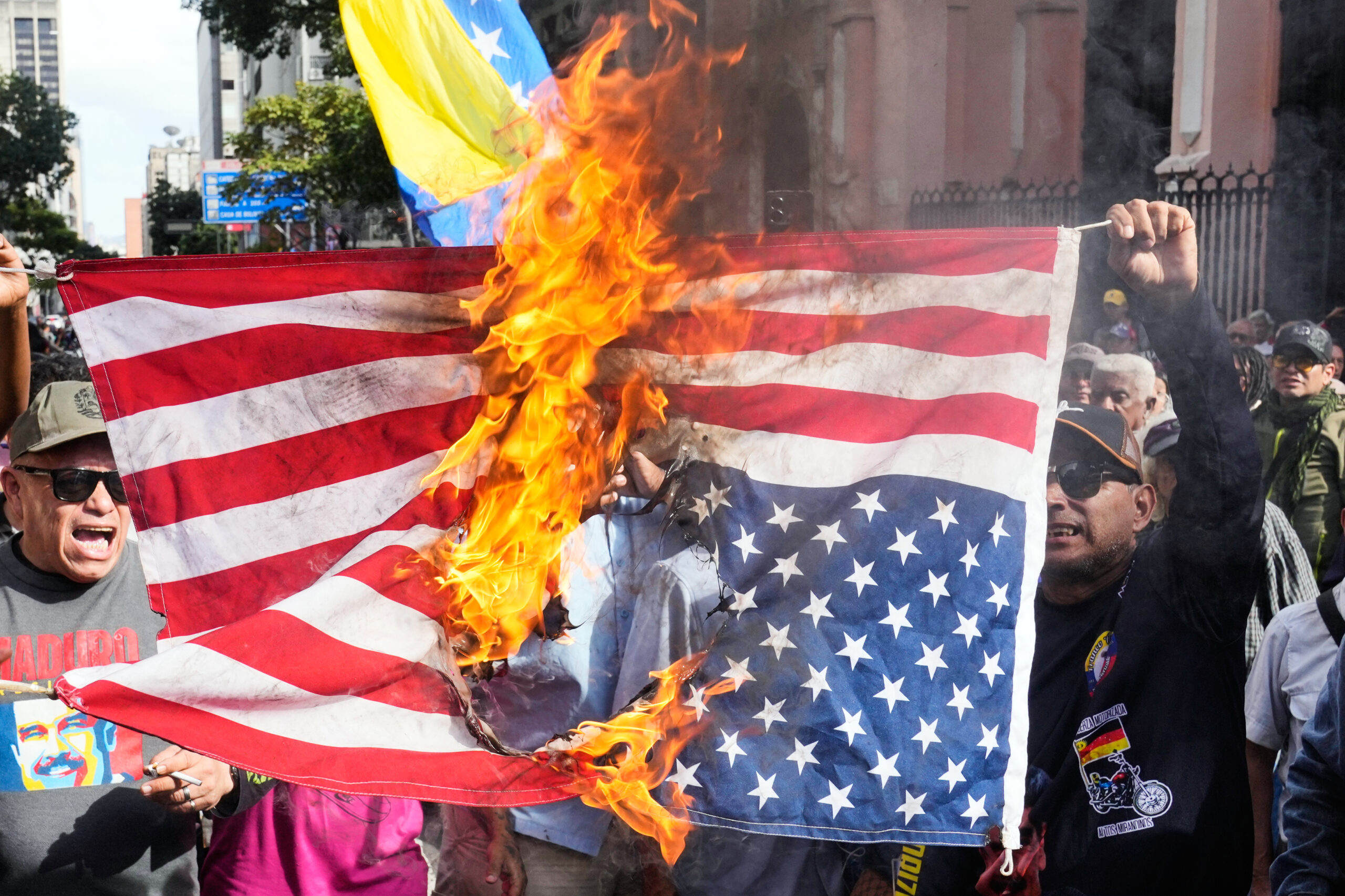
President Donald Trump and his administration spent months insisting that its efforts in Venezuela were solely focused on combatting drug trafficking and not about changing the government in power in Caracas.
But the administration’s strikes on Venezuela, its capture of Venezuelan leader Nicolás Maduro and Trump’s statements that the U.S. will “run” Venezuela have created confusion about what direction the Trump administration will take Venezuela policy now that Maduro is in U.S. custody. The president on Saturday said Secretary of State Marco Rubio spoke with the country’s current interim ruler, Executive Vice President Delcy Rodriguez, and that the U.S. would decide Venezuela’s political future.
To make sense of the state of play, POLITICO Magazine sat down with Carrie Filipetti. Filipetti, who now leads the center-right Vandenberg Coalition think tank in Washington, served in the first Trump administration as principal deputy assistant secretary of State for Cuba and Venezuela and was an integral player in that administration’s efforts to ramp up economic pressure against Maduro.
Filipetti says that capturing Maduro still fits within the framing of this pressure campaign as a counter-narcotics mission, and she was supportive of the operation. But she cautioned that any effort to directly run the country will result in political blowback for the administration.
She also insisted that the future of Venezuela comes down to whether the U.S. will support the opposition and its efforts to restore democracy in the country and cautioned against cooperating with Rodriguez or other former allies of Maduro.
“The only way that we can preserve U.S. security, make sure we don’t get bogged down further, and protect Venezuelan security is if we turn back to the democratically elected leadership there,” she said.
This conversation has been edited for length and clarity.
The top line coming out of the president’s presser today is this idea that the US is going to be “running” Venezuela in the interim. How could this possibly work based on what the president outlined?
I am hoping that when the president says the U.S. will run Venezuela until a proper transition takes place, what he really means is that the U.S. will support the democratically elected leadership of Venezuela. There appears to be an enormous amount of support right now for the president’s operation, particularly among his base and Republican members of Congress, largely because it was accomplished with no loss of American life and was direct and targeted.
Candidly, there would be very limited support, if any, of the United States taking a leadership role of a sovereign nation. The America Firsters in his administration and in his coalition are already beginning to ask some questions about what this actually means. What Venezuela really needs is democracy, not patronage. I think it still remains to be seen exactly what he means by this, but certainly I would not support the U.S. being in any role other than supportive of the Venezuelan people who have been fighting for democracy. And I suspect most Americans would not either.
Speaking of the opposition, the president did not offer the most glowing words about Maria Corina Machado. He essentially insinuated that she didn’t have the gravitas to potentially lead the country. Do you agree with that assessment?
It seems to me that President Trump may have confused Delcy Rodriguez, who I would describe as not having the respect or support of the people, with Maria Corina Machado, who provably does. Her candidate, Edmundo Gonzalez, won nearly 70 percent of the vote, even under authoritarian conditions. Her support has only been growing, as I’m sure you’ve seen polling in Venezuela suggesting that there are super majorities that support her. So this is a provably incorrect statement.
She has been working behind the scenes for many years for democratic change inside Venezuela. She is the most popular candidate by far. She was able to unite nearly all of the Venezuelan opposition parties in a way that no previous Venezuelan leader had been able to do. And notwithstanding the fact that she’s been forced into clandestinity since 2024, she has still been able to retain that support, even so much as winning the Nobel Peace Prize. So once again here, I’m supportive of the American operation, but I think he’s categorically incorrect in his assessment of Maria Corina Machado and in his assessment of Delcy Rodriguez.
What do you think the opposition needs to do to make the most of this moment?
First of all, I think we shouldn’t negate the possibility that a lot of the efforts that the Venezuelan opposition have put forward over the last couple of years helped result in this being a successful operation. Meaning, an operation like this requires significant on-the-ground intelligence on locations, schematics, schedules, etc. That information often comes from insiders, and I would not be shocked if the opposition’s efforts in building bridges to those in the regime and turning them toward democracy was able to generate some of that intelligence. So I think we owe a lot of credit to the Venezuelan opposition, who are partners to us in this in very much the same way that the Israelis were partners to us in Operation Midnight Hammer.
Right now, they are mobilizing. Maria Corina Machado has been activated and is working really hard to unite everyone to make sure that security is confirmed, to make sure they are able to put into place the day after plans they’ve developed for so long. So, again, I think it’s important that we not lose sight of the fact that the Venezuelan opposition really are partners to us in this, and the only way that we can preserve U.S. security, make sure we don’t get bogged down further, and protect Venezuelan security is if we turn back to the democratically elected leadership there.
Why do you think the president ultimately decided to approve the strikes?
I think the president was able to assess the probability of success as extremely high. He knows, and now the rest of the world does as well, what the capabilities of the U.S. military are. This was an incredibly coordinated campaign that was even more remarkable than I could have imagined. The coordination that’s required. The operational security that’s required. The performance on the ground and in the air by American service members. All of this is a huge statement of American strength and power and also a strong message to our adversaries not to test us.
My sense is that for President Trump, it was very important that he was able to come back to the country and say not a single service member was killed, and not a single piece of equipment was shot down. He was rightfully very proud of that.
When we’re thinking about the messages to adversaries, some have said this could also embolden China to launch military strikes in Taiwan or allow the Russians to accuse us of selective standards when they’re defending strikes in Ukraine. What’s your take on that?
The message that our adversaries are getting today is much different. What you have to remember is there were Chinese officials on the ground meeting with Maduro just hours before this strike happened. At the same time, Russian equipment, which is what the Venezuelan regime relies on for its air defenses, were proven completely incapable of taking out American aircraft. And you have the Iranian regime saying that there’s total war against the United States, and President Trump warning them that if they harm any protesters in Iran that the U.S. will be on the side of the protesters.
So what we’ve seen in this one operation inside Venezuela are consequences for other adversaries. First, demonstrating that Russian military support is pretty much a paper tiger at this point. Second, demonstrating that the U.S. is not afraid of China or a Chinese presence. And third, that the United States stands very strongly behind its threats. And if I were the Iranian regime, that would be what I would be most concerned with. So broadly speaking, I think that this has implications not just for the future of Venezuela, but the future of the world.
And specifically there’s the message that if you are a foreign dictator who refuses to engage with good faith in the United States negotiations, you are going to be held accountable for that. That’s a very clear message to Putin, to Xi, and to the Iranian regime.
Another criticism has been that this contravenes principles of international law about sovereignty and about respect in general for borders, and represents an episode of U.S. interference in another country’s political affairs. What do you make of that?
I haven’t yet seen the exact way in which President Trump plans to provide the legal justification for this. I think there’s a few different possibilities. First and foremost, as it relates to the airstrikes, that’s something that based on precedent seems within executive authority. It was done both by President Trump’s first administration as well as President Obama’s administration. And so it has been accepted, at least in precedent, that airstrikes in a limited capacity for a specific target are possible even without congressional approval.
As it relates to the on-the-ground operation, it really depends on how exactly this was conducted and by whom, but of course the president did authorize lethal CIA action, which could allow activity similar to this under Title 50. And then finally, as it relates to international law, there is a principle of responsibility to protect that was developed to protect the civilians of countries whose leaders are committing crimes against humanity, war crimes or genocide. And the U.N. fact-finding mission, which recently was forced out of Venezuela, has over the last few years shown proof of potential crimes against humanity. So one could also look at the responsibility to protect as a potential justification for this activity.
I’m not sure which authority the president will use, nor am I a lawyer, but these are the things I’m thinking about. I imagine as more comes out, this is an area that Congress and others will want to look more deeply into.
How worried are you that Venezuela could devolve into chaos if there’s the second wave of attacks that the president threatened today?
This is why I think it’s so important that we throw our support behind Maria Corina Machado. They have the inroads. They have connections with the military. They have inroads even with regime officials. The safest way to a successful, smooth transition is not for the United States to take power, but for us to make sure that it gets into the hands of the democratically elected leaders in Venezuela.
What they do after that, whether they hold another election, whether Edmundo stays as president for his term and then there’s another election, is ultimately up to them. But that is the best way to make sure that this doesn’t devolve into chaos. People have really underestimated the opposition. They were able to organize elections. They were able to unite. They were able to mobilize hundreds of thousands of protesters and millions of voters. This is a population that has been through so much and is capable of so much.
And the conditions are not, as some suggest, Libya or Iraq. This isn’t the United States forcing democracy on a country. This is democracy returning to a country that originally brought it to the rest of the hemisphere. They’re very trained in electoral processes, in democratic processes, and so this is a very different context. That being said I think there is a potential for chaos if the United States plans to “run” Venezuela from afar. It needs to be in the hands of the Venezuelan people and specifically in the hands of the democratically elected leadership.
If you were at State right now, what other things would be keeping you up at night? What would be the other pitfalls that you’d watching out for?
Obviously, I’d want to make sure that the security situation in Venezuela stabilizes. That would be my number one concern. My second concern would be making sure that Venezuela has what it needs to really rebuild. Rhetorical support is important, but actual tangible support matters a lot more.
This was a major lesson that we learned in the first Trump administration. It would be really important to make sure that we’re looking at the various resources that we can provide. That’s financial resources, but it’s also programmatic resources. I would be working very hard to rally support for what the president has achieved across the world so that we can get other partners to join us in supporting the Venezuelan people and making sure that they have what they need for a transition. And ultimately, all of these investments will help enormously.
If there is a desire for us to partner with Venezuela and their oil sector, then once again, the best, safest and smoothest way to do that is to make sure that they have a democratically elected leadership that’s willing to cooperate and partner with us on their own accord, not because the United States is running it. We have our own country to focus on.
If things break down, how much is the U.S. going to be on the hook for this? And what are the political consequences for the administration should things really fall apart?
This was partially why I wasn’t 100 percent sure whether the president was going to do this. There’s two key questions they’d consider as they’re planning this kind of event. Number one is, will it be successful for the immediate operation? Which is, of course, the taking of Maduro and bringing him to the United States to face his drug trafficking charges. How likely is it for that to be successful? There, the assessment was probably very high, and as we saw that was very successful.
But there’s a second component, which is what is the likely outcome of this in the days, weeks, months afterward? That’s why in the first Trump administration we always emphasized that the method of a transition is as important as the transition itself. It’s also why I keep emphasizing the democratic leadership inside of Venezuela, because they are the ones that can make sure that this doesn’t devolve into chaos. Some of the things that we would be concerned about, of course, would be: Are there regime loyalists who try to assert power and to try to repress the Venezuelan people and continue Maduro’s legacy? Is there a power vacuum? Again, the best protection against this is making sure that we are backing the Venezuelan leadership under Maria Corina and Edmundo Gonzalez.
The administration was saying this wasn’t about regime change in the months and the weeks leading up to this, but it kind of was ultimately about regime change, right? Is that a fair read of the ultimate end state for the operations?
Well, President Trump did continuously emphasize the American victims of drug trafficking in his press conference about this operation. I think the fact that Maduro was taken to face charges on drug trafficking is another important indicator. The way I have always assessed President Trump is that he views the departure of Maduro as a drug trafficking operation, as a counter-narcotics operation. I think President Trump is continuing to see this as a law enforcement operation or counter-narcotics operation and that Maduro, being the head of drug trafficking in Venezuela, needed to be held accountable.
What does all of this tell us about the Trump “corollary” or “doctrine” that the administration is promoting in Latin America right now? How does this affect our posture toward the hemisphere?
We saw in this action a few different things that align with his national security strategy. First and foremost, in his press conference, he did bring up both drug trafficking and immigration, which were two of the main things that worried him as written about in his Trump corollary. He also wrote about foreign malign influence, and I thought it was very telling that both President Trump and Secretary Rubio mentioned our foreign adversaries in their remarks, the fact that this sends a message to those adversaries, and the fact that those adversaries are embedded in Venezuela. So in some ways, this is very much an encapsulation of what he described in his Trump corollary to the Monroe Doctrine. It certainly reasserts American power. It emphasizes the importance of deterrence. I think all of those things are very consistent.
Once again, where I do have a significant question is about this next stage of him suggesting that there’s some role for the U.S. in leading Venezuela. That doesn’t seem to align very concretely with his Trump corollary, nor does it really align with much of what he’s described as America First in the past.
One final question. You were also the Cuba point person at the State Department’s Bureau for Western Hemisphere Affairs. Our policy on Venezuela has always been linked to our policy on Cuba, and Secretary Rubio issued a threat that if “I were in Havana, I would be concerned” right now. I’m curious if you share that same viewpoint that Havana should be worried about what just happened right now in Venezuela.
If I were Havana, I would be worried about what just happened, but not exclusively from the perspective of the United States coming against me. I would worry about the fact that I no longer have my lead patron.
Cuba has always required a patron state to support them. First it was the Soviet Union, and when the Soviet Union fell it was Venezuela. There’s no longer a clear successor to Venezuela in propping up Cuba’s illegitimate regime. So if I were them, I would be worried about that side of the equation as well.