Kevin Warsh learned his earliest lessons about politics while selling pencils at a racetrack.
As a high schooler in upstate New York, Warsh spent his summers working odd jobs at the Saratoga Race Course, the storied horseracing track frequented by New York’s upper-crust clientele. After a few summers setting up beer kegs and delivering ice as a barback, Warsh secured a promotion to sell programs to race-goers near the entryway to the track. At the stall where he worked, Warsh developed a nifty sales trick: When patrons came to buy programs, he would also sell them a “lucky pencil,” along with advice on which horse to bet on in the big race.
But over the course of the day, he would advise eight different customers to bet on eight different horses, assuring each that the “lucky pencil” guaranteed them success. It was a failproof strategy: At the end of each day, the winner would return to the stand to tip him for selling them the lucky pencil.
“It’s a nice way to get a little bonus at the end of a big Saturday racing,” herecalled on a podcast in 2023.
It was also a lesson with applications in both finance and politics: Hedge your bets.
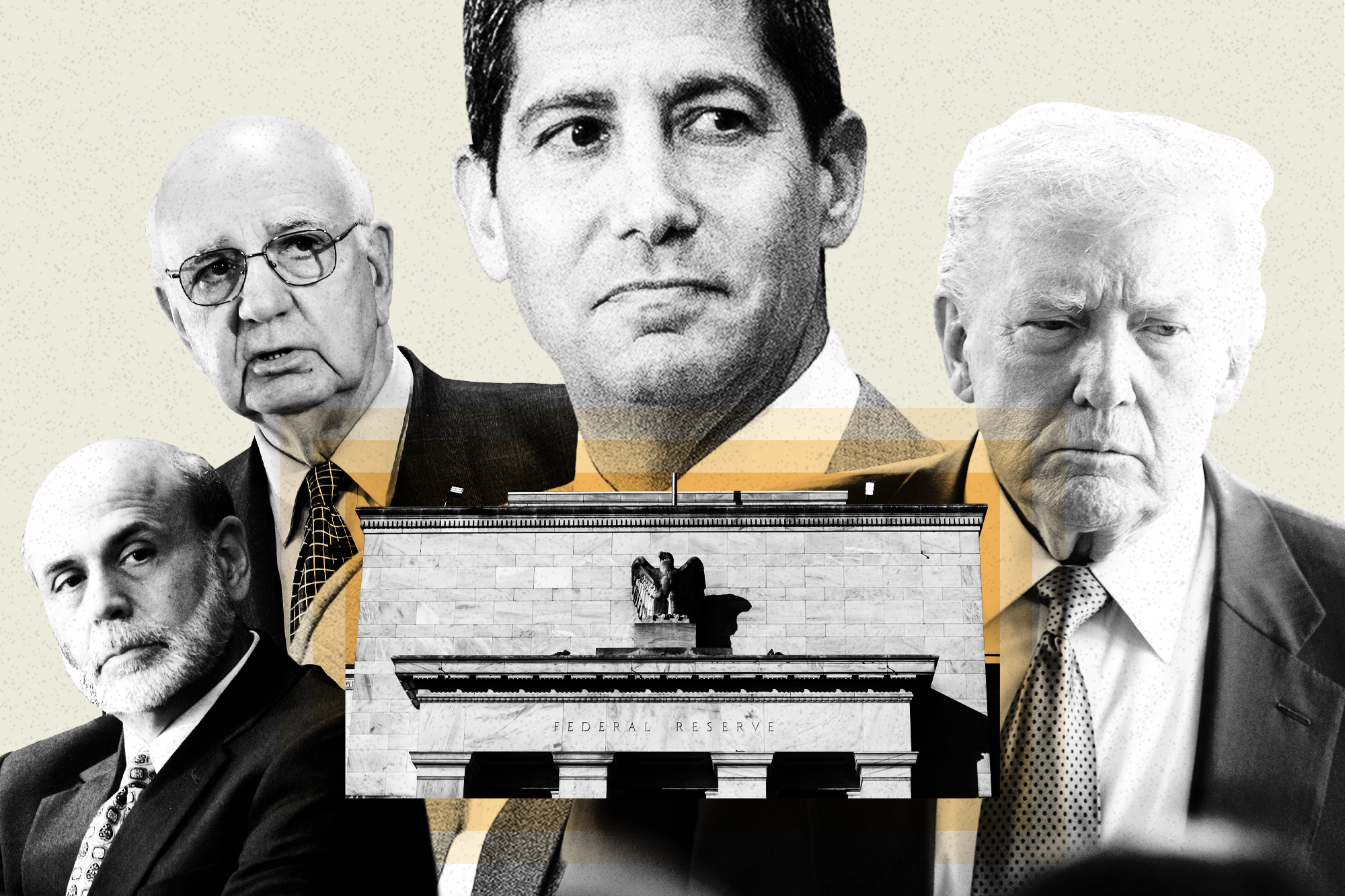
Warsh’s most consequential bet to date appears on the verge of paying off. Last week, he was nominated by President Donald Trump to become the next chair of the Federal Reserve, moving him one step closer to his longtime dream of becoming the nation’s top central banker.
But a greater challenge is still ahead for Warsh: steering the economy through a period of deep uncertainty without incurring the wrath of Trump himself, who has made it clear that he expects personal loyalty — more than savvy economic stewardship — from the next Fed chair. And unlike the pencil-selling scheme he developed at Saratoga, there’s no guarantee that Warsh will come out on top.
Warsh’s likely ascension to the top of the world’s most powerful central bank marks the culmination of a twisting professional and ideological odyssey — one that has seen Warsh transform from Fed insider to conservative reformer to Trump-aligned critic. A product of a middle-class family from upstate New York, Warsh climbed into the upper echelons of America’s financial and political establishment, leveraging a career on Wall Street — and a brief stint as an adviser to George W. Bush’s National Economic Council — to become the youngest-ever member of the Fed’s Washington-based board in 2006, at age 35.
At the Fed, Warsh — who holds degrees from Stanford University and Harvard Law School and is married to the heiress of a multi-billion-dollar cosmetics fortune — became a central figure, working closely with then-Chair Ben Bernanke as the institution navigated the 2008 financial crisis. Under Bernanke’s guidance, he developed a reputation as a fierce defender of the Fed’s political autonomy. He also deepened his relationships with Wall Street and corporate executives, who helped burnish his reputation in ways that would serve him well when he eventually sought out the Fed’s top job.
“Kevin Warsh is a highly respected and experienced leader — across government, business and education — who I have seen act with integrity and a dedication to making our country better,” JPMorgan Chase CEO Jamie Dimon, who led his bank during the 2008 crisis, said in a statement.
As he departed the Fed in 2011 and in the years since, Warsh leaned more into conventional conservative criticisms of the central bank that one often hears made by Republicans in the halls of Congress — that the Fed’s influence on markets is too expansive and that it has been insufficiently wary about tamping down inflation. Those criticisms run directly contrary to those made by Trump, who has relentlessly pressured the Fed to lower rates and accommodate financial markets.
Still, Warsh has recently managed to make inroads in Trump’s orbit, including playing a key role in the president’s 2024 transition team. In recent months, he has publicly echoed the president by calling for lower borrowing costs and predicting a massive AI-driven productivity boom that he says will allow the economy to grow quickly without sparking problematic price increases for consumers. He has also underscored his desire for a more comprehensive overhaul of the Fed’s role in the economy.
The varied stages of his career have left longtime Fed watchers wondering which version of Warsh will ultimately govern the central bank. At the same time, his evolving collection of past positions may prove to be a political asset. On his road to confirmation — a likely outcome, but not one without obstacles — he will also have to contend with two diametrically opposed camps of skeptics: on the one hand, lawmakers who fret that he might bow to political pressure from Trump; and on the other, Trump-aligned populists who believe that, under the rhetorical trappings of his recent MAGA makeover, he’s still the stubborn institutionalist that he’s always been.
Warsh did not respond to a request for comment.
Once he clears the Senate, Warsh will immediately be confronted with another thorny set of problems. The economic outlook could conceivably shift between now and when his term would begin in May, though Trump has said he expects rate cuts regardless. (The president even joked over the weekend about suing Warsh if he doesn’t deliver.) Warsh will have to answer that demand while also determining how to fulfill the Fed’s two mandates of safeguarding the job market and avoiding inflation — all while selling an increasingly divided committee of fellow central bankers on his chosen path forward. Also looming is the Supreme Court’s impending ruling on when the president is allowed to fire members of the Fed board, which will likely set the tone for the institution’s future dealings with the White House.
To strike that difficult balance, Warsh will need to rely on the same strategy that he developed selling pencils at the Saratoga racetrack — garnering sufficient goodwill among several competing constituencies to secure his nomination, and then delivering enough discrete victories to maintain his credibility. The odds seem stacked against him, but the carefully crafted career path that he has traveled up to this point suggests that he is perhaps uniquely situated to do so.
“It might not hurt that Kevin Warsh turns out to be a bit of an enigma,” said Jon Hilsenrath, a visiting scholar at Duke University who formerly covered the Fed for The Wall Street Journal. “Maybe it puts him in a position to shape shift when the conditions require.”
Warsh’s background reads like something out of “central casting” for a Fed chair, as the always-image-conscious Trump put it in the social media post announcing his nomination.
His ambition was clear from a young age. As a student at Shaker High School, a 2,000-student public school in the suburbs of Albany, New York, Warsh joined the school’s “Student Board of Finance” and served as the president of its Key Clubs — activities that earned him the title of “teacher’s pet” in his senior yearbook. During a meeting with a guidance counselor about his college plans, Warsh recalled on the 2023 podcast, he confessed his desire to eventually go to college at “Stanford, in California.”
The guidance counselor looked puzzled. “Do you know it’s in Connecticut?” he said.
Warsh, brandishing a brochure from Stanford University in Palo Alto, resolved the confusion. The guidance counselor had thought he was talking about the University of Connecticut in Stamford. But Warsh knew what he wanted. “I’m pretty sure it’s in California,” he replied.
At Stanford, Warsh majored in public policy and traded his summer job as a pencil-pusher at the Saratoga racetrack for a gig as a research assistant in the university’s economics department. The job paid $13 an hour, but the real payoff was working under some of the most celebrated conservative economists in the world, including Milton Friedman, the godfather of neoclassical economics, and George Schulz, fresh off his stint as Ronald Reagan’s secretary of state. The experience sharpened Warsh’s professional ambitions.
Those economists “really changed my life in terms of my knowledge, [and] changed my life in terms of what I would end up growing up to do,” Warsh later recalled.
Warsh continued his ascent into the establishment after Stanford, graduating from Harvard Law School in 1995 and landing a job in Morgan Stanley’s mergers and acquisitions department. Warsh was in a weekly staff meeting at the bank’s headquarters in Midtown Manhattan on Sept. 11, 2001, when the first plane hit the World Trade Center, where over 3,000 of his Morgan Stanley colleagues worked. After getting evacuated, he was walking down Fifth Avenue when he watched the second tower collapse.
“Almost immediately, I felt the draw of public service,” Warsh said in an unreleased 2023 interview with New York University economist Simon Bowmaker, who spoke to him for a forthcoming book.
That opportunity came just six months later, when Warsh — newly wedded to fellow Stanford alum and Estée Lauder cosmetics heiress Jane Lauder — got a call from the director of Bush’s National Economic Council asking him to come aboard. At the White House, he worked closely with Bernanke, who was then serving as Bush’s chief economist. Warsh focused in particular on federal housing policy, a portfolio that brought him face-to-face with then-Fed Chair Alan Greenspan. When Greenspan’s term ended in 2006, Bush tapped Bernanke for the central bank’s top job and Warsh as a governor.
“I doubt I would have found myself as a central banker without my relationship with Bernanke,” he told Bowmaker.
Warsh sailed through confirmation in the Republican-controlled Senate Banking Committee, but the process proved instructive. In the lead-up to his confirmation vote, Democratic Sen. Paul Sarbanes, the top Democrat on the committee, suggested he sit down with Paul Volcker, the towering former Fed chairman who was credited with breaking the back of double-digit inflation during the Carter and Reagan administrations. Warsh, who idolized Volcker, took a notebook to the meeting to memorialize his advice.
“He said, ‘Kevin, there’s something I need to tell you. This job you’re signing up for, really is quite simple: it really only requires two things,’” Warsh later recalled. “‘The first thing is, you have to get interest rates about right.’” Warsh dutifully recorded the commandment in his notebook. “‘The second thing is probably more important than the first … is to make sure you look like you know what you’re doing.’”
The advice stuck. “There’s a certain theater to it, [and] there’s a certain displaying of conviction to it,” Warsh said in 2023, recalling Volcker’s counsel. “Does the person look like they know what they’re doing? Does the person look like they have conviction about what the future is? Are they conveying a seriousness of purpose to beat inflation down?”
Warsh spent his early months at the Fed with an eye on the political calendar. In one of his first meetings at the central bank’s interest rate-setting committee, he referred to the slow souring of public attitudes toward free trade as his “biggest concern” ahead of the 2006 midterm elections and suggested the Fed could effectively row in the opposite direction.
“To be candid, the business community probably isn’t that eager to enter this debate with a message oriented toward free trade,” he said, according to the transcript. “So, I do think that creeping protectionism may become stronger between now and November.”
“The Federal Reserve has a possible role in trying to moderate some of that discussion,” he added.
On the Fed board, Warsh also emerged as a vocal defender of the central bank’s independence, going so far as to deliver a speech titled “An Ode to Independence” at a gathering of economists in March 2010.
“Central banks must take their own counsel when deciding upon the timing and force [of lowering interest rates],” he said then. “I am confident that any attempt to influence inappropriately the conduct of Fed policy would yield a strong and forceful rebuke by Fed officials and market participants alike. The only popularity central bankers should seek, if at all, is in the history books.”
Meanwhile, Warsh remained in Bernanke’s inner circle at the Fed, assuming a key role as the central bank’s liaison to Wall Street during the depths of the 2008 financial crisis. Drawing on his past career in mergers and acquisition, he helped facilitate the sale of beleaguered bank Wachovia to Wells Fargo.
But as the downturn wore on, Warsh began to publicly diverge from Bernanke’s approach to resuscitating the economy as it struggled to recover from the Great Recession — specifically his decision to purchase massive amounts of U.S. government debt and bundled mortgages to push down long-term interest rates. That policy, known as “quantitative easing,” left the Fed holding trillions of dollars in assets on its books. While Warsh voted with the chairman on a second round of asset purchases, he expressed reservations during the meeting and then wrote an op-ed the next week criticizing the move. A few months later, he resigned from the central bank. (There was no bad blood between him and his boss; Bernanke later praised Warsh’s “loyalty” and “sincerity” in a 2015 book.)
After leaving the Fed, Warsh returned to Stanford to serve as a visiting fellow at the Hoover Institution, home to several prominent conservative economic thinkers, including famed economist John Taylor, known for an eponymous rule that lays out a formula that can be used to determine the proper level for interest rates. At Hoover, Warsh proposed reforms to the central bank, focusing particularly on the need to reduce the Fed’s financial holdings, though his writings often tended toward the abstract. In 2014, for example, he proposed the creation of what he called a “new economic and security commons.”
“Put plainly, if a country acts as a trusted security partner of the U.S. and treats American businesses and citizens as it treats its own, the U.S. will act reciprocally,” Warsh wrote in an op-ed in The Wall Street Journal.
In 2017, Warsh found himself on Trump’s short list of nominees to replace Fed Chair Janet Yellen. Warsh, who’d served in Trump’s first term on his short-lived Strategic & Policy Forum, sat for an hour-long interview with Trump in the Oval Office but ultimately didn’t land the job — in part because Trump thought the 47-year-old was too young for it. On the strength of then-Treasury Secretary Steven Mnuchin’s recommendation, Trump selected Jerome Powell instead — a decision he later came to regret after Powell continued with Yellen’s steady campaign of rate hikes. “I could have used you a little bit here,” Trump said to Warsh at a public event in 2020. “Why weren’t you more forceful when you wanted that job?”
That interview process provided Warsh with valuable insight into Trump’s prerequisites for his next Fed chair — in particular, the president’s monomaniacal focus on cutting rates. “If you think it was a subject upon which he delicately danced around, then you’d be mistaken,” Warsh told POLITICO in a 2018 interview. “It was certainly top of mind to the president.”
Asked if he thought the president appreciated the importance of the Fed’s independence, Warsh dodged: “This might be a good time for a no comment,” he said.
Warsh allies see his current stance on rates as still in keeping with his deeper convictions about the role of the Fed in the economy — while adapting as economic needs evolve. They point, for example, to Warsh’s opposition to the Fed’s rate hike at the end of 2018 and his call for “immediate action” by the central bank in February 2020, when the coronavirus pandemic was threatening to tank the economy.
His approach to monetary policy contains more nuance than just a preference for high rates, they say.
Nonetheless, if the once and future central banker is confirmed, Warsh will have to wrangle both the Fed staff and his fellow policymakers to meet Trump’s key demand: lowering interest rates. In a statement, White House spokesperson Kush Desai argued that Warsh’s “academic credentials, private sector success, and experience on the Fed Board of Governors make him eminently qualified for the job.”
Yet Warsh may have made already the job harder for himself by lobbing a series of increasingly harsh criticisms at the Fed — he has suggested there is “plenty of dead wood” within the staff and promised to “break some heads” along the way — that have rankled many of the same people that he needs to win over.
Don Kohn, who served as vice chair at the Fed during Warsh’s tenure on the board, said his former colleague is “smart — both intellectually and in his ability to read the room,” but he also gently chided Warsh for some of his past statements.
“While I have shared some of Kevin’s criticisms of the Fed in recent years, I’ve disagreed with many others and especially with the caustic tone with which they have been delivered,” Kohn said. “Soon he will be inside again working with the people he has criticized: policymakers and staff. He knows he will need to use his considerable skills to marshal evidence and analysis to support the direction he wants to take policy.”
Though historically consensus-driven, the Fed’s rate-setting committee has 19 members, 12 of whom get a vote in any given year. Warsh is only guaranteed his own vote. Many sitting Fed officials have expressed skepticism about further easing off the economy when inflation remains well above the institution’s 2 percent target.
To cut rates, as Trump says Warsh will, he’ll have to build a convincing economic case.
Warsh’s analysis of the economy, gleaned from transcripts of Fed policy meetings he attended during his tenure, shows that he has a heavy preference for signals that come from financial markets, rather than more academic forecasting tools, as well as a vibes-based focus on economic conditions.
He’s not the first Fed chair to lack a PhD in economics — Powell, for example, doesn’t have one either — but longtime Fed watchers have noted that a deficit in that kind of formal training can put a Fed chair like Warsh on the back foot in conversations with staff.
“The success of any Fed official is going to depend on their ability to engage with and utilize their staff effectively. It’s a two-way thing of challenging their staff to do a better job and answer questions, and [listening] to the staff as well,” former Richmond Fed President Jeffrey Lacker said in an interview. “Warsh has the inclination to challenge [them]. A lot will depend on how well he does that.”
One apparent blemish on his record: He was among the prominent economic commentators who warned in the years after the Great Recession that ultra-low rates would bring about higher inflation. That inflation never arrived.
Still, the memory of a Warsh who was laser-focused on the prospect of damaging inflation is a lingering part of how he is viewed by markets and Fed watchers, with investors slashing interest rate cut bets once they began viewing him as the frontrunner for the job.
That reputation could ultimately help shield him from market worries in the early days of his chairmanship.
Twenty years since he first started at the Fed, Warsh — who now serves as a partner in the private investing firm of the legendary investor Stanley Druckenmiller — still speaks in the same breezy yet grandiloquent manner he always has. But these days he espouses a different set of GOP identity markers than his days as a vocal free trade crusader.
“Climate change and inclusion are politically charged issues. People of good conscience have their own views and motivations,” Warsh said last year at an event hosted by the International Monetary Fund. “The Fed, however, has neither the expertise nor the prerogative to make political judgments in these areas.”
He went on to criticize the Fed’s participation in a global coalition of central banks dedicated to making sure the financial system is prepared to deal with risks posed by a warming planet. He also rebuked the Fed’s adoption of a “broad-based and inclusive” goal for achieving the maximum sustainable level of employment for the U.S. economy.
“Central bankers and bandwagons should be strangers,” he said. “It would be better for the Fed’s long-term success to focus on the time-honored and the enduring, rather than the fashionable and the fleeting.”
Warsh has raised eyebrows particularly for the evolution of his stance on rates, now calling for lower borrowing costs even when inflation has stood above the Fed’s target for nearly five years — a position decidedly unlike the Warsh of yore.
At the same time, Warsh has attempted to make the case for lower borrowing costs in a way that sounds most like himself: by suggesting that shrinking the Fed’s financial holdings would allow for further reductions in the central bank’s policy rate.
Even like-minded allies who have long respected Warsh worry that he has sanded down his principles around the edges.
“It made me happy for my country but sad for Kevin Warsh that he was chosen,” said Charles Calomiris, a professor at Columbia Business School. “Because it meant he couldn’t possibly have had the conversations with the president that the old Kevin Warsh would have had.”
In balancing the various constituencies that a Fed chair must deal with — colleagues, markets, Congress and the president — his best hope is that he offers something to each of them. For Fed officials, he could offer the familiarity of someone who understands the institution. For investors, he might offer the reassurance of someone who would not truly let inflation get out of control. For Republican lawmakers, he holds the promise of a Fed chair who might actually want to shrink the central bank’s footprint. And for the president, he potentially could serve as someone who is willing to help advance the Trump agenda.
Each of those offers a flipside, however. He could also be seen as someone who has chipped away at his belief in the importance of the Fed’s autonomy in order to gain some semblance of power. And for the president, the danger lies in the opposite direction: that Warsh will immediately be insulated from presidential pressure upon ascending to the chairmanship.
Trump openly worried about this possibility just last month while speaking to a global audience in Davos, Switzerland.
“Problem is, they change once they get the job,” he said of nominees to the central bank. “They get the job, and all of a sudden, ‘Let’s raise rates a little bit.’ I call them, ‘Sir, we’d rather not talk about this.’ It’s amazing how people change once they have the job.”
Some of the president’s allies harbor similar doubts. On his War Room podcast the same day Trump announced Warsh’s nomination, MAGA strategist Steve Bannon — who has long advocated for the Fed to weaken the dollar in order to lower the cost of American-made goods for export — offered a tepid endorsement of Warsh.
“He’s an institutionalist,” Bannon said. “He’s a guy that may reform, but he’s certainly not going to deconstruct.”
Bannon sees Warsh’s past support for a strong dollar as a potential source of friction with Trump and his allies on the populist right. “Kevin is highly respected by the institutions of global finance and the capital markets, [but] his monetary policy beliefs — a hawk that favors a strong dollar — seem at first cut to be at odds with the President’s strongly held convictions,” Bannon said in a text message last week.
Warsh, for his part, has appealed to the MAGA populists in their own patois, invoking buzzwords like “regime change”to explain his plan for the Fed. But it remains to be seen whether those entreaties will be enough to overcome lingering skepticism of Warsh on the populist-nationalist right. In late 2024, for instance, rumors that Trump was considering Warsh for Treasury secretary spooked the populist proponents of Trump’s hardline trade protectionism.
So far, Warsh has garnered widespread support within MAGA. In a conversation with The New York Times, Oren Cass, the populist’s right’s chief economic guru, ranked his enthusiasm for Warsh as eight on a scale of 10, praising him as a figure in “the long-running tradition of qualified Fed chairs who will strive to maintain independence, subject to the political constraints of our constitutional order.” Warsh’s nomination also prompted cheers from Trump’s major supporters among Silicon Valley’s “tech right,” with the Trump-aligned venture capitalist Marc Andreessen praising Warsh as a “fantastic choice” who “combines great insights in economics and finance with keen understanding of technology and business.”
“How does Kevin navigate the Trump world? He’s got to end up being like Marco Rubio and not like Pam Bondi,” said one GOP donor, granted anonymity to discuss private thinking among Republicans, invoking the secretary of state as an example of a Trump appointee who has successfully worked to shape policy outcomes amid the president’s often-erratic desires. “Kevin’s smooth enough that he might straddle it well. But how do you not become a pawn of Trump’s randomness?”
Skanda Amarnath, the executive director of worker advocacy group Employ America and a critic of Warsh, pointed out that past Fed chairs who have weathered severe economic crises — like Powell during the Covid pandemic and Bernanke following 2008 — didn’t avoid politics altogether, but cultivated credibility on both sides of the aisle. “In a crisis, you want someone who can be trusted by a broad set of actors — not just the White House, not just your partisan comfort audience,” Amarnath said.
Yet Amarnath said that Warsh’s more partisan lines of critique have damaged his credibility outside of Republican circles. “He’s someone who almost has made his career — and it was probably the correct career play — [thinking] ‘I’ve got to shore up the politics first,’” Amarnath said. “But at what cost?”
Warsh’s “lucky pencil” strategy may have helped him get his dream job. But if he’s faced with the hard decisions as Fed chair, he won’t be able to keep hedging his bets.
Alex Gangitano contributed to this story.