In just the last few weeks, President Donald Trump’s Justice Department has confirmed some of its critics’ worst fears in full public view.
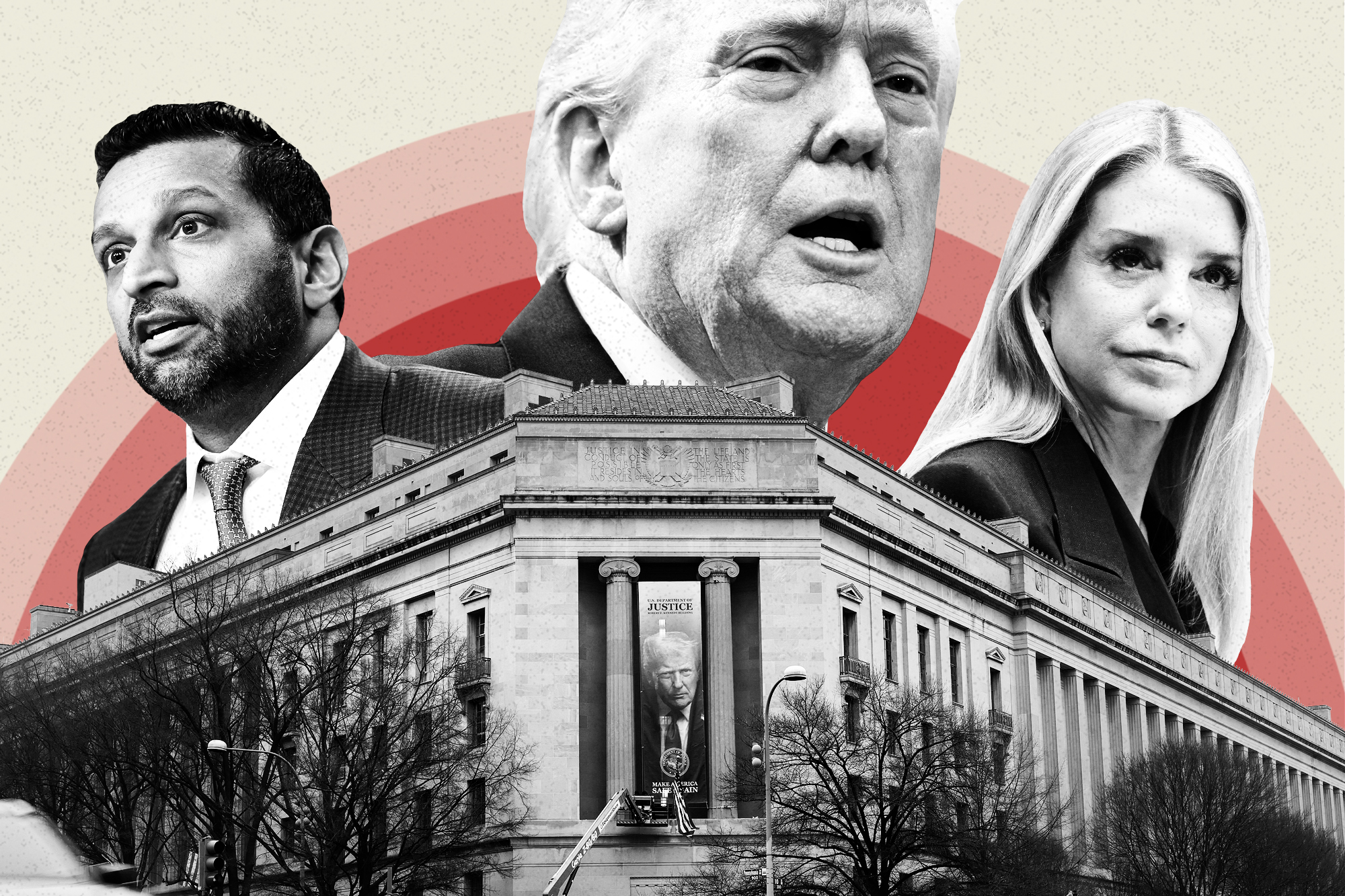
To wit: Attorney General Pam Bondi hung a banner with Trump’s picture on the department’s headquarters in a theatrical expression of her singular commitment to the president and his impulses. Days later, FBI Director Kash Patel — once accused by former colleagues of being dishonest, immature and unsuited for a top law enforcement post — was spotted partying in the locker room of the U.S. men’s Olympic hockey team in Milan. Back in Washington, U.S. Attorney Jeanine Pirro recently insisted at a very loud press conference that she will continue to pursue her effort to criminally investigate Federal Reserve Chair Jerome Powell after the latest setback in her effort to prosecute Trump’s political opponents. Just last week, we learned that the Justice Department is so desperate to refill its dwindling ranks that they are tossing aside longstanding practice and are now hiring prosecutors straight out of law school.
Those are a few of the most visible examples of the degradation in the culture, capacities and professionalism of the Justice Department in Trump’s second term, but the damage runs much deeper than the surface.
Thousands of lawyers have left the department since last year, and many of them have watched in dismay as Bondi, Deputy Attorney General Todd Blanche and the rest of the department’s current leadership have severely curtailed critical department functions — in the areas of national security, public corruption, white-collar crime, civil rights enforcement and more — while shifting resources to a highly unpopular immigration enforcement agenda and regularly berating federal judges, members of Congress, the media and even the private defense bar.
With nearly three years left in Trump’s term, it is hard to say how much worse things will get, but we are likely to find out the hard way. Fortunately, people are already thinking about the future.
In recent months, I have had wide-ranging conversations with a series of officials who previously served in high-level positions in both the Justice Department and the White House, and there is an emerging recognition that there will need to be a serious and concerted DOJ reconstruction effort after Trump leaves office — and that planning for that period should begin sooner rather than later.
It is a worthy conversation to begin, even if it may seem premature given the time that remains in Trump’s second term and amid other pressing matters, like the ongoing war in the Middle East. If and when there is a truly post-Trump DOJ, people will need to be ready to rebuild it.
“Former DOJ career employees and political appointees — from Republican and Democratic administrations — are deeply disturbed by what they are seeing and are invested in thinking through what rebuilding the department looks like,” said Vanita Gupta, who served as the third-ranking official in the Justice Department under Joe Biden and led the Civil Rights Division during Barack Obama’s presidency.
“This includes how to restore and strengthen the career workforce and its expertise, the national security infrastructure, and the Civil Rights Division; how to reestablish DOJ’s independence from political interference in criminal enforcement; and what policies, norms, and operational changes might be necessary to build a Department that is more effective, more resilient against abuse and corruption, and more trusted by the American people. It is not too soon to start these conversations given what’s been happening,” Gupta added.
“We’re in the middle of a full-scale assault on the Justice Department,” said Stacey Young, a former Justice Department litigator and the founder of Justice Connection, a group that has become a critical organizing and messaging hub for career lawyers who have left the department under Trump or who are otherwise worried about the direction of the DOJ. “Restoring what we’ve lost and ensuring the department is more durable than it was will be essential, and it will require far more time and imagination than it’s taken to tear it down.”
One former federal prosecutor who left the department last year has been spending some of their free time writing a memo for a potential presidential campaign or transition team that might take over in 2029. “There is no simple reversion to the norm after this sort of destruction, particularly if it continues unimpeded for another 36 months,” the draft states. The former prosecutor shared it with me and was granted anonymity because they are not authorized in their current job to publicly comment on the department.
The former prosecutor goes on to posit some reform proposals in the memo that, in their view, might address “the collapse of internal capacity (the hollowing out of expertise and ‘brain drain’) and a collapse of external legitimacy (the pervasive perception that the DOJ is acting as the president’s personal prosecution force).”
The former prosecutor is not alone. DOJ alumni across the ideological spectrum — including some who held senior career or political positions — have told me that they are ready and willing to come back to the department to set things straight after Trump leaves office.
Already, it is clear that DOJ reform would need to be multi-faceted.
Ideally, it would be retrospective in critical respects, in order to identify and publicly rectify potential misconduct (for instance, what Democrats have described as deliberately violating the Epstein files disclosure law) and to assess the full scope of the institutional damage by that point.
But it would also be prospective — focused on rebuilding the department’s diminished resources and capacities, and perhaps using the opportunity to implement new policies and priorities in areas that were already under-resourced and strained (in areas like white-collar crime, financial fraud and many others).
There are other potential benefits to an early effort like this as well. It could clarify for many Americans what the full implications of the Trump administration’s legal positions really are; provide something of a rallying point for a public that appears to have taken notice of the department’s degradation (Bondi’s net favorability rating is -25, according to a recent Economist/YouGov poll); and perhaps even dissuade some Trump-supporting Republicans from providing political cover for the administration’s effort to restructure and reduce the department’s law enforcement work across a broad swath of areas both domestically and internationally.
“It’s not premature to remind Americans that Donald Trump will not be the only president — that there will be a Democratic president in the future,” Neera Tanden, the veteran Democratic White House hand, told me. She added that Democrats had already begun thinking about how “some of the powers that have been claimed by the president and sanctioned by the Supreme Court” could be used “to actually reform the government to serve people better.”
“If you can destroy an agency,” she said, “you can certainly make an agency serve people better.”
There are already several whole-of-government reform projects that have been announced on the left, though it is not clear how deep those efforts will ultimately go on DOJ reform specifically.
In a nod to the conservative Heritage Foundation’s Project 2025, which has been a blueprint for Trump’s second term, there are two different Project 2029s. One is a volunteer-driven effort that is currently focused on developing high-level proposals for a future Democratic administration; the other is a separately run initiative announced more recently that is being led by a former Biden White House aide and seems likely to garner party support.
Late last year, an organization called Government Renewal launched, though it is focused on improving government operations and the delivery of government services. Shortly before that, Democracy Forward, the progressive legal advocacy group that has risen in prominence in Trump’s second term, announced its own initiative — Democracy Works 250 — which intends to draw on the experience of former career government officials to develop new policies that are also responsive to public input.
“The work to reform and reimagine a post-Trump Department of Justice must start with listening to the people — Americans who rely on the department to keep our communities and our rights protected, and former career civil servants who have been the backbone of the nonpartisan, independent work of the department,” said Skye Perryman, the president and CEO of Democracy Forward.
And more groups may be in the offing. Particularly as Washington’s focus shifts to the 2028 presidential campaign, a host of Democrats, progressives and anti-Trump conservatives will be eager to craft plans for DOJ that could be quickly implemented if they win back power.
It is not hard to spot some potential agenda items for a reform project — both small and large — even now.
For starters, take down that ridiculous banner, which has been rightly pilloried across the political spectrum for evoking the sorts of anti-democratic regimes that most Americans hate.
Patel, who never should have gotten the job in the first place, should also be removed immediately, assuming he lasts that long. There will be much to uncover from his tenure, including how he has potentially undermined vital law enforcement functions (like counterintelligence, among others); how he has abused his authority to do things like fire agents for partisan political reasons; and how much taxpayer money he may have wasted on things like security details for his girlfriend.
Some DOJ components and U.S. Attorney offices may be so thoroughly diminished that they might need to be reconceived and rebuilt with the involvement of alumni, though doing so could provide an opportunity to strengthen those offices or functions. For instance, the Trump administration quickly hollowed out and hobbled the Justice Department office that focuses on investigating and prosecuting public corruption, but the office had already struggled for years to fulfill its mandate against the backdrop of resource constraints and the Supreme Court’s increasingly lenient jurisprudence in the area. A new approach to public corruption would make good sense.
There are plenty of other items that could be rolled into this effort. The department should determine, for example, which prosecutors presented cases to grand juries and were no-billed — the once-rare and now increasingly common situation in which grand jurors decline to approve proposed charges in an indictment — and whether they tried to bring transparently meritless cases for political reasons. If abuses like that have happened — and there is already evidence of that, particularly given the failed effort to prosecute Democratic members of Congress — prosecutors should face appropriate professional consequences.
The department should also determine if Justice Department lawyers intentionally misled judges in the increasingly large number of cases in which federal judges have directly questioned their honesty or factual representations — a possible dereliction of one of the most basic ethical duties that lawyers owe to the courts.
Then there is perennial low-hanging fruit — like, for instance, including questions about financial fraud in the department’s annual survey of crime victims.
The survey covers violent crimes and basic property crimes, but it does not ask people about financial fraud, even though the limited data that is available on crimes like crypto scams and identity theft suggests that the problem has gotten steadily worse over time and that it will get even worse if the government continues to leave it largely unchecked. I am biased given my own background in prosecuting financial fraud, but I sincerely view this as one of the most serious and consequential law enforcement battles of the 21st century — one that directly and severely affects some of our most vulnerable communities, including the elderly, and that requires the sort of international law enforcement cooperation that has been severely compromised under this administration.
These are just some possible ideas, but there is a very large community of former federal law enforcement officials who are keen to come back and fix the department, including former career officials I have spoken to who were unfairly pushed out in the last year but retain their commitment to the public good and to the highest values of the department.
A separate intellectual project may be necessary to deal with legal accountability for Trump administration officials and Trump himself. Doing so will be difficult when it comes to the president, though perhaps not impossible, given the already-very-poorly-aged Supreme Court opinion issued by the Republican appointees in the middle of the 2024 election campaign that provided Trump with criminal immunity. The public may want — and certainly deserves — an effort to address the potential criminal misconduct of the current administration, in the DOJ and elsewhere. (The last Justice Department, led by Biden Attorney General Merrick Garland, historically bungled this effort in ways that were obvious in real time.)
In the meantime, a large contingent of former federal law enforcement officials remains both dismayed and eager to jump back into action.
“To live up to its name,” Young told me, “the Justice Department must be apolitical and impartial — and career DOJ professionals, who worked there for years across administrations, are the ones who can speak most credibly to what an apolitical and impartial Justice Department should look like.”
“They understand DOJ’s structural weaknesses that led to where we are,” she added, “and they know best how to repair these structural weaknesses so they can never again be exploited by a president who believes he is the law.”