On the unseasonably hot evening of Oct. 2, 1986, a rented bus pulled up to a party on Capitol Hill. Inside, the fare was modest: cheese, crackers, canned Miller High Life. “The style — informal and relaxed — fit the man the New Jersey State Society gathered last night to honor,” reported the one journalist on hand, David R. Palombi of Allbritton News Service.
Around 6 p.m., after a bus packed with lawyers had barreled down the Jersey Turnpike, the man of honor arrived: Antonin Scalia, the Trenton native freshly sworn in as the 103rd justice of the United States Supreme Court, with his wife Maureen. Smiling and shaking hands as he clutched his pipe, Scalia, still black of hair and slender of frame at 50, embodied the American Dream: the son of a Sicilian immigrant father and first-generation Italian American mother who vaulted, through innate genius, hard work, devout Catholicism and Tri-State charm, to the top five at Harvard Law; senior legal positions in the Nixon and Ford administrations; law professorships at the University of Virginia and the University of Chicago; the appellate bench; and finally, the pinnacle of his profession, the Supreme Court, where he was the first Italian American justice.
Though Scalia hated Trenton — had always professed his love, instead, for Queens, where he moved as a child — the attendees smothered him with Garden State gags and gifts: a basket of Jersey corn and tomatoes, a brass paperweight shaped like the state, the state flag and — from the Trenton Times newspaper, presented by Republican Rep. Chris Smith — a photograph of the town’s bridge, with its famous sign reading TRENTON MAKES, THE WORLD TAKES.
The justice pronounced himself “truly touched” that the crowd of 150 had come out to meet him. “One of the unexpected phenomenons of getting this appointment,” he said, “was how many people were happy for me, proud of me. I hope I don’t let any of you down.”
Just before 8 p.m., the Scalias ducked out. The justice’s hand was “a little tired” from the receiving line and besides, the week to come — Scalia’s debut at the Marble Temple — demanded his attention. “Go home,” he replied when asked his plans. “I have 20 tough cases for next week and I have all the briefs to read.”
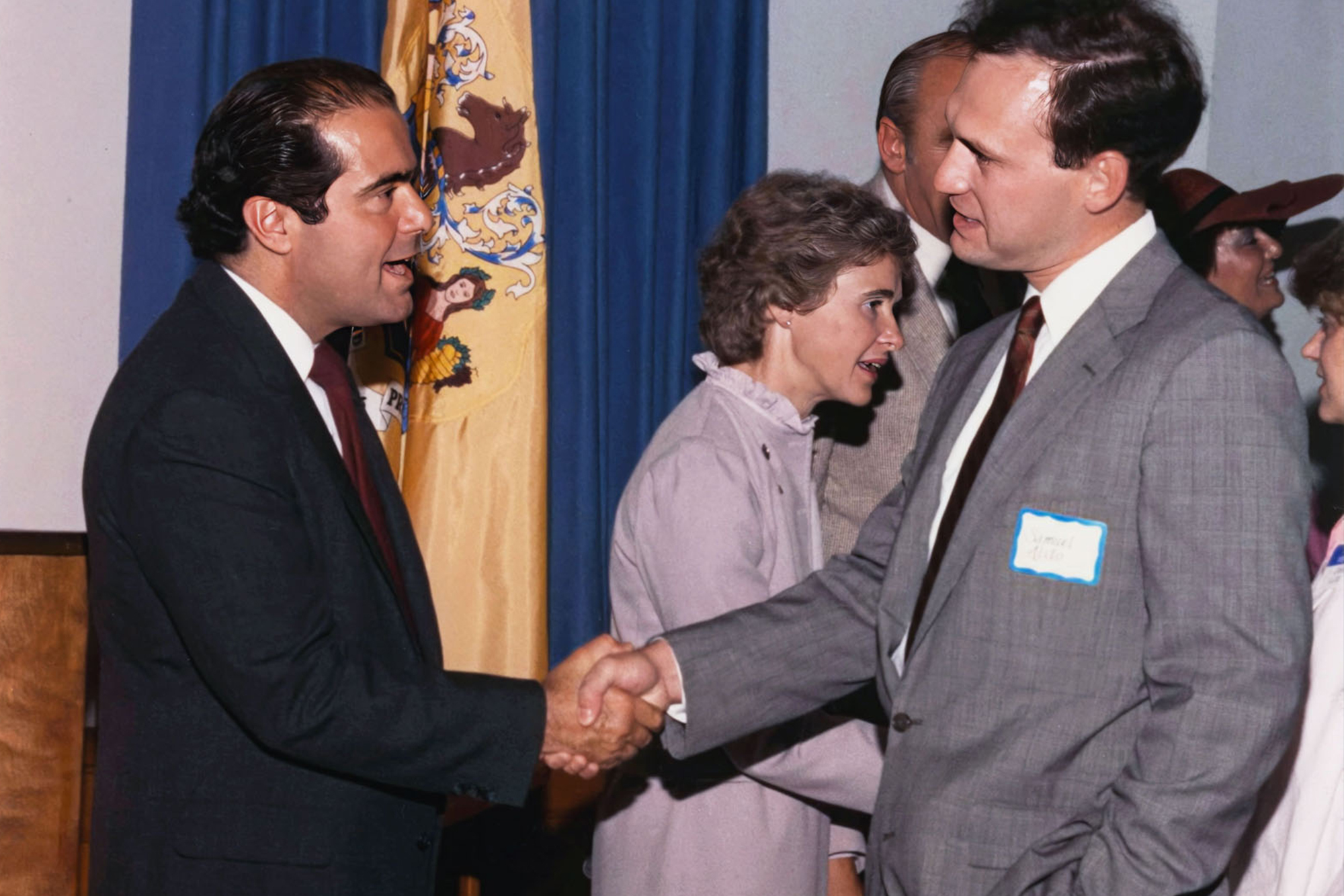
One of the Tri-State lawyers who waited in line that night was a 36-year-old fellow Trentonian and Italian American, a graduate of Princeton and Yale Law with brown, frizzy hair, and taller than the justice. He wore a grey suit, maroon-striped tie and a lapel sticker, white with blue trim, reading: SAMUEL ALITO.
A framed photograph of that handshake hangs today in Alito’s chambers at the Supreme Court. There, on a sunny afternoon last February, dressed in shirtsleeves and another maroon-striped tie, a silver-plated Art Deco belt buckle, charcoal slacks and brown dress shoes, the 110th justice welcomed a reporter warmly, if a bit shyly.
An hour was allotted for us to discuss Alito’s late friend and colleague for my forthcoming book on the man known to intimates as Nino; in the end, we spoke for 90 minutes. It was when I asked about their first meeting that the justice alerted me to the framed picture high above us.
Nearly a decade had passed since the world awakened, on Feb. 13, 2016, to the shocking news that Scalia had died in his sleep during a hunting trip in the wilds of West Texas. As we met, Alito was marking his twentieth term on the court — the same length of time Scalia had served when Alito joined him at the Temple in 2006 as the nation’s second Italian American justice.
Though critics depict him as a prickly, unhappy character, Alito flashed a ready smile and acceded to all my requests: to move my large leather chair closer to his; to remove a pillow from it; to close the heavy wooden door, with its giant gold doorknob, for better audio; to clip a microphone to his tie; to place my digital recorder in an outbox on his desk, standing up, so I could see its red light. “I thought I would put it in my pocket,” he said, “but okay.”
When I remarked that he had spent 20 terms on the great mahogany bench down the hall, Alito joked: “Don’t remind me.” Over those two decades, I observed, what had probably always been a certain level of craziness associated with the job had metastasized to the point where, as I said, “I feel for you.”
The justice nodded in agreement. I hadn’t expected this observation to lead directly to discussion of Scalia and his legacy, but Alito’s reply began: “Even since Nino died, things are so different. I so often wish he were still here. He started so much and it would have been good to have him around to see it to completion.”
Conservatives now boast a 6-3 majority on the court and are reshaping the law for a generation, but Scalia almost certainly wouldn’t have been happy to see how American politics have grown coarser and more polarized than ever before. One of Scalia’s children, I related, had told me she felt grateful to God for taking her father at that moment because it spared the principled originalist, a celebrant of Latin Mass and the American Founding, from witnessing so much that would have upset him.
“He would have been appalled at so much,” Alito agreed.
Asked if he will ever publish a memoir, Justice Alito said maybe. “I don’t know how interesting it would be. My story is not comparable to Clarence Thomas’, for example.” I suggested that the most colorful chapter would be the one covering the years he spent fighting crime in New Jersey, as an assistant U.S. attorney and, later, U.S. attorney. “Oh, yeah,” he replied. “We had fascinating cases.” Then, a bit of the puckish humor for which, as a public figure, Alito isn’t generally known: “There’s no shortage of crime of all varieties in New Jersey.”
I wondered about the similarities between Scalia and Alito — sufficient to spawn the nickname, phonetically clever and substantively challenged, Scalito — and the degree to which the younger lawyer looked up to the pioneer.
Rosen: Was it at all a thing for you when [Scalia] was nominated to the Supreme Court, the fact that he was the first Italian American?
Alito: Yes, it was. And it was for millions of Italian Americans. And you can see that in the reaction within the Italian American community to his nomination. Italian Americans, unlike, let’s say, the Irish, were never a particularly cohesive voting bloc. … But everyone was united behind this because it really did represent the opening of a door, symbolically. … He was the antidote to the stereotypes about Italian Americans … prevalent at the time, and [which] continue to this day. If you look at the Italian American characters in, let’s say, movies and on TV, you’ve got the gangsters and the criminals, and then you have kind of the low — the dumb buffoons. So you look at the character that John Travolta played when he was in that — what was the TV show?
Rosen: “Welcome Back, Kotter.”
Alito: Yeah, “Welcome Back, Kotter.” Or Tony Danza in —
Rosen: “Taxi.”
Alito: “Taxi.” Or Henry Winkler in — what was it?
Rosen: “Happy Days.”
Alito: “Happy Days.” You know, that’s the way people, a lot of people, thought about Italian Americans. You know, maybe they could sing and Joe DiMaggio was a good athlete. … But somebody who was a serious intellectual, that was something. And that was a real antidote.
Rosen: Was that something the two of you ever discussed?
Alito: No. It actually wasn’t. … As you suggested, I think Nino was proud of being an Italian American, but I don’t think he saw himself [that way] chiefly.
Rosen: I think he had an aversion to identity politics, which was gathering steam in this era.
Alito: Yeah … That was definitely true. And there were a lot of Italian Americans who thought that way. My father was that way. And he was proud of being of his Italian heritage but … if somebody ever asked him about his national origin or something like that, he would say, “I’m an American.”
When President George W. Bush nominated Alito to succeed the retiring Justice Sandra Day O’Connor in October 2005, Alito was serving his 16th year on the Third Circuit Court of Appeals, to which he had been appointed by the president’s father. Besides this long experience on the appellate bench, Alito’s credentials for the Supreme Court were indisputable: He had previously served not only as a top federal prosecutor but as a senior Justice Department official, including stints in the Office of Legal Counsel — incubator for William Rehnquist and Scalia — and in the office of the U.S. solicitor general, the department’s third highest-ranking official, responsible for managing its litigation and representing it before the high court.
That the Senate confirmed Alito 52-48 along sharp partisan lines provided an early reminder of how dramatically Washington had changed in the generation since Scalia was confirmed, in 1986, by a vote of 98-0. That unanimity, of course, was achieved in part because the Reagan administration chose to pair Scalia’s nomination with the much more contentious elevation of Rehnquist from associate justice to chief justice. The ugly Senate hearings, dubbed “The Rehnquisition” by Republicans, culminated in confirmation by a vote of 65-33 — then the highest negative tally ever for a confirmed Supreme Court nominee.
Reminded of all that, Alito said the Rehnquist margin would be considered a landslide today. “I wonder if we’ll ever see that again,” he mused.
Over 20 terms, Alito has forged an enduring jurisprudential legacy as a self-described “practical originalist.” His 2010 majority opinion in McDonald v. City of Chicago, which held the Second Amendment right to keep and bear arms applied to the states through the Fourteenth Amendment, was a landmark in firearms-ownership rights. In 2014 in Burwell v. Hobby Lobby Stores, Inc., Alito led a 5-4 court in upholding the right of a family-owned corporation, operated under Christian values, to withhold insurance coverage under the Affordable Care Act for a female employee’s use of contraception. And in Janus v. AFSCME, Inc. in 2018, Alito led another 5-4 majority in ruling that the First Amendment prohibits public sector unions from compelling non-members to pay certain union fees in a major defeat for organized labor.
Soon to turn 75 when we met, Alito was keenly aware that despite his long record on the bench, his legacy is now defined, and forever will be, by a single piece of writing: his 2022 majority opinion in Dobbs v. Jackson Women’s Health Organization, in which the court voted 6-3 to overrule Roe v. Wade, the 1973 decision that had enshrined abortion as a constitutional right. Dobbs returned regulation of the practice to the states. The ruling’s historical significance was only enhanced by the unprecedented publication of Alito’s draft, reported nearly eight weeks before the decision was released, by POLITICO.
Among the “so much” that Scalia started and which Alito wishes he had seen to completion, Dobbs figures centrally.
In December 1978, Scalia, then a professor at the University of Chicago Law School and scholar in residence at the American Enterprise Institute, participated in a videotaped debate, staged by AEI and aired on PBS stations for more than a year, entitled “Imperial Judiciary: Fact or Myth?””
The episode featured a pointed exchange between Scalia, 43 at the time, and the executive director of the American Civil Liberties Union, Ira Glasser, a formidable liberal opponent.
In their discussion of judicial activism, a phenomenon newly discerned, the panelists turned to lower courts’ imposition of mandates and timetables on administrative entities. Without that, Glasser argued, all kinds of corrupt institutions — prisons, mental hospitals, foster homes — would deprive innocent victims of their rights. Scalia’s counter-argument brought his first public comments on abortion.
“You can speak very facilely of rights. Where are there rights and where are there not? That is another judgment that the courts have been increasingly willing to arrogate to themselves,” Scalia said.
“In the abortion situation, for example, whether, indeed, the right that exists is the right of the woman who wants an abortion to have one, or the right of the unborn child not to be aborted — who knows? In the past that was considered to be a societal decision which would be made through the democratic process. But now the courts have shown themselves willing to make that decision for us. That’s, I think, the major objection that most people have with the direction in which the courts are now going, and the major reason why many people believe it is indeed an imperial judiciary.”
It was not until Webster v. Reproductive Health Services in 1989, however, that Scalia ruled substantively in an abortion case. His partial concurrence is best remembered today for its declaration that O’Connor’s writings in the case, muddled and contradictory of her previous rulings, “cannot be taken seriously.” That cutting remark permanently ruptured Scalia’s relationship with the first female justice.
But reread today, in tandem with his 1992 concurrence and dissent in Planned Parenthood of Southeastern Pa. v. Casey, Scalia’s writing in Webster emerges as an originalist roadmap for the day, two decades hence, when a different, more conservative Supreme Court was prepared to overrule Roe. Alito confirmed as much to me.
Rosen: Is Dobbs indebted to Antonin Scalia in any meaningful respect?
Alito: Yes, absolutely, because that was my effort to write an originalist’s opinion. … I think I learned from the model of [District of Columbia v.] Heller [the landmark court ruling, authored by Scalia in 2008, that upheld the Second Amendment right to own a handgun]. I don’t know that Nino would have written [Dobbs] any differently. I flatter myself to think that he wouldn’t have written it very differently. And the language, to a degree, may be influenced by him.
Rosen: I mean, certainly, you were familiar with his [opinions] in the previous abortion cases, like Webster and Casey, right?
Alito: Right, right.
Rosen: Is there a direct line to be drawn, in some sense, from those [opinions] to Dobbs?
Alito: Yeah, there is, because he made the case. And I think he was right.
After our interview, we repaired to the far corner of his office, which included a view of the Capitol and a bookcase shrine cluttered with Philadelphia Phillies memorabilia: signed balls, framed trading cards, a letter from the great pitcher Robin Roberts. I asked who Alito’s baseball hero was growing up, and he pointed to a photo of himself, taken when he was a 43-year-old appellate judge and decked out in a Phillies uniform, next to the Hall of Fame center fielder Richie Ashburn, at Phillies Phantasy Camp.
When I mentioned that my baseball hero was Tom Seaver, the power pitcher who lifted the New York Mets from lovable losers to World Series champions, my host replied with a comment that he might have applied to Scalia, as well.
“They don’t make ’em that way anymore,” Alito said.