
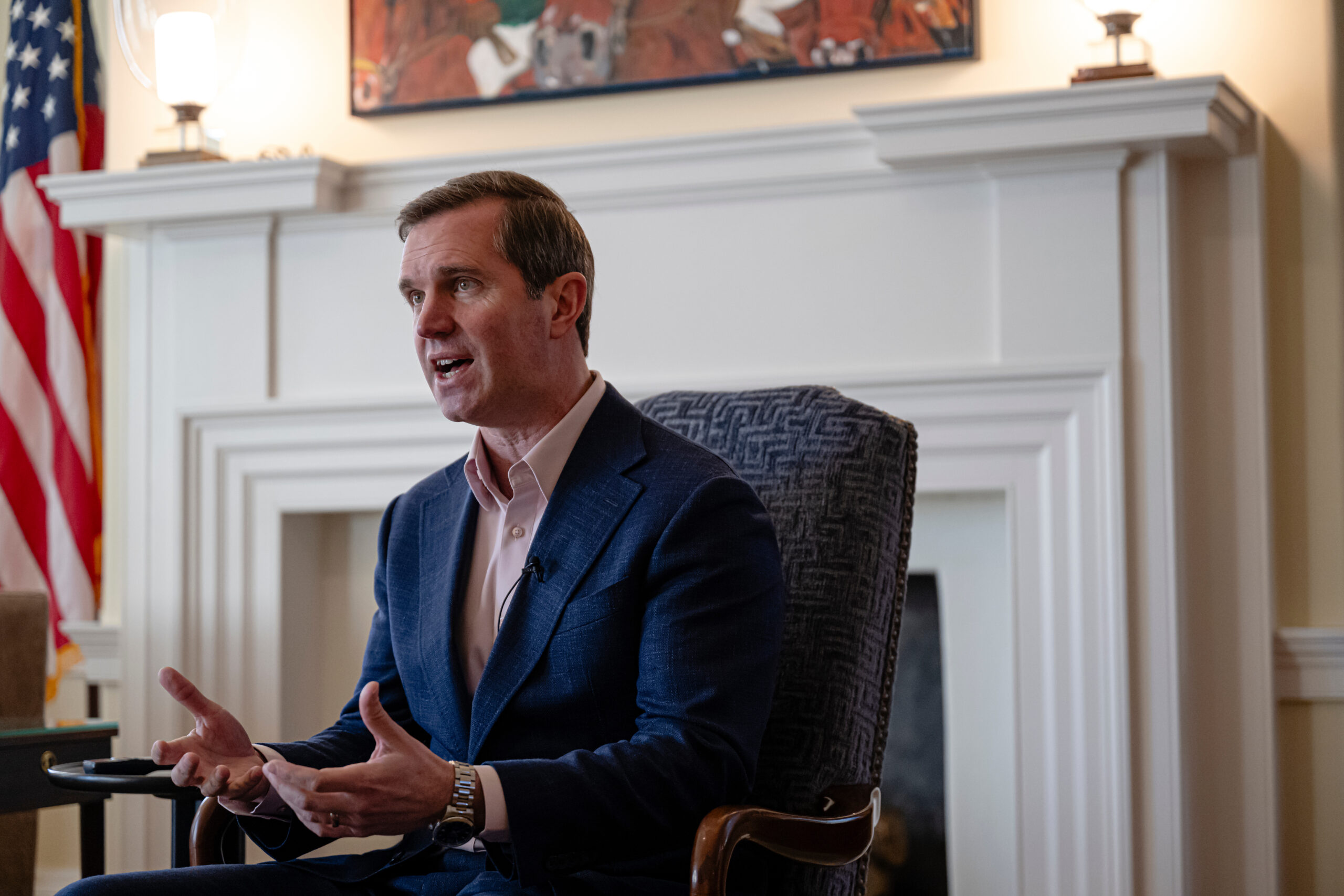
Kentucky Governor Andy Beshear is a rare bird: He’s a Democrat leading a deep red state.
Despite these highly partisan and polarizing times, he’s managed to improve his margins in every election, even in 2024 when Trump won the state by 30 points. He remains one of the most popular governors in the country — and the most popular Democratic governor, according to a Morning Consult poll.
That’s all put him in the spotlight as a potential 2028 contender. Just don’t ask him if he’s running. Beshear, who heads up the Democratic Governors Association, says his only focus for 2028 is “changing the map” and getting more Democratic governors elected across the country.
And while many Democrats may be pointing fingers at each other as part of the party’s soul-searching journey, Beshear is uninterested in such infighting. It’s the current administration that should be scrutinized, he says, particularly JD Vance, who he thinks “could be more damaging than Trump.”
He has a bit of advice for his fellow Democrats to make inroads in 2026 and beyond: “Don’t just talk about your policy points. Talk about your why. People really want to know why are you willing to march into the toxicity of politics right now? They want to know what drives you.”
This interview has been edited for length and clarity.
I want to start with some of your recent comments about Vice President JD Vance that are raising some eyebrows. You said, “There’s no one who will work harder, no matter what I’m doing that year, to beat JD Vance in 2028.” You’ve also previously called the vice president “the most conceited elected official [you’ve] ever heard speak and “incredibly condescending.” Governor, you’re known for being able to play nice with just about anybody, so this seems a little personal.
Well, JD Vance looks down on rural America. He did it in his book where he called the people of my state lazy, blamed them for poverty, even blamed them for the opioid epidemic that has taken so many lives in Kentucky. His administration’s policies also look down on rural America. The big ugly bill threatens to close 35 rural hospitals in my state; lay off 20,000 healthcare workers; kick 200,000 Kentuckians off their coverage. And when the largest payroll in a community shuts down, which is that hospital, the coffee shop closes, the restaurant closes, the bank closes, the insurance company closes. Look at their tariff policy and what it’s done to soybean farmers in my state and others. This is a guy that thinks he is better than everyone else, but his policies are certainly the worst we’ve seen.
Have you talked to Vance in person at all?
I spoke to him many, many years ago. He was an investor in a company in Kentucky. Of all things, me, him and Martha Stewart were in the same room.
What did you find at that time when, you know, he was obviously in a very different position?
This is a guy who’s changed his name multiple times and talks about his childhood as his origin story. JD Vance has reinvented himself multiple times in the pursuit of wealth and of power. So the person that I talked to that day isn’t even close to the person that we see in the vice presidency today.
Wow. That’s fascinating to hear. I mean, you’ve said you’re concerned that Republicans will put up someone in 2028 who is “more scary and damaging than Trump.” Does JD Vance fit that mold in your eyes?
Look at what he is doing around the world. He is insulting our European allies repeatedly. He is flirting with the far right in many of these countries, which is incredibly dangerous. Here at home, he even talked down to our troops when talking to them at Thanksgiving. This is somebody who doesn’t listen to anyone, thinks he has all the answers, and that’s really dangerous in governing.
More damaging than Trump, you think?
I think he could be more damaging than Trump. When I say he’s the most conceited politician that I’ve ever heard, that’s something, given his boss and his self-absorption. But my point is that we talk about Trump a lot, but this is the Trump-Vance administration. Yes, Trump isn’t letting Vance put his name on any buildings in Washington D.C., but that big, ugly bill and the impact it’s going to have on rural healthcare, that’s on JD Vance, too. The tariffs and the fact that 90 percent of them have been paid by Americans and American businesses, that’s on JD Vance, too. This war with Iran that he doesn’t have the courage to say out loud he still disagrees with has gas up more than a dollar; that’s on JD Vance.
I’m sure you’re tired of hearing this, but for those who don’t know, you are the most popular Democratic governor in the country in a state that President Trump won by 30 points in 2024. And you’ve actually been winning your elections by wider margins every time. How are you advising Democratic candidates in red states like Iowa, like Ohio to make their case to Trump voters?
Yeah, I was with Amy Acton, who’s going to be the next governor of Ohio, last night. I was with Rob Sand, who’s going to be the next governor of Iowa, about a week ago.
You sound confident.
I am because I think Democratic governors are going to win races that people aren’t expecting because we do what Republicans can’t: We govern well. In Kentucky, we’ve broken every record from job creation to private sector investment. We had the highest wages for new jobs in our history last year at almost $30.00 an hour. So while the American dream is slipping away in some places, not where I live. We’re fighting for it, as are all our Democratic governors.
So what are you telling those folks in Iowa and Ohio?
Number one, I stand up for all my convictions. I fight discrimination in any form. But I spend 80 percent of my time on things that matter to 100 percent of the people of Kentucky and the American people. It’s that idea that when people wake up in the morning, they’re not thinking about the next political race. They’re thinking about their job and whether they can afford what their family needs. That not only helped me win early on, but it’s helped me govern. People know that they might disagree with me on one or two things, but if I spend 80 percent of my time on the things that matter most to them, I don’t move a state or a country to the right or the left, I just move it forward for everyone with no one being left out. The second thing I try to do is just talk like a normal human being. The Democratic Party at different times has talked at and not to people. It’s even talked down to people, which is wrong. Our words have to have meaning.
But the third thing is the most important, especially in this age of social media. Don’t just talk about the what. Don’t just talk about your policy points. Talk about your why. People want to know you. They want to know what drives you. And the why has to be authentic. For me, my why is my family and my faith. It’s the golden rule that says I love my neighbor as myself and the parable of the good Samaritan that says that everyone is my neighbor.
You know, there’s been this debate among Democrats since 2024 about whether the party should move more towards the center on certain cultural issues like transgender athletes in sports. You actually vetoed a bill in 2022 attempting to ban trans youth from girls’ sports. At the same time, California Governor Gavin Newsom last year called their participation “deeply unfair.” Do you think Democrats have been too quick to pivot on the trans issue?
The bill I vetoed was prohibiting all trans care for youth — all of it. What it meant was a parent wasn’t going to be able to make the best decision they could for their kids, and I know parents that are going through this with their kids. None of the decisions are easy, but they’re better being made by a parent than by a government that is trying to just shove its values on others.
But you have seen Democrats try to take some of these lessons from 2024 and talk about stuff differently. When Gavin Newsom goes and says something like, “It’s deeply unfair that trans youth is participating in girls’ sports,” is that the right tack for Democrats?
Well, I think it gets really process-y when we talk about every Democrat needing to have the exact same opinion on every issue across. People try to put you in boxes: Are you the left wing of the party? Or are you the more moderate wing of the party? For me, I’m practical. As governor, you’ve got to be a problem-solver. And so I look at the housing crisis, and I can say things that Democrats say — that we’ve got to invest more money in our affordable housing trust fund. I can say things that Republicans have said in the past — that we have too many regulations that slow it down. Both are true. If your goal is to better people’s lives and get an outcome, that practical problem-solving approach is, I think, where Democrats need to be. Democrats can have different views on social issues.
James Talarico has had a lot of enthusiasm and success talking about his faith. Do you think Democrats are eager for a candidate that can genuinely talk about religion, who feels authentic in their faith?
Yeah. Democrats stopped talking about their why. It can be your faith. It can be any faith. It can be your values. It can be how you were raised. It could be an experience that you had that changed your life. But people really want to know why are you willing to march into the toxicity of politics right now? They want to know what drives you.
And you can tell when it’s real or not. You know, when Donald Trump held that bible in the most awkward way, you knew he hadn’t read it.
I want to talk a little bit about your approach to the guy that you’ve been criticizing here, President Trump. You have some of your fellow governors, like Gretchen Whitmer, like Kathy Hochul, who’ve shown more of a willingness to work with him. You have folks like Newsom or JB Pritzker who have been really vocal critics, sort of the faces of the resistance. Do you find this sort of resistance-like mentality helpful or hurtful in countering Trump?
Well, I don’t want to criticize. In fact, I want to support all our Democratic governors that are out there because they’re doing what they think is best for their state. The way that Donald Trump is treating Michigan is different from the way he’s going after California and Illinois. And so I think each governor is doing what they think is best to serve the people of their state, and that’s our job. My approach is one where I want to maintain credibility. I criticize this president a lot. I’ve sued him 20-plus times in a state that went for him by 30 points.
But at the same time, when he does something I agree with, I give him credit for it. There’s at least one big investment that happened in Kentucky, Apple investing in Corning to build the Gorilla Glass on your iPhone. They’re going to move it almost entirely to being produced in Kentucky. It’s creating more jobs. It was a good deal that was negotiated. We shouldn’t want a president to fail.
Do you think your fellow Democrats need to do a better job of acknowledging when they do agree with the president or when he has done something beneficial to their constituents?
Oh, I think that’s good for our credibility. It’s also good for the country. The midterms are shaping up great for Democrats, which is good for elections. But the reason is that Trump is damaging the country in awful ways. And so every day I look at the poll numbers, and I think that’s great, but I look at the damage that’s occurring in each and every one of our communities, and we all wish it wasn’t happening. We wish that he wasn’t attacking the places that he did. We all wish that they would withdraw these ICE agents and actually train them like a real law enforcement agency.
You’ve been supportive of bringing data centers to Kentucky with certain guardrails. But polling is showing that voters are overwhelmingly opposing building data centers in their communities, and some progressive Democrats are now introducing legislation to put a moratorium on new data center construction until Congress passes AI regulations. Is that the right approach that Democrats should be taking on this issue?
When we look at AI, listen, we cannot let China win this race. Yes, we need to properly regulate it, and then we need the appropriate way to build out these data centers. For me, it’s really three parts. Number one, you’ve got to pay for all your power. Our bills can’t go up one penny because the datacenter’s coming in.
Number two, you’ve got to pay your fair share of taxes. What makes it worth it is if it kicks off $2 million to the school system every year — the school system that will retrain people with what AI will do, the school system that can then give raises to their teachers, the school system that can provide the very best education. It’s worth it if it kicks off a couple million dollars to the county that can then provide the types of services that people need at a lower rate. It’s worth it if it kicks off tax revenue to the state where we can work on that next economic development project that will bring in those extra jobs. And then, I think the last and most important piece is a lot of the problems that are out there are driven by speculators and developers and not necessarily the end users. End users need to walk into these communities and start a relationship. They need to convince people of the good that’s going to be done and that they’re not just going to be some building on the edge of town, that they are going to be a real part of the community.
Do you think Democrats should be embracing AI more? Should there be a shift in thinking about this?
We need to appropriately regulate it. I agree with everyone who is talking about that on both sides of the aisle. But it’s coming. It is coming. And so we can either do it correctly or we can do it incorrectly. This is going to change our lives significantly, maybe even fundamentally. And I want to make sure that we have the resources that are in place to be ready to address those changes. This’ll be the world that my kids are growing up in, and I want to make sure we’re ready for it.
I do want to ask you about the war in Iran. I know this is personal for you. Two of the U.S. servicemembers killed were from Kentucky. Both parties have failed to solve the Iran problem for decades. The White House says they tried diplomacy; it didn’t work. Fundamentally, do you think the United States is safer today with a weakened Iran?
Number one, the American military is exceptional. There is no other like it in the world. And while we can disagree with those that give the orders, we need to be supportive of those troops, and we need to be supportive of the families of the troops we’ve lost. When you’re a president and you come into a state like Donald Trump did, where at that time we had lost one individual, and you’re doing a press conference for any reason, just please say his name. That family deserves that respect. I think the other thing that we have to say is that the Iranian regime has murdered thousands of its own people. They had sponsored terrorism that had murdered thousands of people around the world. And I don’t feel sorry for the regime whatsoever. But if you are going to take a country to war, number one, you have to have a real justification, not one that changes three or four times in the first three or four days. The second thing you’ve got to do is have an imminent threat. What pushes you from diplomacy to use of force? This president seems to want to start with use of force to ultimately help diplomacy. The third thing you’ve got to do is actually plan for it. Plan for it in a way that Americans abroad can get home in time. Plan for it in a way where we’re not watching our allies sending planes and hearing our own leaders say, “Oh, we didn’t think about it.” Plan for it in a way that the strait would not be closed and gas prices would not be going up. Plan for it in a way that you know what victory looks like.
And on top of it, if you’re going to take America to war, have enough respect for the citizens of our country and the troops to talk about it to the American people. The American people don’t appear to be for this war at all, and a president should show them enough respect to talk to them about it. That and you’ve got to go to Congress. War is a big enough thing that at least two branches of government have to be communicating about it. So I have a lot of concerns.
I was struck by something that Democratic strategist Liz Smith recently told the New York Times. She said, “Too many Democrats when something like this happens default to playing legalistic hall monitor and complaining about how Donald Trump didn’t fill out the right paperwork before launching strikes. That’s technically true and important, but that’s not at all a persuasive argument,” she says. Do you see her point?
Oh, I definitely see her point. And that’s why, you know, you start with you’ve got to have a justification, and not one that changes or that you’re making up along the way. You’ve got to have a plan for what victory looks like. You’ve got to actually understand the situation that you’re in.
Let’s stay in the Middle East for a moment and talk about Israel. A majority of Democrats now view Israel negatively. It’s been a dramatic shift since the October 7 attacks. Your spokesperson recently told POLITICO, “AIPAC has never contributed to Governor Beshear and they’re never going to — ever.” Do you think other Democrats should be taking AIPAC money?
First, Israel has the right to exist as a democratic country, as a Jewish country. It is an important ally of the United States, and my feelings towards the country and its people are not negative. Now, my feelings towards Prime Minister Benjamin Netanyahu and President Trump about how they could have lessened the suffering in Gaza, about their actions in this war with Iran, that’s a different thing. I believe the United States needs a strong Israel, but not one with decisions being made in the way that Netanyahu is making them.
Yeah, some of your fellow Democrats have called Israel’s actions in Gaza genocide. Do you agree with that?
That’s becoming one of those new litmus tests that we said we would never do as a party again. It’s trying to throw out a word and, “Are you going to raise your hand or are you not going to?” I understand that Israel was hit with a terrorist attack the likes of which it had never seen and it has been through a lot and that it deserves the right to defend itself and to eradicate that terrorist organization. I believe that it could have been done without a lot of the suffering, but I put a lot of that blame also on Donald Trump. If he’d said we are coming in and we are bringing food and aid and you are going to make sure that we’re safe, it would’ve happened.
Back to the AIPAC question, should Democrats be taking money from AIPAC?
I think that’s up to each and every Democrat, and they can own who they take money from or who they don’t. In the end, I think people need to be clear about their stance on these issues. And for me, it’s one where I believe that we need a future with an ally in Israel. But we need decision makers there that are not acting the way that Netanyahu is and we need a president that will push when we are seeing humanitarian crises to actually do something about it.
Your time as governor is up next year. I won’t bore you with the “Are you going to run?” question, but I will ask what questions do you still need answered before you make that call?
You know, the only thing I’m thinking about ’28 right now is changing the map. It’s not about flipping the House seat in Des Moines, which we have to do because we’ve got to take back the House. It’s about flipping the governor’s mansion in Iowa. So, how possible this is for a Democrat, I think, depends on how well we do in these governors’ races this year. I will say I think the 2028 candidate should be one of our Democratic governors because people out there are going to be feeling betrayed. Donald Trump said he’d get them results and didn’t. He made life harder. We, the governors, have receipts. We can show you where we built affordable housing. We can show you the wages for the jobs we’ve brought in. We can show you the real things we’ve done to help with public safety, not the stunts that this president does.
Should it maybe be a governor of a red state?
Well, I think there are advantages to that.
Such as?
If you can win in a Trump plus 31 state, you ought to be able to win the purple state, too. We’ve got a lot of great governors. I think you’re going to see a lot of them on the stages. I just want to make sure that whoever’s next can bring this country together, can reduce the division that’s out there, but then actually get real results for the American people — that hopefully can be that person who reignites the American dream.
If we lose the American dream, we lose a lot of what makes the United States exceptional. And while I know the American dream hasn’t always been available for everyone, we ought to keep pushing for that.