MIAMI — In David Oscar Markus’ penthouse office, the wall is lined with framed images of the fictional wrestler Rocky, Bernini’s statue of David, Jackie Robinson sliding into home plate and Yoda — all an homage to the lawyer’s affinity for the underdog.
He counts Ghislaine Maxwell, the accomplice of the late sex offender Jeffrey Epstein and Markus’ client, among them.
“I think she’s a scapegoat,” he said in an extended interview last month. “She would never have been prosecuted had Jeffrey Epstein not committed suicide, or whatever, however he died.”
Markus — a career criminal defense attorney and a disciple of lightning-rod lawyer Alan Dershowitz — is at the center of an ever-growing and inescapable political scandal over the Epstein files, which has distracted Congress for months and served as a perennial cudgel against President Donald Trump’s White House.
Perhaps no one has as much knowledge of Epstein as Maxwell, his longtime girlfriend and the onetime British socialite, and few people at this point have as much knowledge of Maxwell as Markus. Maxwell — the only convicted co-conspirator of Epstein — was sentenced to 20 years in prison in June 2022 on several sex crime charges, including sex trafficking of a minor. She is seeking clemency from Trump, whose relationship with Epstein has become the subject of much scrutiny and intrigue, and Markus is playing a key role in her communication with senior Justice Department leadership.
The bipartisan pressure on the Trump administration and Congress to deliver further accountability in the Epstein case, including potentially more prosecutions, has complicated Maxwell’s path to clemency and, by extension, Markus’ mission. It could also serve as leverage in Maxwell’s quest to get out of prison. Markus has told Congress that his client, who previously invoked her Fifth Amendment right against self-incrimination when she declined to cooperate with the House Oversight Committee probe, would testify freely if she were granted clemency.
“Ghislaine Maxwell is a convicted sex offender who helped Jeffrey Epstein traffic young women and girls, and she refused to answer a single question before the Oversight Committee,” said California Rep. Robert Garcia, the top Democrat on the committee probing the Epstein case. “The idea that she deserves a pardon is disgusting and outrageous.”
“They have their own job to do, and they’re trying to make their constituents happy,” Markus said of the lawmakers investigating the matter. “I’m trying to protect my client.”
Markus declined to make Maxwell available for an interview.
Maxwell isn’t Markus’ first high-profile client. The garrulous 53-year-old attorney represented former Secretary of State Hillary Clinton when she was sued by Trump over allegations that he had colluded with Russia to win the 2016 election. (Trump was ultimately fined $1 million for what a federal appeals court said were “frivolous” claims.). He worked for former Tallahassee Mayor Andrew Gillum, when the onetime rising Democratic star was accused of public corruption (Gillum was never convicted). More recently, Markus worked for Rep. Sheila Cherfilus-McCormick, the Florida Democrat facing federal charges for allegedly stealing millions in FEMA funds. (She has pleaded not guilty and her trial is poised to start soon.) And just last month, he questioned Secretary of State Marco Rubio on the stand in a trial involving former Rep. David Rivera (R-Fla.) and GOP political consultant Esther Nuhfer, who are accused of acting as foreign agents for the Venezuelan government.
Markus’ clients have spanned the political spectrum, and he is a registered Democrat, though he sees his party affiliation in the same way that he sees his Judaism — he’s neither a practicing Democrat nor a practicing Jew, he joked.
Perhaps most importantly when it comes to choosing his cases, “I like the big stage,” Markus said.
In representing Maxwell, Markus is on one of his biggest yet. He has rare insight into a global political and legal scandal and if he’s successful in getting one of its main characters a pardon or commutation, he could reach the echelons of celebrity lawyers with famously controversial clients — revered and reviled in equal measure.
“I think there’s a lot of people like, ‘How could you like that person that’s accused of these crimes?’” he said. “And I think people forget these are people. There are very few sociopaths out there, who are just 100 percent evil. Most people have good in them, and I find that good.”
Markus was one of 50 or so law students taking Dershowitz’s fall course at Harvard Law School during the 1995 trial of O.J. Simpson, when his professor was on a team of lawyers working for the embattled former football star on trial for a double murder. Markus recalls most of his peers wondered how Dershowitz could represent the accused killer and assumed Simpson would be found guilty.
But Markus disagreed. He was rooting for Dershowitz.
“I was thinking, of course, there’s reasonable doubt,” he said.
“He and I have that in common, neither of us are trying to distance ourselves,” Dershowitz said of Markus’ readiness to engage with the Epstein scandal.
Since Epstein’s 2019 death by suicide, the Epstein case has prompted a cascade of resignations in the highest echelons of academia, government and business. Those who fraternized with the convicted sex offender or hired him as a financial adviser have been forced to answer questions about what they knew and face the consequences of association with a person at the center of the most notorious sex trafficking scandal in recent history.
Dershowitz, a former lawyer for Epstein during the financier’s 2007 plea deal for solicitation of prostitution, got ensnared himself: Virginia Giuffre, a victim of Epstein, alleged that she had been trafficked to Dershowitz. After Dershowitz vehemently denied the charges, Giuffre sued for defamation. As part of the case settlement, she said she “may have made a mistake” in her identification. Giuffre died by suicide last year.
Dershowitz has remained close to Markus, and the loyalty goes both ways.
“David also understands that we live in an age of sexual McCarthyism, where people are found guilty by association, guilty by accusation,” Dershowitz said.
Markus echoed that sentiment.
“Listen, what Jeff Epstein did was terrible, and you know, he should go to jail and the rest of it, no question about it,” he said. “The net has been cast way too wide, and there’s a lot of innocent people being — like Alan — being caught up in it.”
In the Maxwell case and others, Markus’ job, as he sees it, is to “put a check on the Department of Justice, or, as I like to say, the Department of Injustice.”
Nowadays, that puts him at odds with a professional acquaintance and former fellow criminal defense lawyer: Todd Blanche, who is the acting attorney general and a former personal lawyer to Trump. The two first met years ago at a legal conference, Markus says, and have appeared together twice on Markus’ podcast: first to discuss, among other things, Blanche’s representation of former Trump campaign chairman Paul Manafort in a state financial crimes case and again to discuss his representation of then-former president Trump in his New York state hush money case. (The court dismissed the indictment in the former case, citing double jeopardy, and Trump was convicted in the latter case.)
They would cross paths again after Trump’s team considered Markus as a potential co-counsel in the emerging classified documents case against Trump out of Florida around 2023. The team was interviewing for a local trial lawyer to join them at a time when the investigation was “a poorly kept secret,” Markus said.
But Markus’ wife, Mona Markus, and his business partner A. Margot Moss were vehemently opposed to bringing on Trump as a client, according to Markus, arguing that it would eat up their firm’s time and come to define its identity. (Mona Markus declined to comment, and Moss did not respond to a request for comment about the Trump case.) So Markus said he blew Trump’s team off for a little while.
Then Walt Nauta, who was Trump’s body man, was charged in June 2023 as part of the case concerning the mishandling of classified documents. At that point, Markus wanted to explore representing Nauta to get in on the action without representing Trump directly.
Markus and his business partner went to Doral, where Trump has a golf course, to meet with Nauta. Once there, according to Markus, a Secret Service agent interjected to tell the lawyers that the president wanted to speak with them. They were shepherded into a room where a group including Trump, his son Eric Trump, Trump’s former personal lawyer Alina Habba, another former personal lawyer Lindsey Halligan, and Blanche were on one side of a long conference table. The group discussed whether Markus and Moss, situated on the opposite side of the table, would represent the then-former president in Florida.
A second person familiar with it confirmed details of the meeting. The White House referred questions about Blanche to DOJ.
Through a DOJ spokesperson, Blanche declined an interview. The spokesperson confirmed Blanche was at the Doral meeting and said, “Todd Blanche didn’t interview or engage with Mr. Markus. He was in the room with many people who were speaking.”
The other people in attendance at the meeting either did not respond to requests for comment or declined to comment.
Markus’ firm ultimately did not represent either the president or Nauta in the classified documents matter. (Both cases were dropped after Trump’s reelection.) Markus regrets it to this day — even if his wife, kids and business partner stand behind it. After all, Markus likes a big stage.
Markus got involved with Maxwell after he wrote an opinion piece in September 2020 for The Hill criticizing the Trump-era Justice Department’s outspoken press strategy in the case. He argued that the Department’s “media machine” prejudges someone’s guilt and effectively destroys a person’s reputation before he gets the chance to defend himself.
According to Markus, Maxwell’s family then enlisted him to help with her appeal after she was forced to await her trial behind bars instead of being granted bail.
While an opinion piece may have gotten him connected to Maxwell in the first place, his loquaciousness has ruffled some feathers. In 2021, the Justice Department accused him of jeopardizing the impartiality of the jury in Maxwell’s trial by making repeated media statements and writing a piece in the New York Daily News comparing Maxwell’s case to Bill Cosby’s. (Cosby’s sexual assault conviction had just been overturned; “Bill Cosby is free; Ghislaine Maxwell should be, too,” Markus’ headline blared.)
“Mr. Markus’s comments to the media—most egregiously, the Op-Ed—were clearly in violation” of a Southern District of New York court rule relating to public statements by attorneys, federal prosecutors wrote in a letter to the judge. “Not only did his statements directly comment on the merits of this case, but they did so in a manner designed to appeal directly to the pool of potential jurors.”
Markus argued the rule didn’t apply to him because he was not currently representing Maxwell in any proceeding. But Judge Alison Nathan sided with the government and put Markus and the other lawyers on notice about the relevant court rule to protect a fair trial.
Maxwell was found guilty later that year of crimes including sex trafficking a minor and sex trafficking conspiracy. Now, almost five years later, “I have to say, I’m surprised it’s still in the news,” Markus said. “I can’t believe the legs this story has.”
In part, what has shot the case back into the public zeitgeist was the decision by the Justice Department and FBI in July to quietly announce there was no so-called client list and it would not release further information in the case. The unsigned memo stirred up outrage among the president’s base and fueled momentum on Capitol Hill to ultimately pass legislation requiring DOJ to release the Epstein files. Lawmakers continue to interview those who knew Epstein as part of their own ongoing investigation.
The Justice Department memo also prompted new questions about Trump’s relationship with Epstein, which the president has maintained ended years before Epstein’s 2019 arrest on new sex crime charges. He has also denied wrongdoing in connection with Epstein. Democrats, however, have alleged that the administration was engaging in a cover-up.
Markus, meanwhile, was helping Maxwell with her appeal before the Supreme Court, in which she had alleged that Epstein’s 2007 federal non-prosecution agreement precluded her indictment.
With the new media attention on the Epstein saga, Markus saw an opportunity. He reached out to Blanche.
“I thought it would be important, because there was so much misinformation going out there about her and about the president and about the former president, Bill Clinton,” Markus said, referencing questions around the relationship between Epstein and Clinton, who borrowed Epstein’s plane on occasion but has denied knowledge of Epstein’s crimes. “I just thought there’s just a ton of misinformation, and she could help.”
The Justice Department moved to set up the meeting between Blanche and Maxwell in July 2025. “[Markus] may have originally reached out to [Blanche], but the communications and logistics on the meeting were handled by others within the Department, including the security detail,” the DOJ spokesperson said.
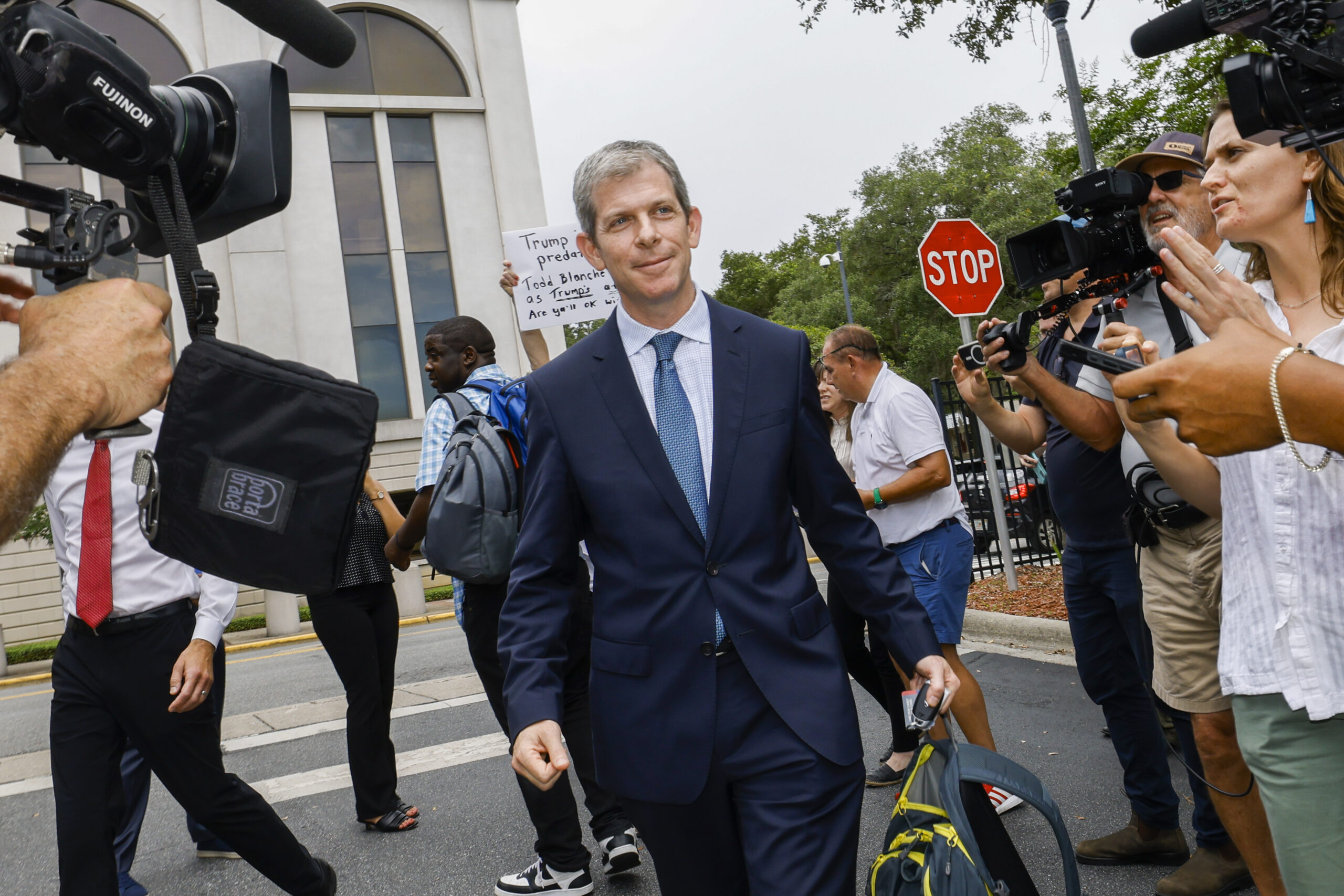
Someone leaked the plan for the meeting — Markus said it wasn’t him — and the press descended on Tallahassee, where it was to be held at the U.S. Attorney’s office. Markus, unprepared for the deluge of media, had to borrow a tie from a man at the Courtyard Marriott.
Given the location outside of the prison, Markus offered to bring Maxwell some food. She requested Camembert cheese and fresh French bread, he recalled.
“But we’re in Tallahassee and not Europe,” he laughed.
The Florida Publix did not have Camembert cheese, and there was no French bakery in Tallahassee. But he picked up some fresh bread and Brie, which seemed like “the greatest meal she had ever eaten in her life,” Markus said.
Over the course of the two-day meeting, Maxwell said she did not witness Trump in any sort of inappropriate setting and “admire[d] his extraordinary achievement in becoming the President now,” according to a transcript of the interview with Blanche that was released publicly. She was granted limited immunity so that her remarks would not be used against her, including an exception for false statements.
Afterwards, Maxwell was moved to a minimum security prison camp in Texas, where Theranos fraudster Elizabeth Holmes is also serving her time. Democratic lawmakers questioned whether the transfer to a facility some perceived as less harsh was a reward from the administration.
Markus denied that the move was a kind of quid pro quo. “She was being threatened after the meeting — the prison itself raised concerns that they were really concerned about her safety,” he said. “The question was where can we get her that was safe.” At the time, Blanche also said the move was over security concerns.
Blanche’s direct involvement in the Maxwell meeting in Tallahassee, as the No. 2 Justice Department official at the time, prompted further concern among some legal observers.
“The whole structural relationship between Blanche and the DOJ is highly unusual to start with,” said Scott Cummings, a professor of legal ethics at the UCLA School of Law, pointing to Blanche’s former role as Trump’s criminal defense attorney. “What they clearly broadcast to the legal community is that if you want a deal for your client, you know, it runs through these relationships,” he said of the current leadership of the Justice Department.
The DOJ spokesperson downplayed the extent of Blanche and Markus’ relationship and said “absolutely not,” when asked if their acquaintance played a role in Blanche’s attendance at the Maxwell meeting.
In October, the Supreme Court declined to hear Maxwell’s appeal to consider the issue of whether the Justice Department was prohibited from bringing the case. At this point, the only clear path for Maxwell to avoid continuing serving her prison sentence is some kind of clemency from the president.
When asked about the prospect of clemency for Maxwell, a White House official pointed to previous remarks from Trump and White House press secretary Karoline Leavitt on the issue. The president has said he has not thought about it — nor has he ruled it out. He has also said he would have to confer with DOJ on the matter.
Markus said he has not yet spoken to the administration about a clemency request. He does not believe this is the right moment, with the heat on the administration over its handling of the release of the Epstein files.
“[Maxwell] obviously wants clemency. There’s no secret about that. I don’t think now is the best time to do it, with everything going on,” he said. “We’re not on a full court press right now.”
It’s not clear when will be the best time for Markus and Maxwell. Former Attorney General Pam Bondi’s ousting — in part for botching the Epstein issue — has elevated Blanche to acting DOJ chief. Trump has yet to nominate a new attorney general, but if Blanche is looking to get the job permanently, he may not want to raise any talk of Maxwell. DOJ did not respond to questions about whether or how the Department would engage in conversations about her potential clemency.
Asked about the chances of a pardon, Markus appeared somewhat bullish despite the massive political fallout for Trump that would surely follow. But he wouldn’t give a firm number.
“I don’t know what the percentages are,” he said. “There’s a good chance and for good reason that she would get a pardon.”