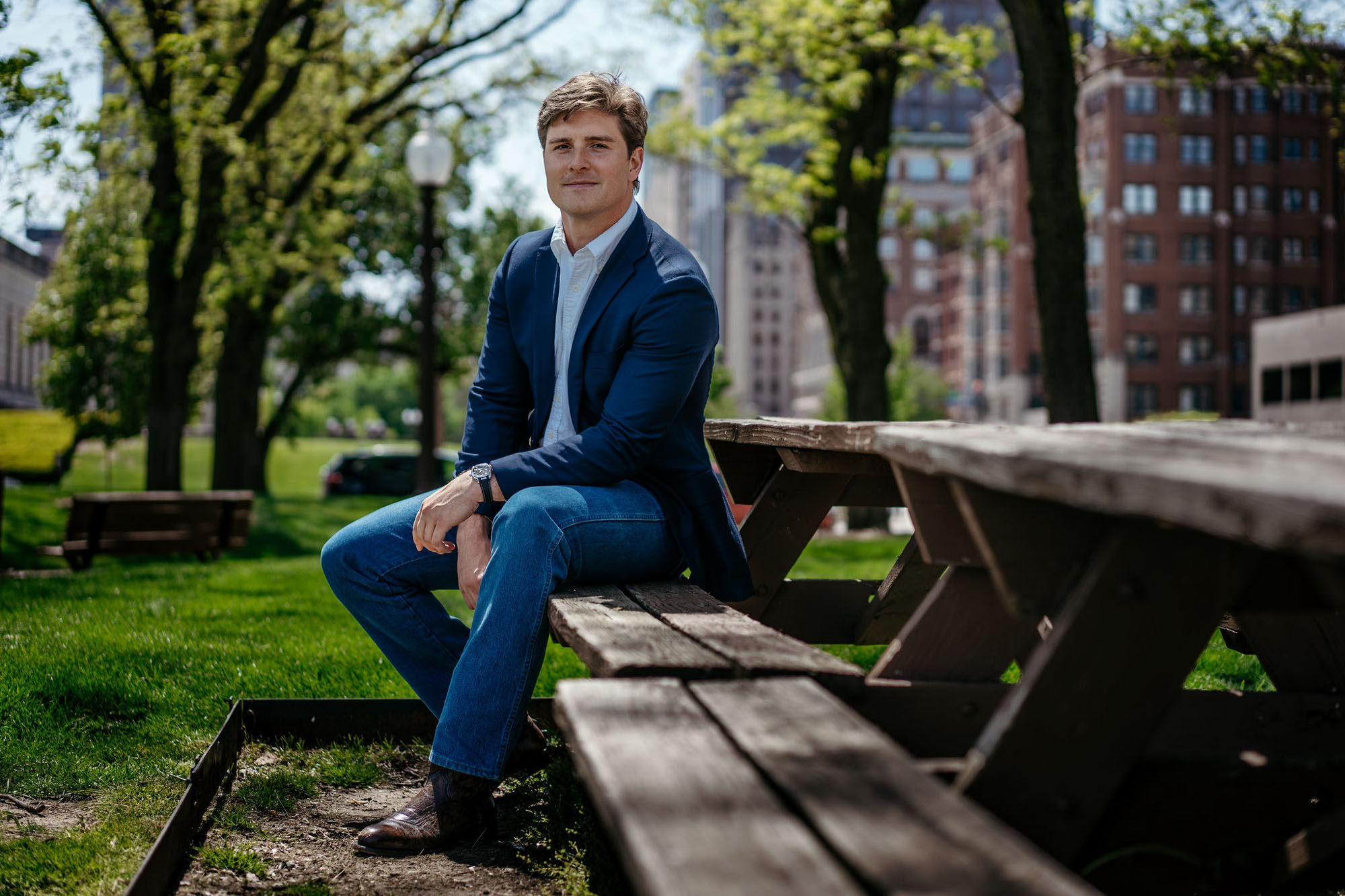
Nashville, Ind.—Beau Bayh knows the way out of the wilderness.
“You got to go north on Main Road,” he tells me over the phone, trying to guide me through the fall foliage of the Little Smokies, as the locals call them. The candidate for Indiana Secretary of State is set to meet me for a run at a trailhead here in Brown County State Park this morning. It’s his 30th birthday. How else would a chiseled, 6’3 ex-Marine and ambitious Hoosier political scion celebrate but with some PT in the deep woods of southern Indiana? There is, of course, an Indiana University game later in the day, and he’ll watch that with friends.
When I finally catch up to him, his campaign manager has dropped him off, and he’s already limbered up for a run across a four-mile stretch of some 16,000 acres of rugged hills and ravines etched into the southern half of the state. His family would vacation here when he was a kid, one of the reasons he chose it as the location of one of our many ranging talks over the last year.
I’m not the only one looking to Bayh to lead me out of the wilderness. Democrats haven’t won a statewide office in barn-red Indiana since 2012. And their performance across the rest of middle America hasn’t been much better. President Donald Trump won both Michigan and Wisconsin in 2024. Once-purple Iowa is down to one last statewide Democrat in elected office, Auditor Rob Sand. The old neighboring battleground of Ohio has trended red, too.
But Bayh is bringing hope to the ruins — literally. He announced his campaign six months ago amid sculptures from the 1970s called “The Ruins” that look like the vestiges of ancient Greece.
Bayh has checked all the right boxes. His grandfather, Birch, was a three-term Democratic senator and sought the presidency in 1972 and 1976. His father, Evan, was a two-term senator and governor who briefly flirted with a campaign of his own ahead of 2008. He went to Harvard and Harvard Law. He served his country in the Marines. He clerked for the 7th Circuit. And, as Kentucky Gov. Andy Beshear — a fellow red-state Democrat with a family history in politics — recently said on his podcast, he cuts a figure like “Captain America.”
“I’ve even heard people sometimes say he’s so good looking, he almost looks like he’s AI. But there’s no question that Beau looks the part,” says Mike Schmuhl, who managed a presidential campaign for a former Indiana mayor by the name of Pete Buttigieg, and who recently signed on as a senior adviser to Beau. “Former Marine, lawyer, well educated, very smart, but also very dedicated to the task at hand.” His campaign manager, Jack Tormoehlen, served as executive director of the New Hampshire Democratic Party under Chair Ray Buckley.
His campaign against scandal-ridden GOP incumbent Diego Morales has attracted an enormous amount of attention for a state-level race, building out a fundraising operation that would make Senate Democratic primary candidates jealous in some other states. He says he’s raised a staggering $2.4 million so far.
Why so much focus on a state-level race? If national Democrats hope to become a majority governing party again, they have to solve their problem in places like Indiana, a state that mattered to them not too long ago. And Bayh is looking like an increasingly strong candidate who could show Democrats how to win an election in Trump country — in part, by building back trust with voters through managing typically non-partisan elected offices. (The Indiana Secretary of State isn’t usually a figure in breathless social media rants or fiery cable punditry.) Like other Democrats angling for power in red states across the map in 2026, Bayh is running a back-to-basics campaign, focused on kitchen table and good government issues, free from the culture wars.
“Too often, in Indiana and nationally, Democrats are running with a sense of cultural superiority — they’re looking down their noses at people in Indiana,” Bayh tells me as we navigate a switchback.
Part of the reason Bayh’s approach could work is that Indiana Republicans — even though they are at the apogee of power, controlling the governor’s mansion and a supermajority in the legislature — are historically divided following a redistricting battle last year. Gov. Mike Braun even endorsed primary challengers against sitting Republican senators who opposed Trump’s plan to gerrymander the map ahead of the midterms.
Intraparty conflicts have impacted the secretary of state race as well: GOP chairwoman Lana Keesling recently approached one of Morales’ two GOP convention challengers — they currently face a contested convention — to gauge his interest in joining the Indiana election division of the secretary of state’s office. If he took the job, it could winnow the field. (Shelton told POLITICO Magazine an offer “was inferred.” Keesling did not respond to a request for comment.)
Democrats are hoping a figure like Bayh could take advantage of those rifts.
“I think that you can only have so much power for so long before you start to crack from within, or you start to kind of tip over because you’re so top-heavy,” Schmuhl says. “You’re starting to see those cracks widen in the Indiana Republican Party.”
But he faces some obstacles in the coming weeks.
For starters, he’s running at a time when political dynasties are crumbling around the country. Democratic voters have rejected strong family names up and down the ballot, from a Cuomo in New York to a Carter in Georgia.
“Does the Bayh name resonate the way it did when Evan ran? I can’t believe it does,” says Bob Blaemire, a former staffer of Bayh’s grandfather who wrote a biography of the late senator. “Too much time has passed. A decade in politics is an eternity, and it’s been more than that.”
Bayh also faces a progressive convention challenge on June 6 from U.S. Army Reserves veteran Blythe Potter, who served on the personal security detail of Gen. George Casey in Iraq.
More broadly, Bayh has to answer the small question of who, exactly, he is — a question about legacy and inheritance, but also about the future. Those are the same questions that the Democratic Party writ large is also wrestling with following its existential loss to Trump. Bayh’s grandfather, Birch, was known as a great liberal; his father Evan, is known as a great centrist. Which one does the party need today — a progressive fighter to take on the conservative excesses of the MAGA era, or a pragmatic moderate who can reach non-liberal voters the president has alienated with his own hardline partisanship? Which will Bayh try to be?
Or will he be something else entirely?
Back on the trail, Bayh tears ahead of me on the narrowest of paths. We had planned a run earlier in the fall, but he had sprained an ankle while moving into a new condo. Now, each of his Saucony-shoed footfalls is measured and deliberate.
He is, after all, navigating uncertain terrain.
On a sweltering day last August, Beau and I stepped up to the sweeping porch at the scenic French Lick Resort, where Franklin Delano Roosevelt whipped support at the 1931 National Governors Association conference for his 1932 presidential bid. We were there for the Indiana Democratic Editorial Association, an annual party confab where candidates convene before November elections and conduct party business by day — and grease relationships by night. That includes turning bathtubs into beverage coolers packed with booze. Back in 2010, Buttigieg famously launched his state treasurer bid here. It’s a place to make big entrances.
A barbershop quartet crooned in close harmony. It felt like we had stepped back in time. In a way, that’s the core thesis of Bayh’s campaign — a return to an era that had the semblance of more civility and fewer culture wars.
“What I would say about his style of politics is we need to get back to a place in the state, frankly, in the country where we can find common ground,” Bayh told me. “My dad was successful in this state for a long time because he reached out to people from the opposite party, and he tried to find common ground with them. And in order to be successful here in the future, we are also going to have to do that. It’s just a fact, and it happens to be the right thing to do.”
Beau’s grandfather, Birch Evans Bayh Jr., served in the Senate as the architect of not one but two constitutional amendments: the 25th Amendment, dealing with presidential disabilities, and the 26th Amendment, giving 18-year-olds the right to vote. He supported Title IX, barring sexual discrimination and expanding women’s sports. And he championed an unsuccessful amendment to abolish the Electoral College — a goal Beau generally seems to support, even if he can’t make it happen from the office he is pursuing.
“In today’s day and age, I think it makes not as much sense,” he told me. “You have a politics where the person garnering a majority of the popular vote is not ultimately successful. I think that doesn’t make intuitive sense.” Not that he’d be able to topple the Electoral College as a secretary of state. What he could do, he said, is give Hoosiers the chance to back citizen-led ballot initiatives.
Beau’s father, Evan, carved out a reputation as a pragmatic centrist Democrat. When he was 32 in 1988 and atop the Indiana government, press reports called him a “boy wonder.” The Los Angeles Times profiled him as “tall, Hollywood-handsome and untainted by scandal or controversy,” noting that he “sometimes sounds more Republican than his GOP rivals — quite unlike his father, Birch Bayh, an unabashed Democratic liberal.” He pulled the plug on his own potential presidential campaign in 2006, but still landed on Obama’s veep shortlist in 2008.
That’s when Beau’s political consciousness first stirred. Obama’s presidential campaign traversed his home state and took his father on nearly a dozen stops across Indiana. That year, Obama painted Indiana blue by winning 15 of the state’s 92 counties, including three of the state’s southern counties along the Ohio River, home to Butternut Democrats in Perry, Spencer and Vanderburgh counties. It was the first time any Democratic presidential candidate had notched the state in 44 years.
As the veepstakes rolled on, the family’s 5,000-square-foot, six-bedroom Spring Valley Georgian Colonial on Tilden became a draw for the press. “There were all these camps, and people would just sit in lawn chairs, and every time we’d leave, they’d get up and swarm the car,” Bayh says.
Once, when his father was driving him to football practice, his pads fell out the back of the trunk — Evan hadn’t fully closed it. “My helmet is rolling down the street, and there are Fox News reporters grabbing it,” Bayh recalls. “Like, what’s going on?”
Birch and Evan may have had different approaches to Democratic politics, but they both had their political careers shaped by tragedy. Birch lost his mother to cancer when he was 12, and in 1972, he abandoned a presidential bid after his wife, Marvella, underwent surgery for breast cancer. He tried again in 1976 but was foiled by another folksy candidate: Jimmy Carter. Three years later, Marvella died.
That loss would echo through three generations of Bayhs. In 2021, not long before Bayh joined the Marines, his mother, Susan, died of glioblastoma — the same cancer that killed Beau Biden. President Joe Biden spoke at her funeral at the National Cathedral in Washington and invited Evan, Beau and Nick to the White House.
In some ways, his family’s grief has made Bayh more relatable — a deep wound in an otherwise charmed life. The question now is whether he can use his name recognition to make a name for himself.
“He’s very handsome. He’s very engaging. He can work a crowd,” said Kip Tew, Obama’s state senior adviser in Indiana in 2008 and former state chairman for the Indiana Democratic Party. “He doesn’t have to climb the same mountain because of his last name that some people have to. He does have to distinguish himself: ‘I’m coming out here to earn this. I’m not just doing this because it was my dad’s. I want to earn it.’ And I think he’s about that business.”
Inside a sweaty American Legion Hall, not far from the resort, Beau had his political coming out party: a speech at the Orange County Democratic Party Dinner in French Lick.
Flanking the entrance were blown-up campaign posters from Evan’s 1998 Senate run featuring a made-for-TV family life — Evan holding little Nick, Susan holding little Beau.
“I’m here because I’ve seen what’s going on in our country and our state,” Bayh told the room of the party faithful as they sat before pitchers of lemonade and bottles of Miller Lite. “Someone needs to stand up. That’s why I’m here. We’ve got to rebuild the middle class.”
Rebuilding the middle class isn’t exactly what the Indiana secretary of state does. It’s a more quotidian portfolio that, in addition to serving as the state’s chief election administrator, involves providing business services like commissioning notaries public, regulating the securities industry and licensing auto dealerships. It is unsexy. But it is also a mostly culture-war free office that would allow a Democratic candidate like him to gain a foothold and build trust with otherwise wary Hoosier voters.
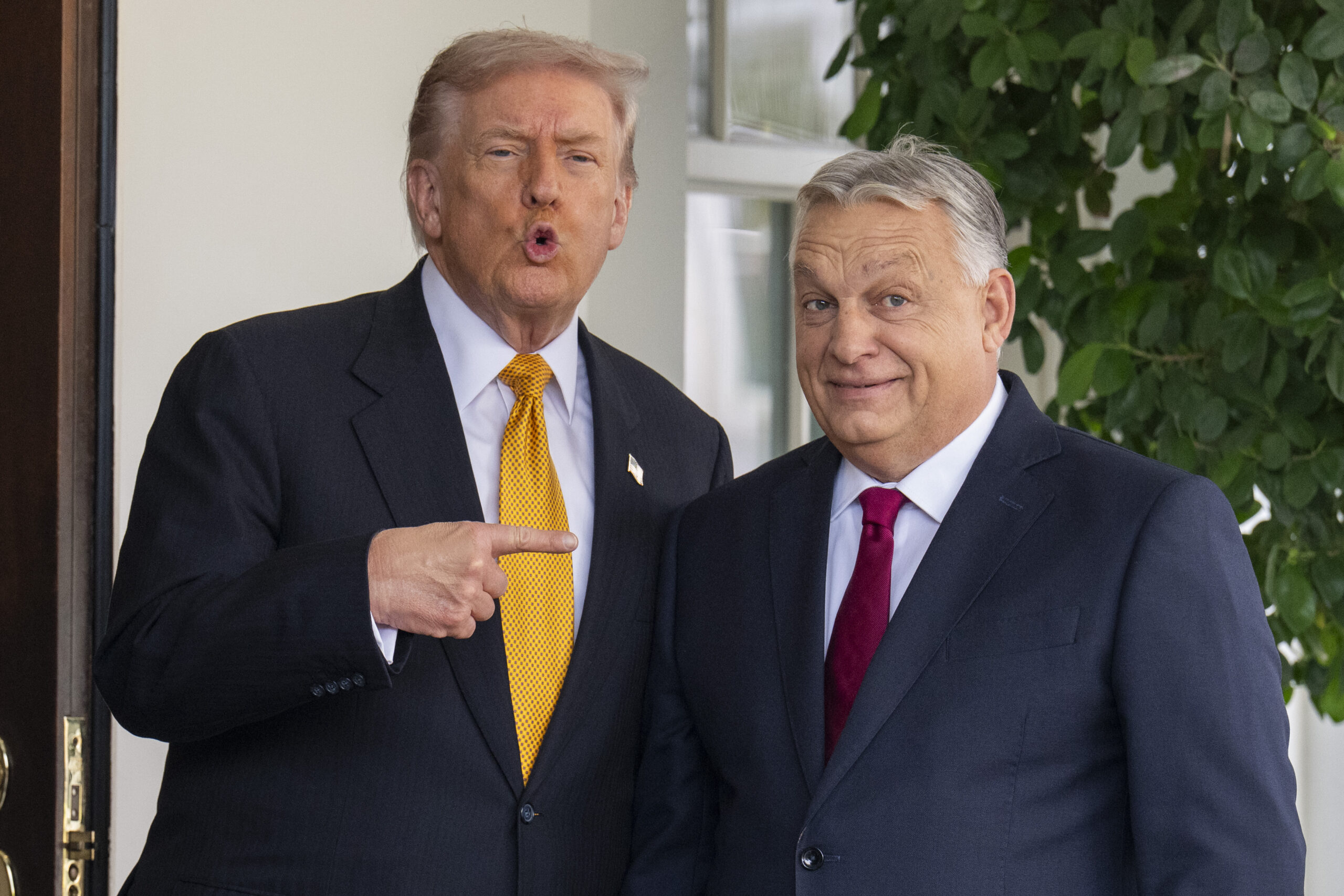
That is not how the GOP incumbent has handled the post. Diego Morales, who has drawn two Republican convention challengers and an independent bid from former Indianapolis Republican Mayor Greg Ballard, has doled out millions in no-bid contracts to campaign donors and taken dozens of foreign trips — not to mention hired family members to work in his office. He has cozied up to former Hungarian Minister Viktor Orbán at a CPAC Hungary conference that included a “No Woke Zone” panel. On his campaign website, he touts leading “the fight against BlackRock and their use of Hoosier dollars to push a woke agenda.”
He also used taxpayer money to purchase a $90,000 GMC Yukon Denali from an auto dealer who donated $65,000 to his campaign. With trust in public officials cratering and concerns about affordability all around, Bayh is betting that Morales is the perfect foil in the perfect year.
“We’ve got to rebuild the broken bond of trust between our elected officials and the people,” Bayh told the rank and file in the room. “I see the folks in Indianapolis. They’re serving the insiders, the special interests. They’re not serving us, they’re serving the establishment. That’s not what public service is. They serve us. We deserve leaders who show up for every Hoosier.”
At the back of the room, Evan would later tell me, he had “butterflies.” It felt like a torch being passed. Democrats in the room reacted to his son like he was some kind of Moses ready to lead them to the promised land. “He’s the real deal,” Evan said. “He’s in it for the right reasons, and he’s got what it takes to try to convince people to have a better kind of government.”
Indiana Republicans didn’t quite react to Beau’s speech the same way. They called him a “Nepo baby.” They predicted Hoosier voters wouldn’t like his “elitist vibe and Daddy’s big donors.”
“We continue to be amused that an East Coast liberal visitor to Indiana has decided to run a negative campaign against Secretary of State Diego Morales,” Blair Englehart, Morales’ senior adviser, told me in response for this story. “Beau’s campaign attacks are a result of what happens when all you have is an ancient political legacy and a bunch of liberal donors telling the candidate what to say.”
Beau’s donors have included a $25,000 donation from the private equity billionaire and President Donald Trump ally Marc Rowan, who serves on Trump’s Board of Peace. In a Facebook video, Potter, Beau’s Democratic opponent, hit him over the connection: “If we are going to stand up to Trump’s attacks on our rights and our elections, we cannot cozy up to Trump’s donors,” he said.
“Someone can be very nice and personable and capable, but what is going to happen in the future with these large-dollar, scary donors?” Potter told me. “Like, what, are we going to have to do favors for that?”
A spokesperson for Beau responded by saying he was building “a winning campaign with supporters who agree we shouldn’t be wasting taxpayer dollars on no-bid contracts and luxury cars.”
Beau has said his candidacy is one that aspires to build a big coalition, one that includes Democrats and disaffected Republicans. In one of our many interviews for this piece, he was careful to try and thread a needle between Pat McAfee, the prominent and occasionally controversial Hoosier ESPN personality, and John Cougar Mellencamp, the Seymour, Indiana native rocker. (The two had a war of words over what “Hoosier hospitality” meant during the 2025 NBA Game Four Finals). Beau counts Mellencamp as an early donor. “I think they’re both great voices for Indiana,” he said.
Still, Beau has racked up a number of large-dollar donors who also backed his father’s senate campaign. Republicans have taken to calling him “Trust Fund Beau.” (“All these are people that know me,” Beau tells me over breakfast in Nashville the Saturday after our run, “[have] known me since I was a little kid. So it’s not a surprise. I think any politician, when they’re looking at how to raise resources, would start with their family. It seems like a logical thing to do. And yeah, I’m very lucky.”
The day after Thanksgiving, I met Beau, Evan and Nick for ice cream at a Graeter’s not far from Holliday Park in Indianapolis, where Beau officially launched his campaign last October. There’s a memorial to Susan there called the Susan Bayh Outdoor Classroom, and we’d made plans to visit. It seemed like the right time for a question about family legacy.
“Are you an Evan,” I asked, “or a Birch?”
Bayh thought for a moment.
“I’m a Beau,” he said. “I know what you’re getting at, but I think — look, my granddad and my dad and I hope to do the same: confront the big issues of the day.”
Later, at the memorial, he laid down flowers over a stone that read: IN MEMORY OF SUSAN BAYH, FIRST LADY OF INDIANA.
“Give us just a minute,” Evan said.
They bowed their heads. Their breath lingered in the November air.
In the more than five years since Susan’s death, Evan has decamped to Indianapolis to be closer to his sons. “Anytime you go through something hard like that as a family, it does bring you together,” Beau had told me earlier. I observed to Evan that Beau’s campaign, if nothing else, seemed to have given the Bayh boys a project to work on amid their grief.
“My deal with him is the same as my father,” Evan said. “I’m here to offer advice if he wants it, but then I try not to stand in the way, because he’s his own man.”