
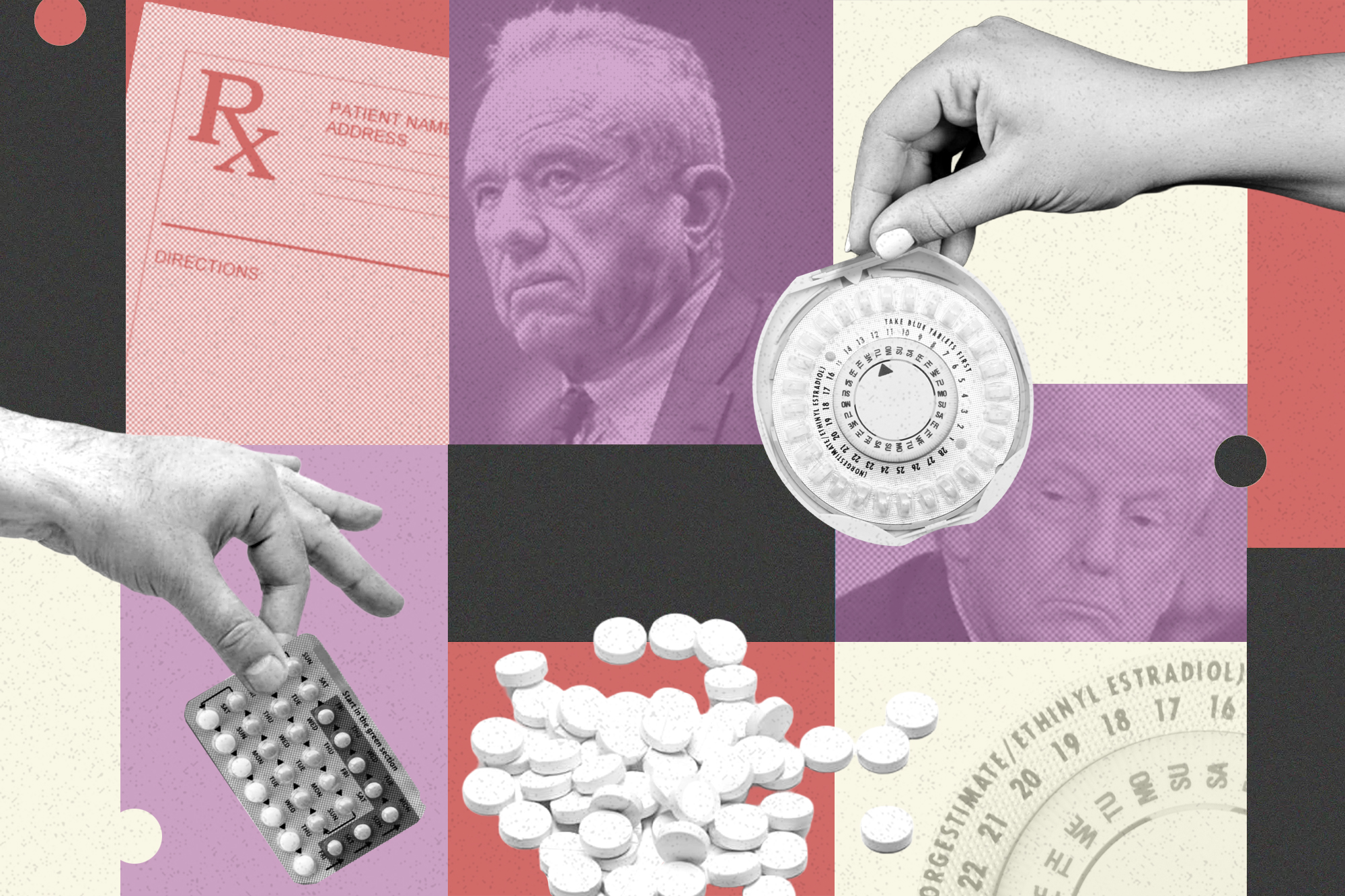
We are entering a startling new era in the politics of birth control, with President Donald Trump launching the most serious effort in decades to curb contraception.
The Department of Health and Human Services recently released new guidance that outlines a major overhaul of federal family planning programs — prioritizing childbirth over contraception, and privileging “natural family planning,” like period-tracking apps, over far more effective methods, like the birth control pill. The Trump administration is also poised to establish new regulations that would end further funding for Planned Parenthood chapters.
Millions of Americans who receive federally-backed family planning services are likely to feel the impact of such a policy shift. And there is real political risk as well. Birth control remains overwhelmingly popular in the United States: Only 8 percent of Americans say using contraception is morally wrong, according to Pew Research Center polling. (More Americans object to drinking alcohol, getting a divorce or being extremely rich).
Given widespread support for birth control, it’s no surprise that politicians have long been reluctant to zero in on it. So, what’s changed?
The unwieldy political coalition that sent Trump back to the White House in 2024 is clamoring for action. For different reasons, an alliance of MAHA adherents, social conservatives and pronatalists are eager to go after birth control. With Trump sinking in the polls and his coalition fracturing, he may want to deliver for his core supporters. But regardless of whether he succeeds, the administration’s move signals a major transformation in America’s culture war: Contraception has gone from being politically untouchable to a real target on the right.
A bit of history underscores just how significant this shift is.
In 1960, the Food and Drug Administration approved the birth control pill, and a broad consensus in support of birth control quickly took hold. Nearly a century after moral crusaders had introduced the first laws criminalizing the use, mailing or sale of birth control, millions of Americans began using the pill.
At the same time, as sexual mores changed, opposing contraception became a liability for an emerging anti-abortion movement. These activists claimed to champion the civil rights of the unborn. If they also targeted birth control, they opened themselves up to the argument that they were really trying to control women or police sex. The result: For years, opposing birth control outright was something of a political third rail, even after Congress passed Title X in 1970to provide free or low-cost contraceptives to low-income patients.
Social conservatives did mount indirect attacks on contraception in the 1980s and 1990s. Some Republicans called for the repeal of Title X because it poured money into the coffers of groups like Planned Parenthood that also offered abortion. The Reagan administration argued that parents had rights to limit teenagers’ access to birth control.
When conservatives directly attacked the idea of contraception, though, they paid a price. That was a central lesson of Robert Bork’s failed 1987 Supreme Court nomination. A hero to the Federalist Society, Bork was widely expected to be confirmed and ultimately cast the deciding vote to overturn Roe v. Wade. But when he testified before Congress at his confirmation hearing, Bork condemned Supreme Court decisions recognizing a right to birth control. The backlash, led by a Delaware senator named Joe Biden, sank the nomination.
In the intervening years, conservatives shied away from campaigning against birth control, even if they secured some policy wins like effectively blocking research on new contraceptives.
The new assault on contraception is a result of the shifting political, cultural and legal landscape in the Trump era, and of key factions in the Trump coalition uniting on the issue.
The Supreme Court’s 2022 decision to throw out Roe was a monumental victory for social conservatives, but it angered much of the public. Since then, polls and election results have made it seem costly for conservatives to further curb access to abortion. At least so far, the Trump administration has slow-walked changes on mifepristone, the abortion pill that anti-abortion groups are targeting, and ignored social conservatives’ calls to use the Comstock Act, a 19th century obscenity law, to ban the mailing of abortion drugs.
The Trump administration’s seeming reluctance to take further steps on abortion has frustrated social conservatives, who have threatened to decrease campaign spending in the midterm or just tell their voters to stay home. Attacking contraception may strike Republicans as an alternative way to placate the social conservative base. After all, anti-abortion groups have long framed certain birth control methods like emergency contraceptives and the pill as abortifacients, an argument that helped secure a win in the Supreme Court in Burwell v. Hobby Lobby (2014), a challenge to the contraceptive mandate of the Affordable Care Act.
In recent years, abortion opponents have also repackaged their arguments to reach a broader audience. They insist that Americans can’t trust drug companies to tell them the truth about how birth control drugs work. Attacks on Big Pharma have struck a nerve with some Americans at a time when the nation is still reeling from the fallout of the opioid epidemic and revelations about the irresponsible marketing of drugs like Oxycontin.
Worries about birth control are also increasingly spreading to a growing group of wellness influencers on Instagram and other online platforms. Those already invested in healthy living — or trading daily suspicions about drug companies and vaccine safety — are primed to see chemical contraceptives as problematic. The Covid-19 pandemic helped crystallize these concerns and expand the reach of what would become Robert F. Kennedy Jr.’s Make America Healthy Again movement.
Anti-contraception messaging appeals to MAHA voters convinced that the pill or IUDs are unnatural, just like food additives or pesticides. Ironically, public affirmations about the safety of common contraceptives only deepen those suspicions, suggesting to some that contraception’s dangers are being buried by an untrustworthy public health establishment. One study of the most viral TikTok videos on contraception found that 34 percent expressed distrust of health care professionals.
With new allies, social conservatives have become far more willing to argue that birth control threatens marriages and families. The Heritage Foundation, which has taken a hard-right turn under Trump 2.0, has asserted that the chemicals in birth control pills have polluted the groundwater, potentially exposing boys to estrogen and compromising their masculinity.
Heritage and its allies also condemn birth control for underwriting the sexual revolution and allegedly making marriages weaker and men and women less happy. Without the pill, conservatives seem convinced that women would be more likely to prioritize marriage and child-rearing. And if that happened, these advocates suggest, we’d all be better off.
Then there is the rising influence of pronatalists, who want to see more babies being born and blame contraception in part for declining birth rates. In 2024, the U.S. birth rate hit a record low of 1.6 children per woman (largely echoing declining fertility rates across the world, and especially in developed countries where more women receive a higher education and fewer teenagers are getting pregnant).
While most Americans don’t seem concerned about falling birth rates, pronatalism has increasingly appealed to a conservative cohort claiming that birth control, combined with lower birth rates and an aging population, could short-circuit economic growth and threaten national security. For this group, anything that prevents more births, like contraception, is a hurdle to overcome.
Meanwhile, anti-immigration conservatives, another key part of the Trump coalition, are also convinced that the only way to address the country’s declining population is not for more people to move to the United States but for Americans who are already here to have more children.
Anti-abortion activists have supplied all of these groups with a perfect alternative: natural family planning, in which people track their menstrual cycles and try to avoid pregnancy by not having sex in the most fertile window of a woman’s cycle.
Natural family planning isn’t a new idea: In the 1920s, scientists proposed what they called the rhythm method, which advised women who didn’t want to get pregnant to avoid having sex for an eight-day period around the second week of their menstrual cycle. In the 1950s, the Catholic Church, which still strictly prohibits the use of contraceptive drugs and devices, approved of the rhythm method, which it labeled natural family planning. In recent years, a growing number of evangelicals have embraced natural family planning too.
Because women can ovulate more than once in a cycle, though, the rhythm method is famously ineffective, with roughly 25 percent of people becoming pregnant in a year of using it. Newer tools to track basal body temperature and cervical mucus changes have made fertility tracking methods somewhat more effective, and fertility awareness apps like Femm and Natural Cycles, some of them funded by religious conservatives, have capitalized. But they are still not considered as proven as the birth control pill; the Mayo Clinic, for example, describes these methods as among “the least effective methods of birth control.”
That reality doesn’t seem to matter to the Trump administration, which has put natural family planning at the heart of its new guidance. The reasons seem clear: Targeting conventional birth control methods is a way to appease social conservatives at a time when the Trump administration is unsure of how far to go on abortion and a way to cement the fragmenting coalition that helped put Trump back in office in 2024.
And because some Americans aren’t fully satisfied with their contraceptive options, anti-birth control claims and even misinformation can sometimes find a receptive audience. Common contraceptives do have side effects, like spotting, headaches, acne and nausea. And like all drugs, contraceptives have risks; the pill, for example, lowers the risk of some cancers while increasing the risk of others.
Unfortunately, even if Americans would prefer different contraceptive options, research and development on the drugs have stalled since the 2000s. Worried about political blowback from social conservatives, drug companies haven’t developed new products that might work better for consumers. Now Trump and his coalition have targeted birth control at a time when many people aren’t fully happy with their options.
Again, that hardly means an anti-contraception campaign is risk-free for Republicans. Polls show that more than 90 percent of Americans support access to contraception. Even the conservative super-majority on the Supreme Court hasn’t shown an interest in revisiting the idea of a right to contraception. And being somewhat unhappy with current contraceptive choices is a far cry from supporting new policies that would hamper access to the most effective family planning solutions.
But whether or not the Trump administration can effectively wage war on contraception, the apparent political consensus of the last 60-plus years is a thing of the past. One of the nation’s oldest culture war battles is raging once again.