In many ways, the book party promoting Poisoned Ivies: The Inside Account of the Academic and Moral Rot at America’s Elite Universities — the new tome authored by Republican Rep. Elise Stefanik — has all the usual trappings. There’s a pile of books at the entrance of the room. Attendees are eagerly snapping up copies in hopes of snaring the author’s autograph. And there is the chitchat of friends and casual acquaintances, all the while keeping an eye out for someone more interesting or useful to talk with.
But this isn’t your typical Washington book party. For starters, the venue isn’t a tweedy bookstore but a glossy trade association building just blocks from the Capitol. Here, the vibe is more like a high end hotel conference room than a literary salon. Waiters circulate among the crowd, passing around plates of hors d’oeuvres. Attendees — among them congressional colleagues, lobbyists and a bevy of former staffers and aides — queue up at the open bar in the back of the room where mid- to top-shelf liquor is being served. And, in a striking departure from the average book party, where the goal is to boost sales, copies of Poison Ivies are free for the taking.
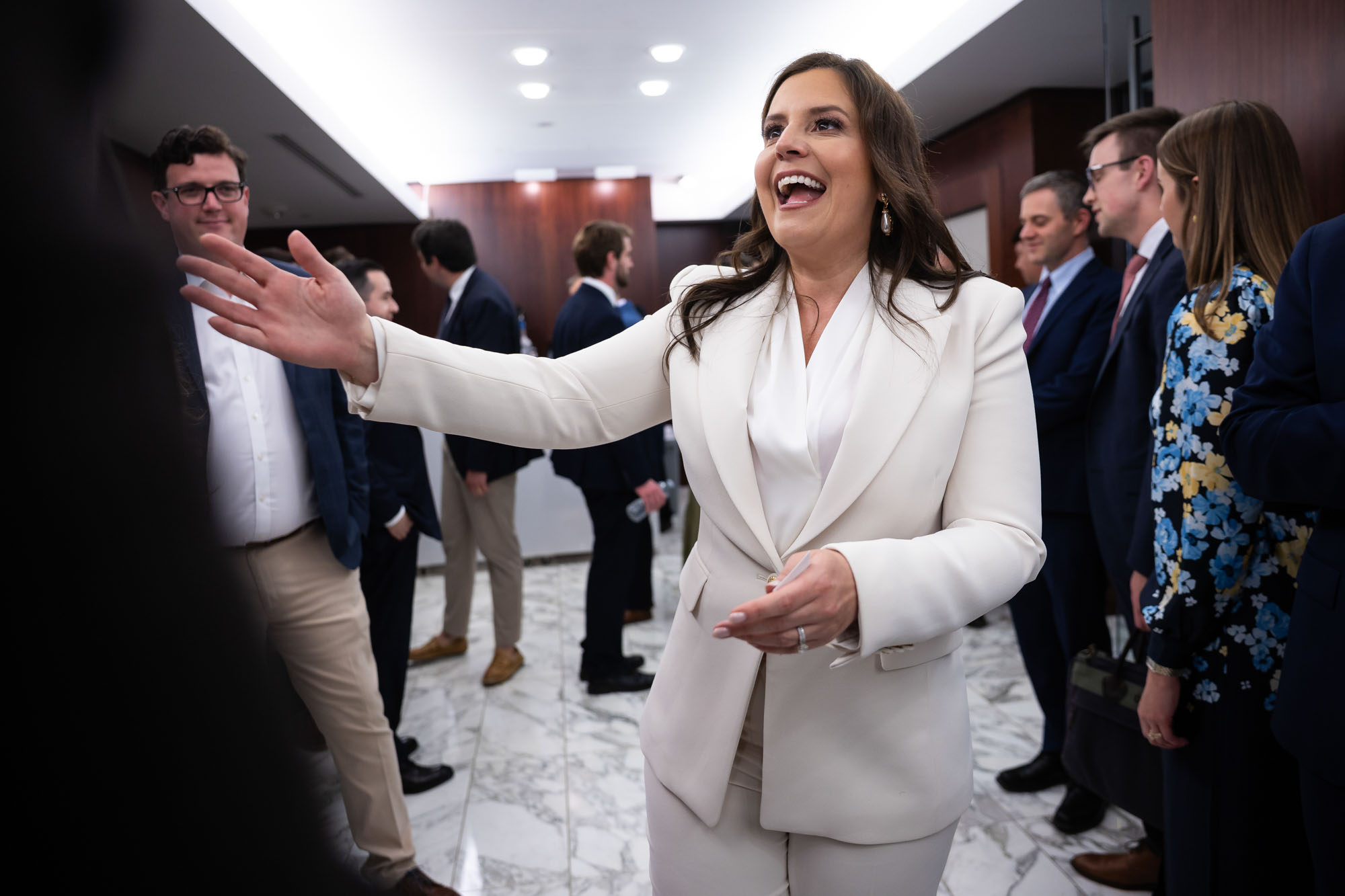
Holding court is the New York congresswoman, sitting against a backdrop of American flags and decked out in a white pantsuit, smiling and shaking hands in a meet-and-greet. It feels a lot like a cocktail party fundraiser with deep-pocketed donors — notwithstanding the attendees holding their phones aloft, filming her entire remarks.
But Stefanik’s not running for office. She’s leaving it. After six terms representing her upstate district, Stefanik has decided not to run for re-election and will be vacating Congress in December. It’s the end of a stint in the House which began with her as the fresh-faced great moderate hope and ended with her as an ardent Donald Trump acolyte dangling in the wind after her UN Ambassador nomination didn’t pan out.
Often when politicians are leaving office, they become relaxed and unburdened, willing to speak openly and directly for the first time in their careers. But Stefanik remains relentlessly on message, sticking to polished talking points repeated in interviews promoting the book. At times, as she addresses the invite-only crowd in Washington, she almost sounds like she is giving a floor speech on C-Span.
Speaking about the premise of her book, Stefanik says the wave of post-October 7 antisemitism signals “a turning point in American higher education, and it highlights the need for moral clarity.” She praises Trump: “We have an administration that is holding these universities accountable.”
Later, in an interview with POLITICO, Stefanik made clear that she would not rule out a future bid for any office and took pains to tout her status within the New York GOP. She describes herself as “the New York Republican who has earned and is very grateful for the strongest fundraising apparatus, strongest grassroots apparatus, strongest political record, highest turnout of any congressional district in New York State.”
If anyone thought the low profile Stefanik has kept in recent months since she decided not to pursue a gubernatorial bid in New York means she’s done with politics, the book party demonstrates that’s not the case. Still one of the youngest people ever to serve in congressional leadership, she has pivoted her career twice already, and it doesn’t seem like she’s ready to join the K Street-flavored crowd packing the room for her.
The venue. The canapes. The open bar. It’s not quite a fundraiser but it’s certainly not an opportunity to flog books. Instead, it’s a gathering of allies and loyalists. Stefanik may only be focused at the moment on finishing atop the New York Times best sellers list but she doesn’t seem like someone whose ambitions are quite that limited.
She might be leaving Congress but, it seems, she’s still running for something.
Stefanik, a native of Albany, got her start as a policy aide during the George W. Bush administration, quickly making a name for herself in mainstream Republican politics. In 2012 — after Mitt Romney was soundly defeated by incumbent President Barack Obama — she was one of the key staffers behind the RNC “autopsy” pushing for a more dovish immigration policy and trying to strengthen the party’s appeal to younger and more diverse voters.
At 30, she made history when she was elected to Congress in 2014, becoming the youngest woman ever elected to Congress. (In 2018, her fellow New Yorker, Democrat Alexandria Ocasio-Cortez, then 29, would go on to break that record.) At the time, Stefanik was seen as a harbinger of a more moderate and more modern Republican Party. But since then, she’s morphed into one of Trump’s most loyal and fervent allies on Capitol Hill, vocally defending him during the first impeachment in 2019 (“a witchunt”), through his efforts to overturn the 2020 election (“the 2020 election featured unprecedented voting irregularities”) and beyond. And, when Trump announced his third presidential campaign right after the 2022 midterms — as some party stalwarts were blaming him for the GOP’s lackluster showing — Stefanik instantly endorsed Trump. “It’s very clear President Trump is the leader of the Republican party,” she said at the time.
Her transformation baffled her more moderate colleagues; former Rep. Barbara Comstock (R-Va.) once called her a “handmaiden of Trump.”
Her breakout national moment was in 2023 when Congress held hearings on the massive surge of antisemitism on elite college campuses in the aftermath of Hamas’ October 7th terrorist attack on Israel. Stefanik, herself a Harvard alumna, relentlessly grilled the presidents of Harvard, MIT and the University of Pennsylvania, asking at one point, “Does calling for the genocide of Jews violate your university’s code of conduct on bullying or harassment?”
All three dodged the question and in the wake of the resulting backlash, two resigned. The hearings served to focus national attention on the discrimination and harassment that many Jewish students said they had been experiencing, particularly on elite college campuses. And they firmly established Stefanik’s bona fides as a culture warrior on the right on the rare issue that plays as well on Central Park West as it does in Central Wisconsin. She took her moment in the spotlight and ran with it, taking credit for the resignations and celebrating them online. (“One down. Two to go,” she posted on X shortly after Penn president Liz Magill resigned.)
Nearly three years later, she’s still basking in the afterglow. The hearings, she tells the book party crowd, “became the most watched hearing in congressional history, more than Watergate, more than impeachment hearings, more than any other issue ever in history.” In a Trumpian boast, she adds, “it garnered 1 billion views in a week” online.
Trump seemed to reward her loyalty, even floating her as a potential vice presidential candidate in 2024 before offering her a high-profile consolation prize: U.S. Ambassador to the United Nations. She gave up her elected House GOP leadership position, let her staff go and began prepping for a Senate confirmation vote.
And she waited.
As the weeks ticked by, House Speaker Mike Johnson’s already razor-thin majority margin got thinner and thinner. She watched Matt Gaetz resign from his congressional seat before his failed nomination to be attorney general and later, Tennessee Republican Mark Green stepped down in the aftermath of an extramarital affair. Congressional Republicans began to worry that the deep red congressional district that both Stefanik and Trump won handily in 2024 might be vulnerable in a special election. Eventually, Trump pulled the plug on her nomination.
Stefanik’s return to the House was rocky. She had given up her leadership post and her perch on the House Intelligence Committee in expectation of going to the UN. Eventually, she got back on the House Intelligence Committee and had a leadership position created for her after internal drama with Johnson.
Stefanik eventually pivoted to something new —- and announced a bid in November to be the first Republican governor of New York since George Pataki. One plugged-in New York Republican, granted anonymity in order to speak frankly, suggests that Stefanik got into the race “almost out of spite” after her bruising experience with the UN nomination and her return to the House.
But even that effort turned sour. For her to win in deep-blue New York, she needed to “have a pitch perfect year,” according to another person close to Stefanik granted anonymity to share private conversations. Nearly every conceivable factor needed to break her way, particularly when national trends were so grim for the GOP. The entry of Nassau County executive Bruce Blakeman in December into the Republican primary ensured that wasn’t going to happen. The specter of having to waste resources in a primary meant that not even the first domino would fall in her favor. She quickly decided it wasn’t worth it. Stefanik told New York Magazine that while she was confident that she would win the primary, “our theory of the case is that, in a challenging state like New York, you need to have a clean shot. And that was not the case.”
The decision likely did some short term harm to her. One national Republican operative, granted anonymity to speak candidly, argued that Stefanik is “not taken as seriously now” as she was before 2025. Others, like Terry Schilling, a prominent social conservative activist who runs the American Principles Project, argue her long-term future is bright.
“Elise Stefanik is a star,” Schilling says. “For America, not just the GOP.”
But for now she’s merely an author — not an elected official nor candidate for the first time in over a decade. Instead of competing with Democratic Gov. Kathy Hochul among suburban swing voters in what’s shaping up to be a tough midterms for Republicans, she just has to worry about trying to fend off Lena Dunham on the New York Times best sellers list.
Put another way: Instead of worrying about life in Congress, likely as a member of the minority on the backbenches in 2027, now she can focus on a book about perhaps her proudest moment in politics.
It wouldn’t be a bad jumping off point for the next phase of her career and gives her more than enough time to recover from the political damage she’s taken over the past couple of years.
The book itself is not exactly a Dunhamesque chronicle of all of Stefanik’s feelings. As the title, Poisoned Ivies, indicates, it focuses on the Ivy League and, in particular, Harvard, the University of Pennsylvania and Columbia. The book focuses on various stories on college campuses from the past few years, ranging from violent attacks, like a Yale student allegedly stabbed in the eye with a Palestinian flag to the more performative manifestations of student activism like an effort to ban Sabra hummus from Northwestern University dining halls because it is partially owned by Israelis. It lays out how, in her view, these campuses have not just been blighted by antisemitism but by left-wing bias, ideological conformity and foreign money.
Interspersed are occasional personal details: how she was bullied in grade school, her disdain for longwinded opening statements in congressional hearings and her loathing of the SNL sketch depicting her questioning of the college presidents.
As Stefanik described it, it’s not “a typical political memoir.” Neither is it “a book about congressional oversight on a particular issue.” It’s a compendium of what she sees as some of the worst campus excesses of recent years and a call for universities to emulate schools like Vanderbilt and Dartmouth, which have made efforts to “recruit conservative professors to counterbalance the inherent left leaning that we see in higher education,” she says at her book event.
It debuted at number three on the New York Times best sellers list in early May — behind Dunham — but only stayed on for one week. Stefanik and her allies have alleged the Times deliberately suppressed the book in its rankings. The congresswoman posted online that data shows that her book was the top selling non-fiction book in the United States that week and that “because of the topic and viewpoint of the book, the NYT refuses to acknowledge the crisis of antisemitism and the fact that their paper has helped fuel this moral rot.”
In a statement, Times spokesperson Charlie Statholder said, “We follow a methodology for all books, which is linked here. The goal of our lists is to reflect books that are broadly popular among individual purchasers.”
Since the book’s release, Stefanik has crisscrossed the country promoting it with events at venues ranging from the Manhattan Institute to the Richard Nixon Presidential Library. However, unlike Nixon after his political reversals in his ’40s, she does not seem even close to announcing her “last press conference” as the former president did after his 1962 gubernatorial loss in California. (Six years later, of course, Nixon was elected to the White House.)
“I’m just now starting my professional prime years traditionally, and yet, I’m coming out of Congress with the experience of a 60 year old,” says Stefanik. In fact, the 41-year-old will be leaving Capitol Hill at a younger age than the average freshman member arrives in Washington. As she noted, “many 50 and 60 year olds call me asking for advice.”
In the short term, Stefanik seems to be setting out her stall for a private sector perch, perhaps in tech, noting that as a member of Congress, she’s been able to see “the pace of innovation changing.” Stefanik reminisced that she was “one of the earliest members to engage with Palantir” when it was still a small obscure firm. She marveled at emerging companies in defense tech as well as “the importance of VCs, private equity, FinTech and even the media landscape” as she talked about all the outreach and interest she had received in contemplating her immediate next steps.
But, in the words of the person close to Stefanik, she is “maintaining optionality.”
Stefanik might be out of politics — for now — but she’s got some thoughts on the future of her party, particularly in her home state, which she says has “atrophied to a historic low.” The Empire State’s GOP, she says, used to have a strong fundraising infrastructure, but no more. “That is not built overnight,” she continues. “It needs to be built over time in terms of the infrastructure. … The state party just doesn’t have that apparatus.That’s something that will have to be addressed over time with much stronger leadership that understands the modern challenges of campaigning and the tools that are used in the 21st Century to communicate with voters.”
The plugged-in New York Republican suggests Stefanik is positioned to take “control of the state party at some level” after the midterms “because everybody can see where this is going this November.”
In the meantime, Stefanik warned ominously that “New York is in for a very dark couple of years. You have a socialist who has taken over New York City. … Democrats are fully embracing socialists, and that will be catastrophic for the state, policy wise, in the next couple of years. So I think there will be some interesting political shifts happening.”
The question for Stefanik is what those shifts mean for her. The general expectation in Washington, D.C. is that the 2026 midterms are likely to be a rough year for Republicans everywhere. But after that, who knows? Public memory is short and Stefanik has maintained an ardent following among grassroots New York Republicans.
Further, Stefanik, who is Catholic, has become very popular among Jewish voters — a reputation burnished by her book on antisemitism. One Democratic operative marvelled at the reception that Stefanik received at a recent AIPAC event in New York City. “Guys who were good Democrats and regularly supported strong progressive candidates were on their feet cheering,” says the operative, granted anonymity to speak frankly.
And as it turns out, her disappointments and humiliations may turn out for the best. After all, a UN Ambassador would have to fully own any potential negative consequences of Trump’s Iran policy in a way that members of Congress don’t. And as embarrassing as it may have been to drop out of the governor’s race a year before election day, it would be far more risky to be a blue state Republican in a potential Democratic wave year.
She still seems to be someone who attaches special power to serving in office. Stefanik dismisses the influence of podcasters like Tucker Carlson in the GOP simply because they’ve never held elected office.
“There’s a difference between obviously, a former leader in the House versus someone who’s never been elected, will never be elected,” she says. Stefanik cited former pols like Mike Pompeo, Kevin McCarthy and Patrick McHenry as particularly important voices in the party in contrast to “people who’ve never been elected.”
The ultimate example of this for Stefanik is Donald Trump, who in her view, “was just as impactful, if not more, than when he was in his first term during those four years when he was out of office.” Left unsaid of course, is that despite leaving the White House in ignominy after January 6, Trump made a seemingly improbable comeback.
It’s a model it seems Stefanik is ready to emulate.