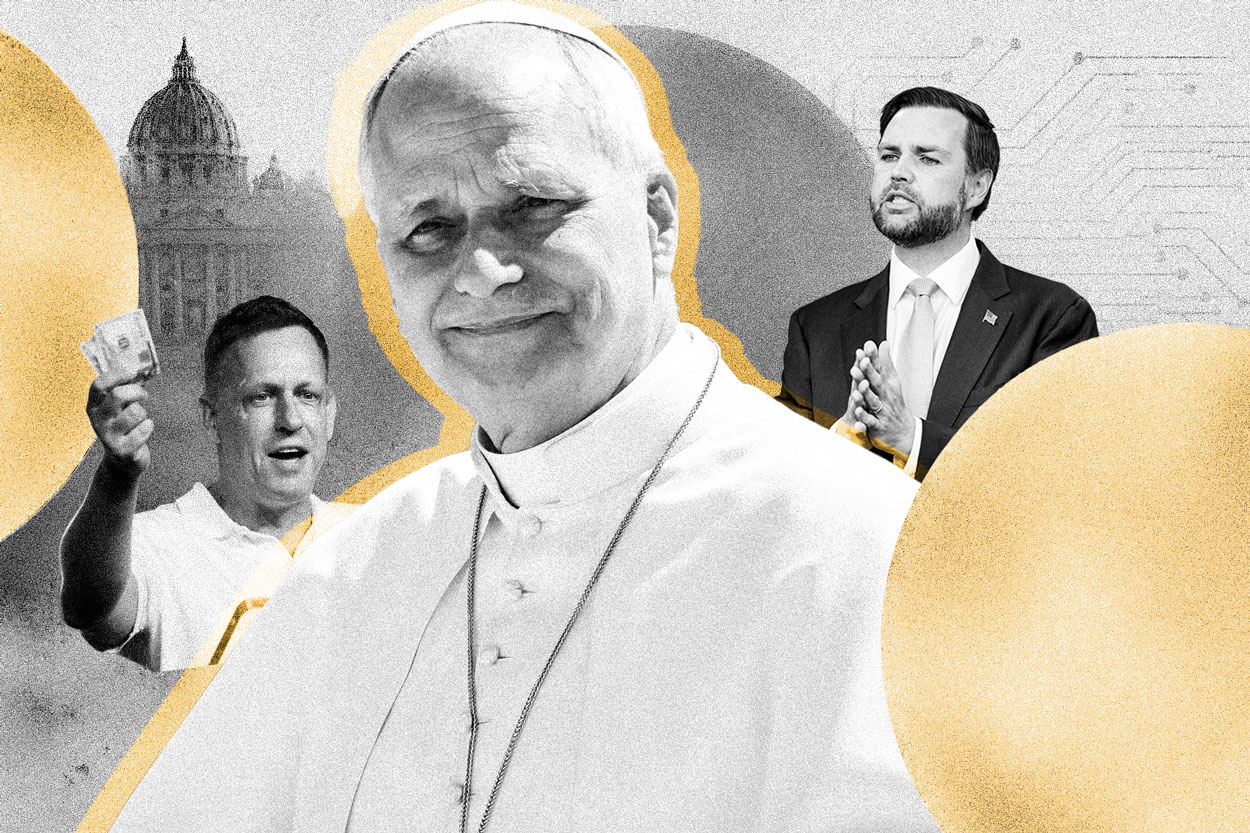
Pope Leo XIV has chosen a side in the AI battle gripping Washington: He’s Team Anthropic.
No, Leo isn’t weighing in on the Trump administration’s ongoing battle with the frontier AI lab and no, he isn’t donating to its super PAC of choice. But on Monday when he unveiled Magnifica Humanitas, his first encyclical letter, on “safeguarding the human person in the time of artificial intelligence,” it was hard to miss that Anthropic co-founder Christopher Olah was there at the Vatican to effectively give it his blessing.
Anthropic has sought to frame its “AI safety” approach as something of a middle ground between the AI accelerationists who want no restrictions and the doomers who want to stop AI development in its tracks. Leo’s document, which runs at over 35,000 words, struck a similar note.
“Technology is never neutral, because it takes on the characteristics of those who devise, finance, regulate and use it,” Leo writes at the outset. “Therefore, the primary choice is not between a ‘yes’ or ‘no’ to technology, but rather between constructing Babel or rebuilding Jerusalem; between a power that claims to dominate the heavens and a people who work together in the presence of God to rebuild the walls of fraternal coexistence.”
For 1.3 billion Catholics around the world, his warning against unfettered AI holds significant moral authority. It also contains a truism easily exportable to American politics: Nothing, and no one, is ever neutral.
As soon as Leo declared that this hot button issue would be at the center of the first major missive of his papacy, he was jumping into the churning waters of the politics of AI in the United States. The encyclical amounts to the most high-profile example yet of a growing trend of faith leaders speaking out against unchecked AI development. For politicians, advocates and technologists who have centered many of their arguments in their own faith, the pope’s incursion into this discussion has led to a sharp divide — opportunity for some, complication for others.
Some in the industry have welcomed the conversation, even seeing it as necessary to their products’ and their companies’ continued flourishing.
“The point that all the religions have in common is a starting point of humanity first,” said Brad Smith, the vice chair and president of Microsoft. “Whereas the people in the tech sector sort of start from the other direction. They start with the technology they’re creating, and then they think about its impact on people second.”
But many in Silicon Valley — including some who are devout themselves — bristle at the pope’s message.
“I think it’s a pretty weak document,” said Dean Ball, a senior fellow at the Foundation for American Innovation and a former AI policy advisor in the Trump administration. “[It] essentially amounts to a deeply anti-American screed in favor of technocratic regulation of artificial intelligence; that’s just not what I needed from the Church.”
Big Tech conservatives have frequently lashed out at attempts to rein in AI growth, with some even arguing that building, and building quickly, is the best way to serve God. Earlier this year, the billionaire Peter Thiel delivered a series of controversial lectures in Rome, in which he reportedly suggested that the antichrist is likely a luddite figure who wants to slow or stop progress. In response, Friar Paolo Benanti, an advisor to the Vatican on AI, wrote an essay in the French Magazine Le Grand Continent, titled in English: “The American Heresy: Should We Burn Peter Thiel?”
Among people of faith with strong ties to Silicon Valley, perhaps no one faces a thornier dilemma when confronting Leo’s encyclical than Vice President JD Vance.
The country’s highest-ranking Catholic, Vance also is surely aware of growing AI skepticism on the religious right. At the same time, he has championed President Donald Trump’s hands-off approach to AI and is a longtime Thiel ally. In the days leading up to the release of the encyclical, the vice president was being pressed on it by reporters at a White House press briefing, and he predicted he’d agree with some parts of it and disagree with others.
Vance critics are skeptical he’ll be able to balance the competing political tensions.
“I think that there is this impossibility that JD Vance is trying to do — courting the Silicon Valley right who got him to the dance and keeping the Catholic right, who’s going to be trying to get him to the presidency,” said Christopher Hale, who writes Letters from Leo, a left-leaning Substack about the pope and U.S. politics. “He has too many plates in the air.”
A Vance spokesperson declined to comment for this article.
Even apart from how Vance grapples with the encyclical, Leo’s guidance is set to echo across sermons in the United States and continue to increase the salience of AI as a political issue. That’s particularly true in a country that’s 20 percent Catholic and where the Church is on a collision course with some of America’s most prominent politicians, policy advocates and companies.
Pope Leo XIV just put forth a moral framework for how to build the technology of the future as he sees it. Now, the debates will begin about what that really means, and what place the Church has in deciding the contours of our shared future.
When the encyclical was published on Monday morning, criticism from parts of Silicon Valley came fast — with various attacks directed at the Vatican, at Anthropic, at the alliance between the two and at an amorphous government overreach.
“The small clique of Bay Area ‘Effective Altruists’ behind Anthropic are more dynamic moral and theological thinkers than the entire Catholic Church,” wrote Marko Jukic, a senior analyst at the research firm Bismarck Analysis, on X. “The Pope is aping their ideas rather than the reverse.”
David Sacks, the former White House AI czar who continues to wield significant influence on the administration’s AI policy, was more polite, though he also quickly pushed back — suggesting the pope wanted to “hand governments sweeping power over AI development in the name of safety,” inevitably leading to an Orwellian surveillance state.
Asked to comment on why Olah decided to engage with the Vatican, Anthropic pointed to its efforts to broaden the conversation on AI by holding a series of meetings with clergy, scholars and ethicists from many faith groups.
Much of the tech world that is aligned with the White House cast Leo’s missive as a purely political attack on their goals.
“I’m going to remember the people who are draping their arms around this document and are draping their arms around the Church right now who are not Catholic,” said Ball, who told POLITICO Magazine he is a Christian and believes in God but is not a regular churchgoer. “It’s really not that religious a document. It’s an extremely political document. It’s a document basically about European technocratic regulation, and why that’s good. … The world will forget about this document in 24 hours, or at least we will in America.”
Similarly dismissive was Michelle Stephens, who runs the ACTS 17 Collective, a Bay Area-based nonprofit that stands for “Acknowledging Christ in Technology and Society.” Stephens counts Thiel as a friend; in 2023, he gave a Christian-inflected lecture at the 40th birthday bash for her husband Trae, a co-founder and executive chairman of the defense technology firm Anduril.
Stephens said she and her group were approached about working on the encyclical but were uninterested in doing so.
“I think no one’s really tracking it,” she said in the days leading up to the document’s release. “If anything, what it feels like is the Vatican wants to have a position on AI. And I think Silicon Valley’s position is, ‘How do you even know what AI is, to have a position on it?’”
She also rejected concerns about building a “machine God.”
“It’s absolutely crazy, because if we build any sort of machine, that’s building a human creation,” Stephens said. “We believe in God and what God can do, and there’s no way for that not to be consistent.”
Other Christians aren’t so sure. The natural rejoinder from the Vatican is that even those of us who aren’t building any actual technology have a stake in how it will change the future for all of humanity — and that there is a moral code that can be applied to technology.
And the suggestions that the encyclical will be a one-day story may also prove to be wishful thinking.
A growing number of figures aligned with the religious right want to see the federal government embrace more safeguards on AI. They are insistent that the pope’s encyclical is only the beginning of a debate that could define the future of both the Republican Party and the country.
“The alarming thing is, I think quite simply when you create or when you engineer something which has the appearance of consciousness, it’s intrinsically godlike,” said Michael Toscano, a senior fellow at the Institute for Family Studies, a socially conservative nonprofit. “And honestly, the evocation of Christian teaching by some people on the tech right has also raised an interest for a counter voice.”
Toscano, a Catholic himself, says that the encyclical will serve as the basis for continued conversations and advocacy around the issue of AI in Washington.
Mark Beall, also a Catholic and the president of the bipartisan AI Policy Network, noted the Catholic Church and the U.S. government have vastly different roles to play in modern society. But he added that the encyclical can help to establish a framework for discussion.
“I think the religious right, especially, is a critical voice that needs to be heard in shaping AI policy,” Beall said. “I think it’s going to help government leaders offset some of the worst outcomes that could come from AI growth if it was just left to the unbridled accelerationist right, that doesn’t have that same kind of philosophical grounding in Western moral tradition.”
Beall, who recently penned a letter to Congress signed by a host of former military officials and AI safety advocates urging caution when using AI on the battlefield, is one of the more influential conservatives on tech policy in Washington.
The debate raging over the encyclical is mirrored within policy conversations. Last week, Trump was on the verge of signing an executive order that would have given the government more potential power over AI systems but reversed course at the 11th hour after hearing concerns from Sacks, among others. It was a victory for the accelerationists and a defeat for those on the right who want more safeguards. Still, there are signs that not everyone within the administration wants to continue to hand big policy decisions over to Sacks.
As a leading contender for the 2028 GOP nomination, there was always going to be plenty of scrutiny on Vance’s stance on AI. But his ties to both Silicon Valley and the Catholic Church have only raised the stakes for how he handles the issue.
It also appears Vance’s approach may be shifting. After seeing the Anthropic model Mythos, which has yet to be released due to security concerns, Vance reportedly told an assembled group of AI CEOs on a call last month that it scared him, and that they needed to “work together” on the best way forward for the industry.
That’s a very different message from a year earlier, when he said in a landmark speech in Paris that “we believe that excessive regulation of the AI sector could kill a transformative industry just as it’s taking off.”
Vance was also largely supportive of the pope’s message in an interview with NBC on Tuesday, saying he was glad Leo issued the encyclical.
“What I read of it sounds very profound, and the sort of thing that you would expect and hope from a leader of the Church,” he said.
Those comments were slightly more positive than his remarks to the press before the encyclical was released, when he said, “I’m sure it will contain a lot of insights, some of which I’ll probably agree with, some of which I may not. But I think that it’s going to be a very, very important document.”
Some Vance skeptics were not impressed with his initial maneuvering.
“[Vance’s] response was an effort to inoculate himself, I think, against what he knew would be some of the sharper edges of this document,” said Stephen Schneck, a Catholic activist who is the former chair of the United States Commission on International Religious Freedom and a political ally of former President Joe Biden. “He took steps to try to immunize himself against it, and he’s already picking and choosing what parts of the document he’s going to recognize and what parts he’s going to bracket.”
“The encyclical will fuel Leo’s rhetoric for a year,” said Hale. “JD Vance’s dream is probably of Leo XIV writing an encyclical on abortion, but it’s just not happening. That’s the uncomfortable reality: The pope is highlighting issues that they oppose him on.”
How Vance weaves together his relationship with the broader Christian right, the tech right and the people who move between those two worlds will be critical as the 2028 presidential primary campaign approaches. Both the pope’s missive and the consternation over the proposed executive order have kicked off another round of infighting between these two powerful constituencies that Vance is attempting to straddle.
Part of the complication for Vance and others is that the encyclical does not always neatly map onto one ideological camp.
“It is a document that should reach across the religious right and the religious left,” said Anna Rowlands, a British theologian and academic who spoke at the encyclical presentation at the invite of the Vatican. “I think the people who will feel frustrated by it are those who want profit growth and competition with no limits. Equally, those who are radically pessimistic about the current tech picture will feel that it is a little too optimistic for them.”
Jon Stokes, a co-founder of an AI and media company who also studied early Christian history and apocalyptic literature at Harvard Divinity School and the University of Chicago, predicts the problem for Vance has more to do with the president than the pope.
“He’s probably more hamstrung by the Trump administration’s complex relationship with AI [than the Church’s],” he said. In fact, Stokes argued that both the pope and Thiel are concerned about how AI can lead to further centralization of power — and Vance’s response to the question of centralization will be key.
It might not be so simple for him to align himself with the Church because of his role in government.
“I think that if he wraps himself too much in the garment of the Catholic Church, then he risks alienating some portion of the electorate that he is going to need for his own political ambitions,” Schneck said.
At the same time, even as some conservatives in Silicon Valley shun the pope, there’s an increasing number of people who work in tech who count themselves as religious conservatives and who worry about what they and their colleagues are building — and are pushing for safeguards themselves.
“I talk to a lot of Catholics who work in Silicon Valley, and they’re very concerned. I mean, they are very hopeful about this technology, but they’re also concerned with how it’s being misused,” said Paul Scherz, a professor at the University of Notre Dame whose work explores connections between theology and technology. “They’ve seen how social media was misused. They see how AI is being used in potentially problematic ways in warfare and in other areas.”
For all the lines drawn in the sand, the political terrain around AI is far more complex and ever shifting than it appears. Nowhere is that clearer than in Anthropic’s place in the firmament.
In Silicon Valley, as the maker of Claude and Mythos, it’s currently the hottest AI lab in the business.
At the Vatican, Olah was calling for oversight from political and religious bodies unconcerned with the inherent profit motive of AI companies. “If we want this technology to go well, it is enormously important that there be people outside those incentives — people who care about things going well and insist on safety, who are paying close attention, who are willing to say hard things, who are willing to be our earnest, thoughtful, critics,” he argued.
And inside the White House, the lab exists almost at once as an enemy and an ally. On the one hand, the Pentagon has labeled the company a supply-chain risk; on the other, Trump nearly signed an executive order that would essentially endorse Anthropic’s preferred policy outcome.
Meanwhile, the company has been on the offensive in multiple ways, both fighting the administration in court and trying to endear themselves to religious and business leaders around the country with listening sessions in Washington and San Francisco about the future and morality of AI.
Some tech skeptics see that effort as part of a broader, cynical PR strategy.
“I think Anthropic’s use of a Catholic encyclical as part of its run up to IPO is a signal our civilization-supporting institutions are dying. You literally have an AI company trading on the moral authority of the church to try to generate favorable comms,” the musician and professor David Lowery wrote on X. “Say what you will about Worldcom and Enron, but all they did was corrupt public markets and steal money.”
But many who have participated in the sessions have found themselves charmed.
“My experience with Chris [Olah] in just personal correspondence and discussions, and in two convenings that I attended, is that though he identifies as an atheist, he really takes these views extremely seriously,” said Charles Camosy, an associate professor of theological and social ethics at Fordham University and a Catholic religious leader himself. “He takes them so seriously that I think it’s fair to say he is unlike any atheist I’ve ever met.”
And as Camosy tells it, this makes him a natural thought partner with Leo. Olah is a technologist who thinks deeply about religion. Leo is a religious leader who thinks deeply about technology.
The reason that Cardinal Robert Prevost chose the name Pope Leo XIV, Camosy noted, was to echo Leo XIII, who wrote an influential encyclical calling for workers’ rights amid the Industrial Revolution; today’s Leo is concerned with the AI revolution. Smith, the vice chairman of Microsoft, said he was the first business leader who Leo met with after his ascension, and he maintains a strong relationship with the Vatican.
For Camosy, the AI debate opens up the possibility of the Church having a broader societal impact.
“I really think this provides a moment, a new moment, for religious discourse in public,” he said. “It is astonishing that Leo is being taken so seriously on this question even as he is being so theological. It’s not watered down, warmed over pablum. It is deeply, deeply theological.”